View methods side by side.
Choose up to four methods. Add them using the search and share the comparison by copying its link.
| Criterion |  Systems Thinking Leverage Points | 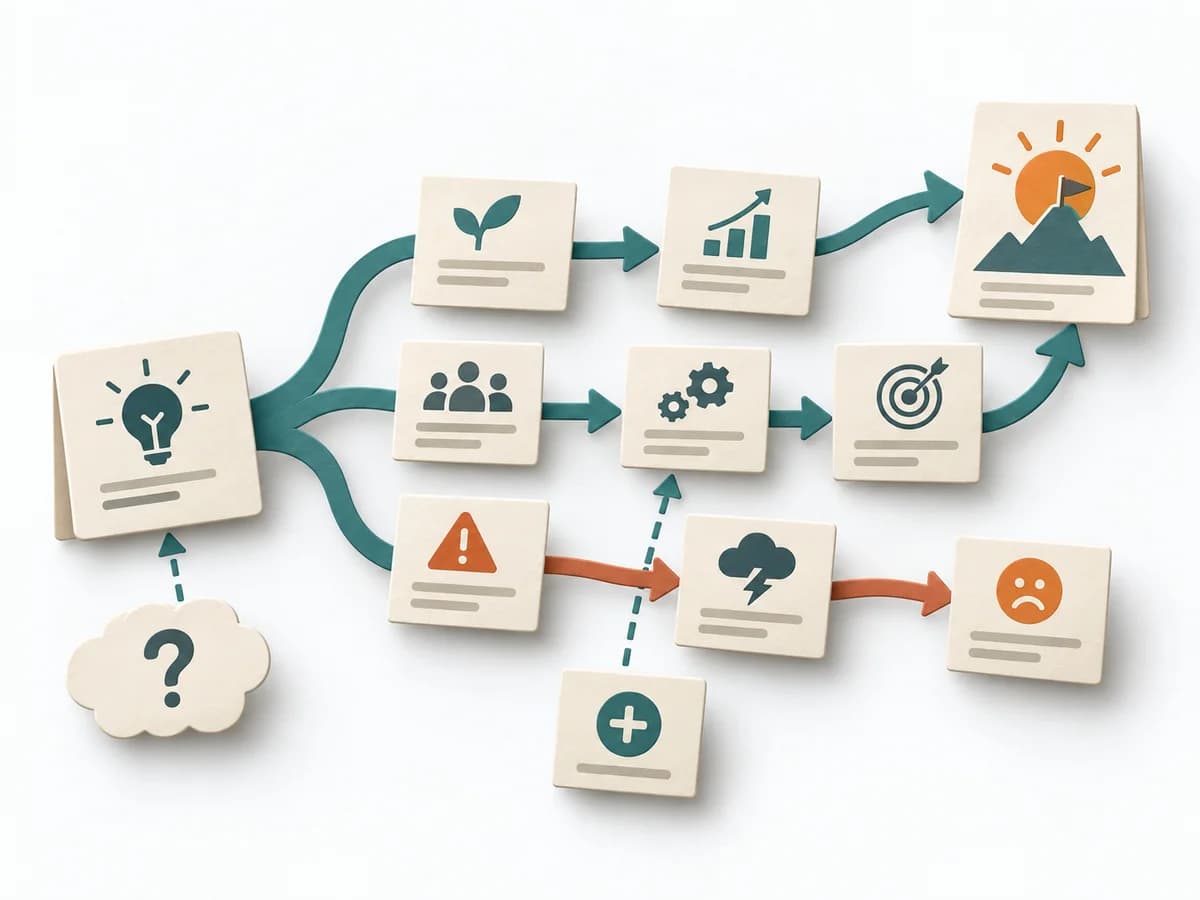 Systems Thinking Future Reality Tree |  Knowledge Modeling Ontology Design Patterns |  Knowledge Modeling Competency Questions |
|---|---|---|---|---|
Purposedifferent | Leverage Points show exactly where interventions in a system produce a disproportionate effect. It draws relationships, patterns, and feedback loops. The result is captured as a leverage map and action strategy. | A Future Reality Tree shows how desired actions are meant to lead to a better system state. The method checks whether a path of change holds together logically before time flows into implementation. | Ontology Design Patterns provide reusable building blocks for recurring modeling problems. The method brings structure to the search for clean concepts, relationships, and roles. | Competency Questions translate a domain model into concrete questions that it must be able to answer. The method keeps the model's scope clean and prevents pretty but useless structures. |
Complexitydifferent | High | High | Medium | Medium |
Timedifferent | Half day | 2-4 h | 1-3 h pro Pattern | 2-4 h |
Participantsdifferent | 3-12 | 3-8 | 1-6 | 2-8 |
Formatdifferent | Workshop | Workshop | Workshop + async | Workshop + async |
Outputdifferent | Leverage Map, Action Strategy | Future Reality Tree, Negative Branches, Assumption List, Improved Injections | Selected Patterns, Adapted Schema Fragments, Pattern Documentation | Competency Question Set, Required Concepts, Test Queries, Coverage Matrix |
Tagsno overlap | Systems thinkingChangeStrategy | Theory of ConstraintsSystems thinkingChange | OntologyPatternsReuseSemanticModeling | OntologyKnowledge graphScopeRequirementsSemantic |