View methods side by side.
Choose up to four methods. Add them using the search and share the comparison by copying its link.
| Criterion |  Systems Thinking Leverage Points |  Innovation Design Thinking | 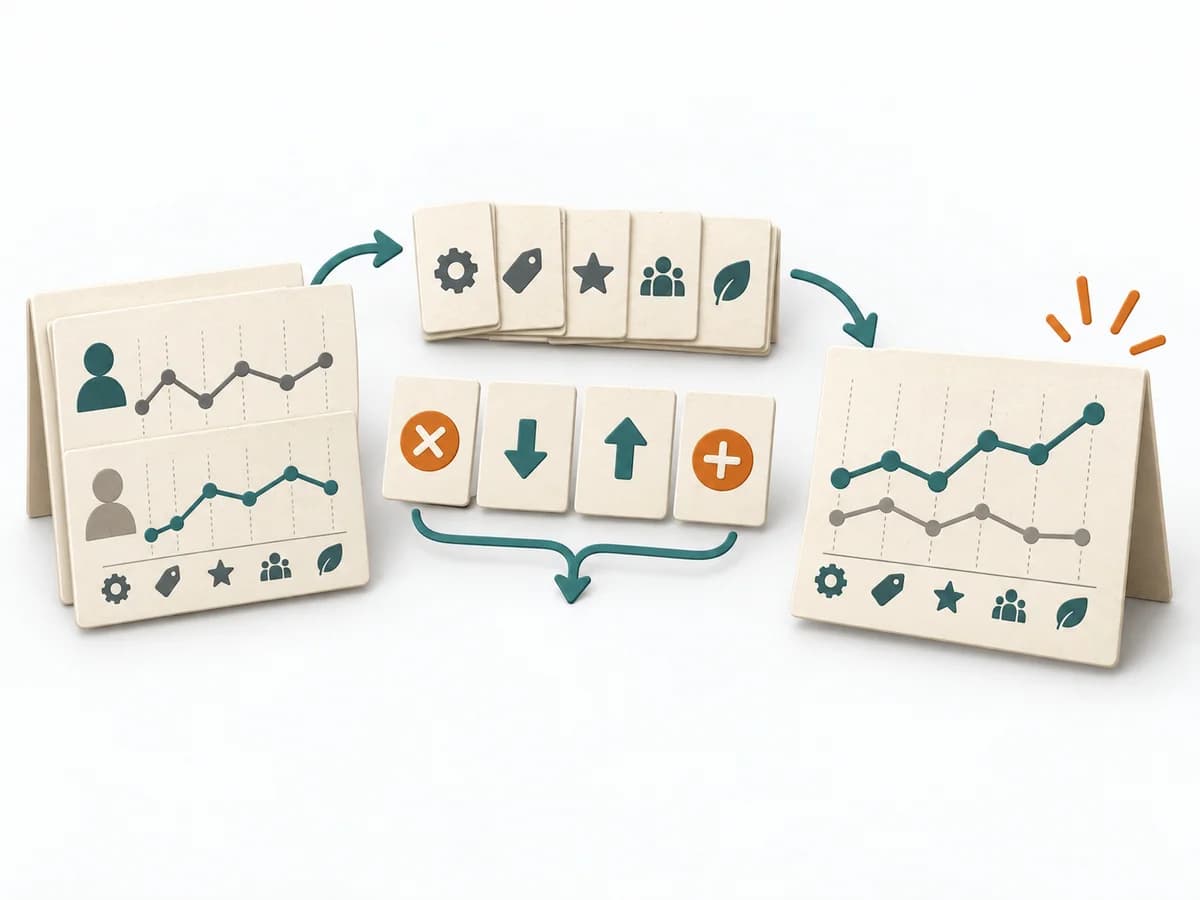 Business Strategy Blue Ocean Strategy Canvas |  Decision Making Force Field Analysis |
|---|---|---|---|---|
Purposedifferent | Leverage Points show exactly where interventions in a system produce a disproportionate effect. It draws relationships, patterns, and feedback loops. The result is captured as a leverage map and action strategy. | For complex user problems with an uncertain cause, the method connects observation, interpretation, and experiment into a learning cycle. It keeps the focus on real needs and avoids premature solution language. This produces robust decisions for product and service. | The Blue Ocean Strategy Canvas shows how an offering is positioned relative to the market. Differentiation thereby becomes tangible in value factors instead of merely being claimed. | In change initiatives, supporting and restraining forces sit at the table at the same time. Force Field Analysis makes these tensions explicit and shows where change can be pushed forward by strengthening or relieving. |
Complexitydifferent | High | High | Medium | Low |
Timedifferent | Half day | 1 Tag bis mehrere Wochen | 2-4 h | 45-90 min |
Participantsdifferent | 3-12 | 4-10 | 3-10 | 3-12 |
Formatsame | Workshop | Workshop | Workshop | Workshop |
Outputdifferent | Leverage Map, Action Strategy | Problem Statement, Prototype, Test Learnings | Strategy Canvas, Value Curve, ERRC Actions | Force Field Map, Change Levers, Risk Notes |
Tagsno overlap | Systems thinkingChangeStrategy | InnovationPrototypeResearch | StrategyPositioningInnovationValue | ChangeDecisionStrategy |