View methods side by side.
Choose up to four methods. Add them using the search and share the comparison by copying its link.
| Criterion |  Systems Thinking Leverage Points | 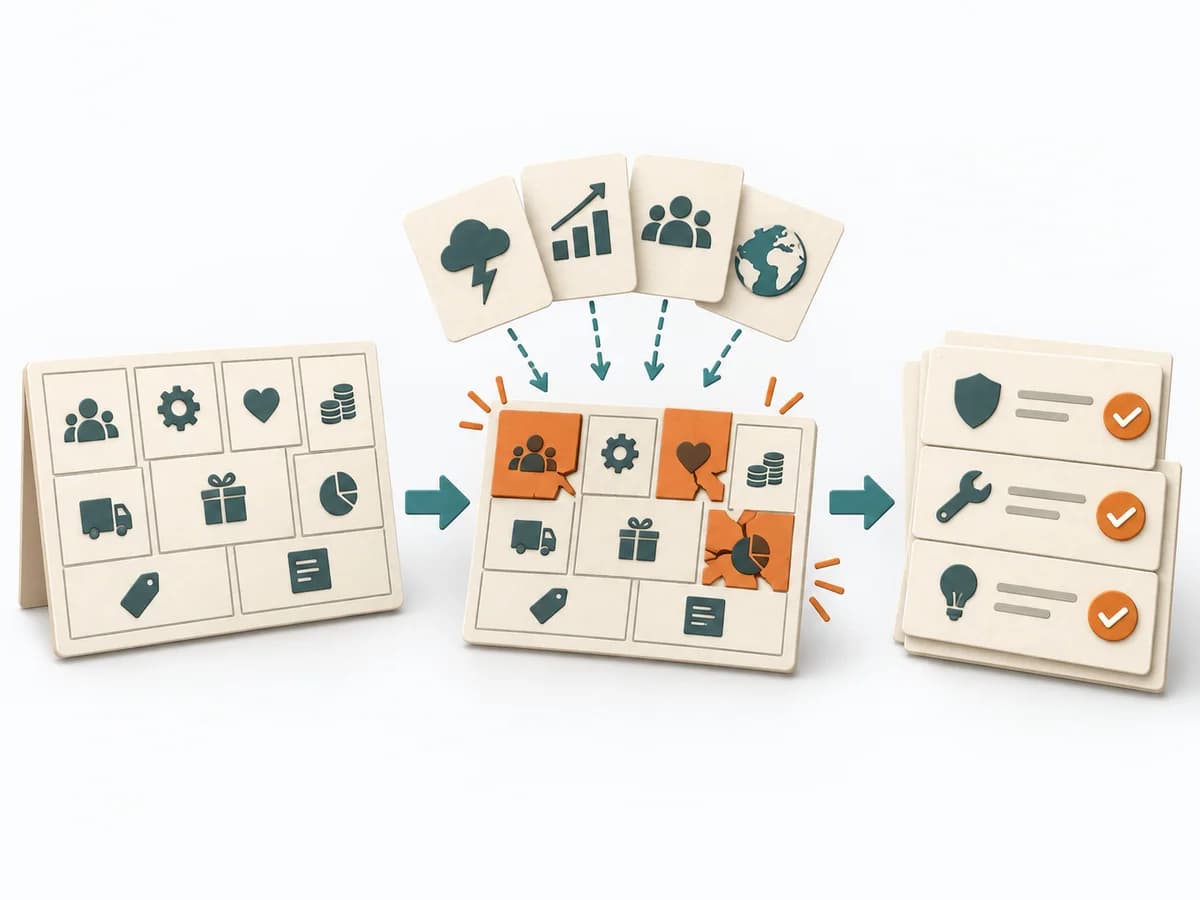 Business Strategy Business Model Stress Test |  Domain Modeling Bounded Context Canvas |  Domain Modeling Context Map |
|---|---|---|---|---|
Purposedifferent | Leverage Points show exactly where interventions in a system produce a disproportionate effect. It draws relationships, patterns, and feedback loops. The result is captured as a leverage map and action strategy. | A Business Model Stress Test checks how well a business model holds up under pressure and headwinds. It compares strengths, risks, market logic, and courses of action. The result is captured as a stress-test report and action plan per scenario. | When a business context is still loosely outlined, it shapes language, responsibility, and integration space. It clarifies what belongs together and where a boundary needs to hold. | When several contexts need to talk to each other, it makes their relationships and dependencies legible. It helps sort integration pressure and responsibilities across system boundaries. |
Complexitydifferent | High | High | Medium | Medium |
Timedifferent | Half day | Half day | 1-3 h | 1-3 h |
Participantsdifferent | 3-12 | 3-8 | 3-8 | 2-8 |
Formatdifferent | Workshop | Workshop | Workshop + async | Workshop + async |
Outputdifferent | Leverage Map, Action Strategy | Stress Test Report, Action Plan per Scenario | Context Canvas, Glossary, Integration Notes | Context Map, Integration Patterns, Boundary Notes |
Tagsno overlap | Systems thinkingChangeStrategy | StrategyBusiness modelRiskDiagnosis | Domain-Driven DesignBoundariesModeling | Domain-Driven DesignBoundariesStrategy |