View methods side by side.
Choose up to four methods. Add them using the search and share the comparison by copying its link.
| Criterion |  UX Design Lean UX Canvas | 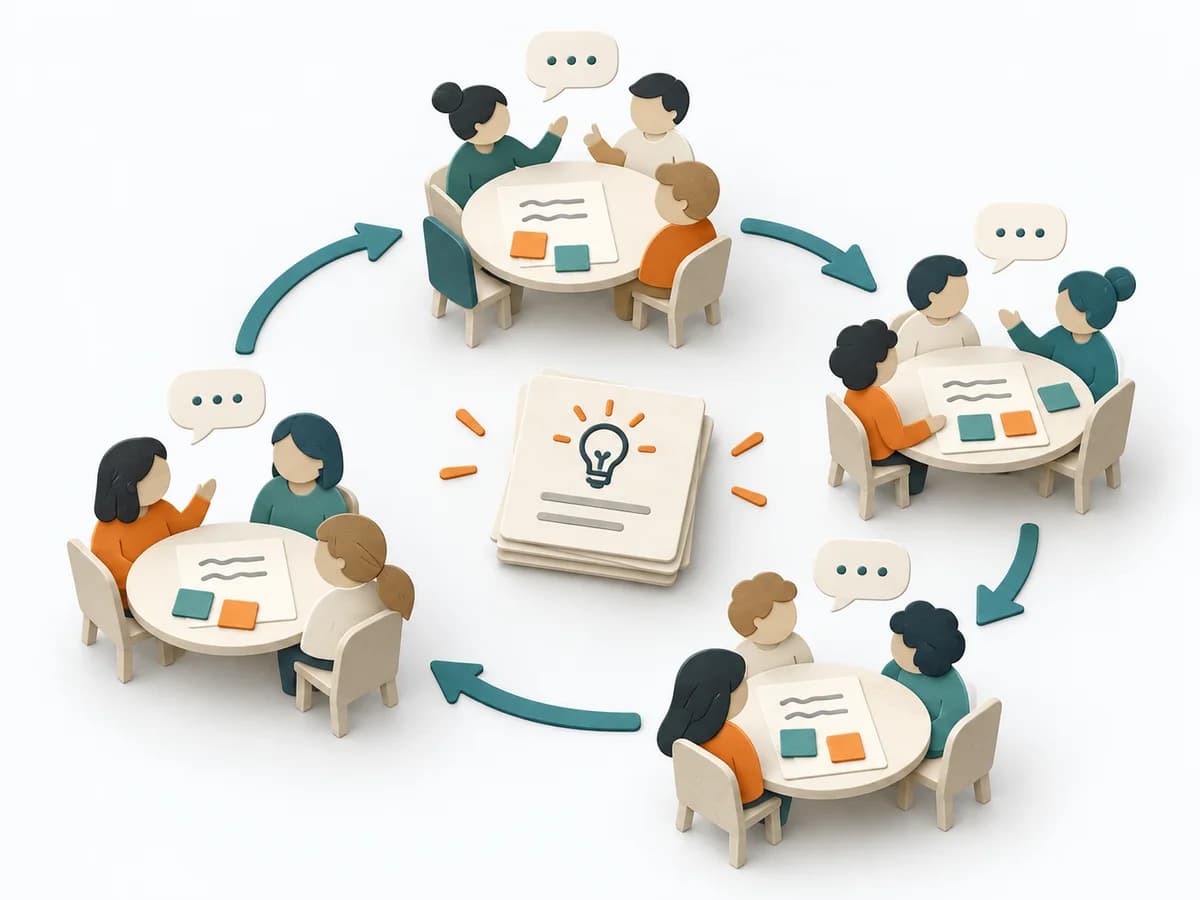 Facilitation World Café |  Facilitation Barcamp |  Product Discovery Experiment Canvas |
|---|---|---|---|---|
Purposedifferent | The Lean UX Canvas helps clarify user behavior, touchpoints, and concept decisions. It makes assumptions and desired outcomes visible and captures the result as a completed canvas, hypothesis list, and first experiment. | When a group needs to connect many viewpoints in a short time, World Café creates a calm alternation between closeness and rotation. It sets thinking in motion without forcing the conversation into full-plenary rigidity. | When many people can contribute knowledge and the flow should stay open, Barcamp provides a framework for self-organized sessions. The format channels energy without defining the content too narrowly in advance. | When experiments become unreadable after the fact, it arranges hypothesis, signal, and learning goal on a single canvas. It separates problem, assumption, solution, and evidence. The result is captured as a Completed Experiment Canvas and a Success Metric. |
Complexitydifferent | Medium | Medium | Medium | Low |
Timedifferent | 2-3 h | 60-180 min | Halber Tag bis 2 Tage | 30-60 min |
Participantsdifferent | 3-8 | 12-100+ | 15-200 | 1-5 |
Formatdifferent | Workshop + async | Workshop | Workshop | Workshop + async |
Outputdifferent | Completed Lean UX Canvas, Hypothesis list, First experiment | Table Notes, Emergent Themes, Shared Questions | Session Board, Session Notes, Community Learnings | Completed Experiment Canvas, Success Metric |
Tagsno overlap | CanvasHypothesisOutcomesDiscovery | FacilitationDialogueLarge groupSensemaking | FacilitationLarge groupLearning | ExperimentsValidationDiscoveryHypothesis |