View methods side by side.
Choose up to four methods. Add them using the search and share the comparison by copying its link.
| Criterion | 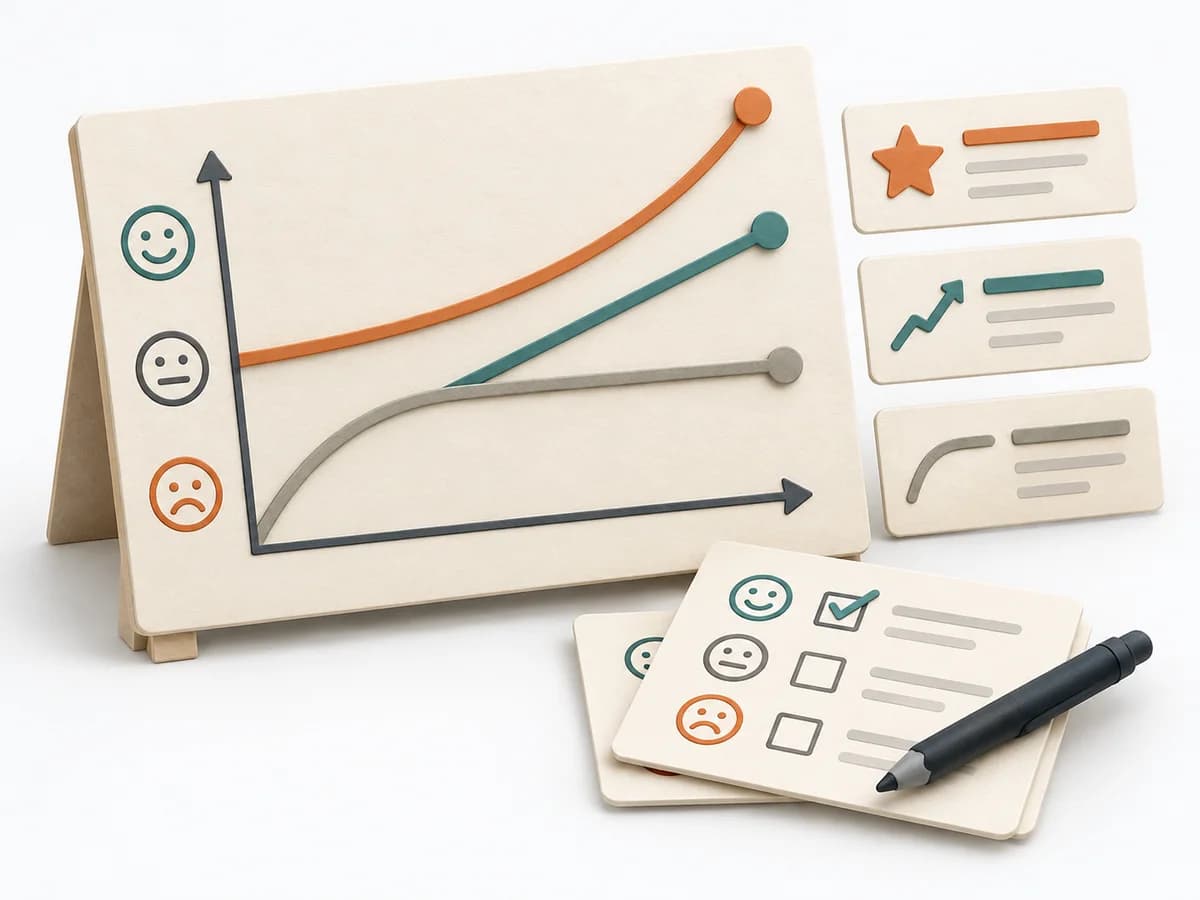 Product Discovery Kano Model |  Facilitation Alignment Mapping |  Product Discovery Test Card |  Product Discovery Experiment Canvas |
|---|---|---|---|---|
Purposedifferent | When features need to be distinguished by their effect on satisfaction, it makes expectations and surprises comparable. It separates basic needs, performance contribution, and delight. | When several people work toward one goal but hold different mental maps, Alignment Mapping makes the discrepancies visible. It arranges goals, assumptions, and priorities so shared direction becomes verifiable. | The Test Card turns a critical assumption into a testable claim and specifies in advance which result counts as success. | When experiments become unreadable after the fact, it arranges hypothesis, signal, and learning goal on a single canvas. It separates problem, assumption, solution, and evidence. The result is captured as a Completed Experiment Canvas and a Success Metric. |
Complexitydifferent | Medium | Medium | Low | Low |
Timedifferent | 1-2 Tage | 1-2 h | 20-35 min | 30-60 min |
Participantsdifferent | 10-50 | 4-12 | 1-5 | 1-5 |
Formatdifferent | Workshop + async | Workshop | Workshop + async | Workshop + async |
Outputdifferent | Kano Matrix, Feature Classes, Priority Themes | Alignment Map, Open Issues, Decision Questions | Test Card with a pre-set threshold | Completed Experiment Canvas, Success Metric |
Tagsno overlap | SatisfactionPrioritizationCustomer | AlignmentStakeholdersStrategyFacilitation | ExperimentsValidationDiscoveryHypothesis | ExperimentsValidationDiscoveryHypothesis |