View methods side by side.
Choose up to four methods. Add them using the search and share the comparison by copying its link.
| Criterion |  UX Research Customer Journey Mapping | 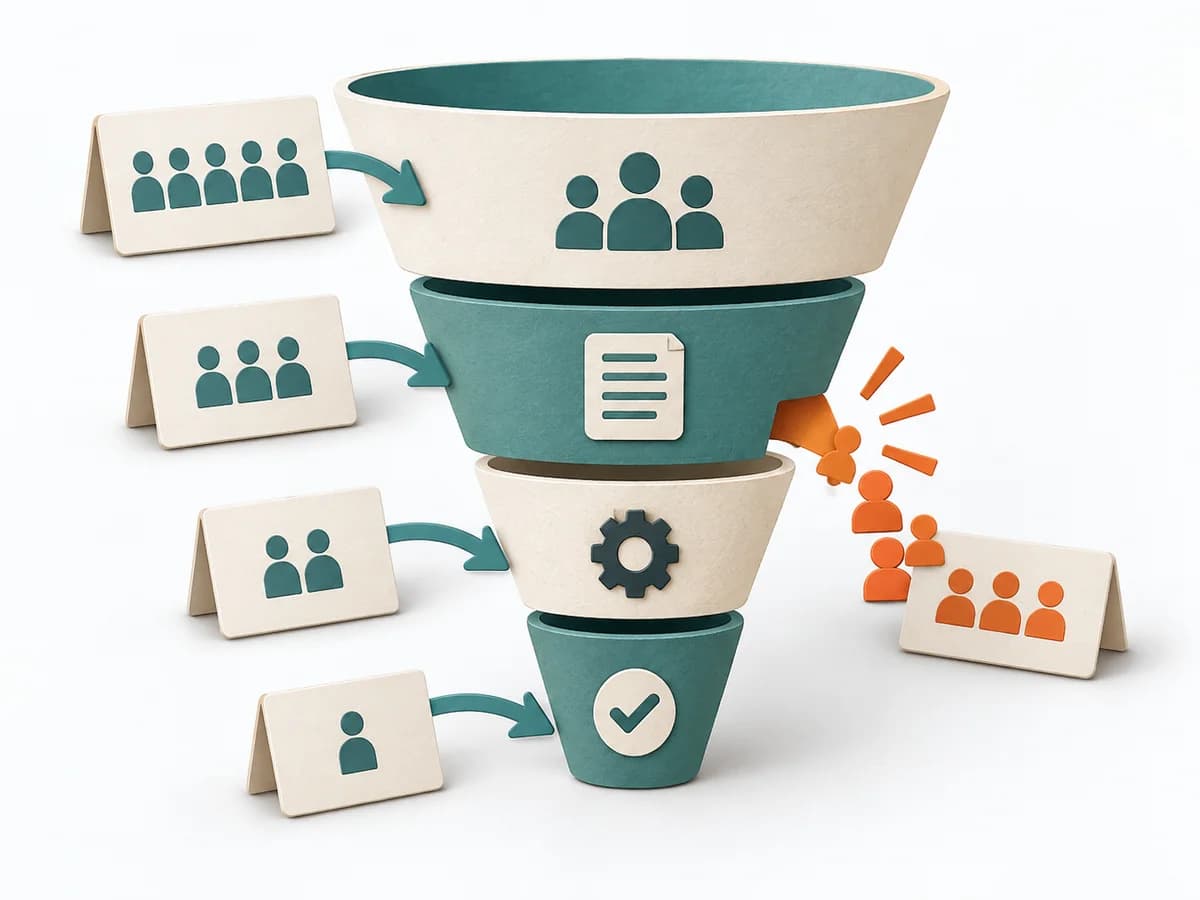 Growth Funnel Analysis |  Product Discovery Assumption Mapping |  Growth A/B Testing |
|---|---|---|---|---|
Purposedifferent | When a user journey falls apart across many touchpoints, customer journey mapping makes the experience visible as a coherent arc. Phases, emotions, and breaks become legible enough to prioritize critical moments deliberately. | When many visitors or users drop off along the way, the reason behind the number often stays hidden. Funnel Analysis exposes these transitions and makes visible exactly where the path collapses. | When assumptions still sit unordered in the room, it weighs uncertainty against leverage. It makes visible which hypotheses should be checked first. | When two variants compete, discussions quickly decide by taste rather than effect. A/B Testing checks behavior under controlled conditions and separates real improvement from chance or expectation effects. |
Complexitydifferent | Medium | Medium | Medium | High |
Timedifferent | 2-4 h | 1-3 h | 45-60 min | 1-4 Wochen |
Participantsdifferent | 4-10 | 1-5 | 2-8 | 1-6 |
Formatdifferent | Workshop | Async | Workshop + async | Async |
Outputdifferent | Journey Map, Pain-point List, Opportunity Backlog | Funnel report, Drop-off analysis, Optimization hypotheses | Assumption map, Test backlog, Risk ranking | Experiment results, Decision log, Learning summary |
Tagsno overlap | JourneyServiceService design | AnalyticsConversionGrowth | AssumptionsRiskExperimentsValidation | ExperimentsGrowthAnalyticsValidation |