View methods side by side.
Choose up to four methods. Add them using the search and share the comparison by copying its link.
| Criterion |  UX Research Customer Journey Mapping | 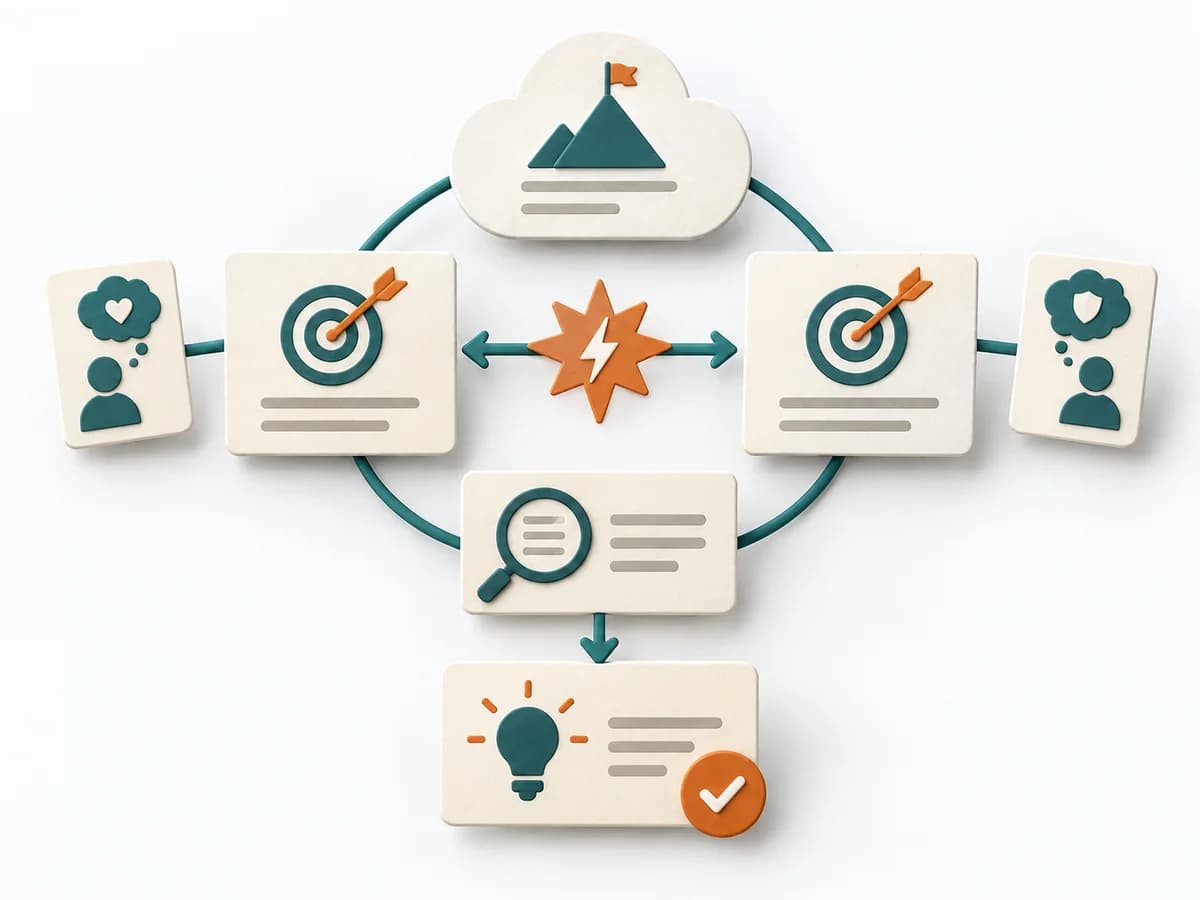 Systems Thinking Evaporating Cloud |  Decision Making Force Field Analysis |  Product Strategy DIBB |
|---|---|---|---|---|
Purposedifferent | When a user journey falls apart across many touchpoints, customer journey mapping makes the experience visible as a coherent arc. Phases, emotions, and breaks become legible enough to prioritize critical moments deliberately. | The method makes visible why two seemingly incompatible demands arise and which assumption must be tested to resolve the conflict. | In change initiatives, supporting and restraining forces sit at the table at the same time. Force Field Analysis makes these tensions explicit and shows where change can be pushed forward by strengthening or relieving. | DIBB helps clarify target groups, value, goals, and priorities by making the logic behind a decision explicit. It captures results as a DIBB document, belief list, bet list, and learning report. |
Complexitydifferent | Medium | Medium | Low | Low |
Timedifferent | 2-4 h | 60-120 min | 45-90 min | 1-2 h |
Participantsdifferent | 4-10 | 2-8 | 3-12 | 2-8 |
Formatdifferent | Workshop | Workshop | Workshop | Workshop + async |
Outputdifferent | Journey Map, Pain-point List, Opportunity Backlog | Conflict Cloud, Assumption List, Breakthrough Ideas, Next Experiments | Force Field Map, Change Levers, Risk Notes | DIBB document, Belief list, Bet list, Learning report |
Tagsno overlap | JourneyServiceService design | Theory of ConstraintsAssumptionsSystems thinking | ChangeDecisionStrategy | StrategyDecisionAssumptionsHypothesis |