View methods side by side.
Choose up to four methods. Add them using the search and share the comparison by copying its link.
| Criterion |  Systems Thinking Intervention Mapping | 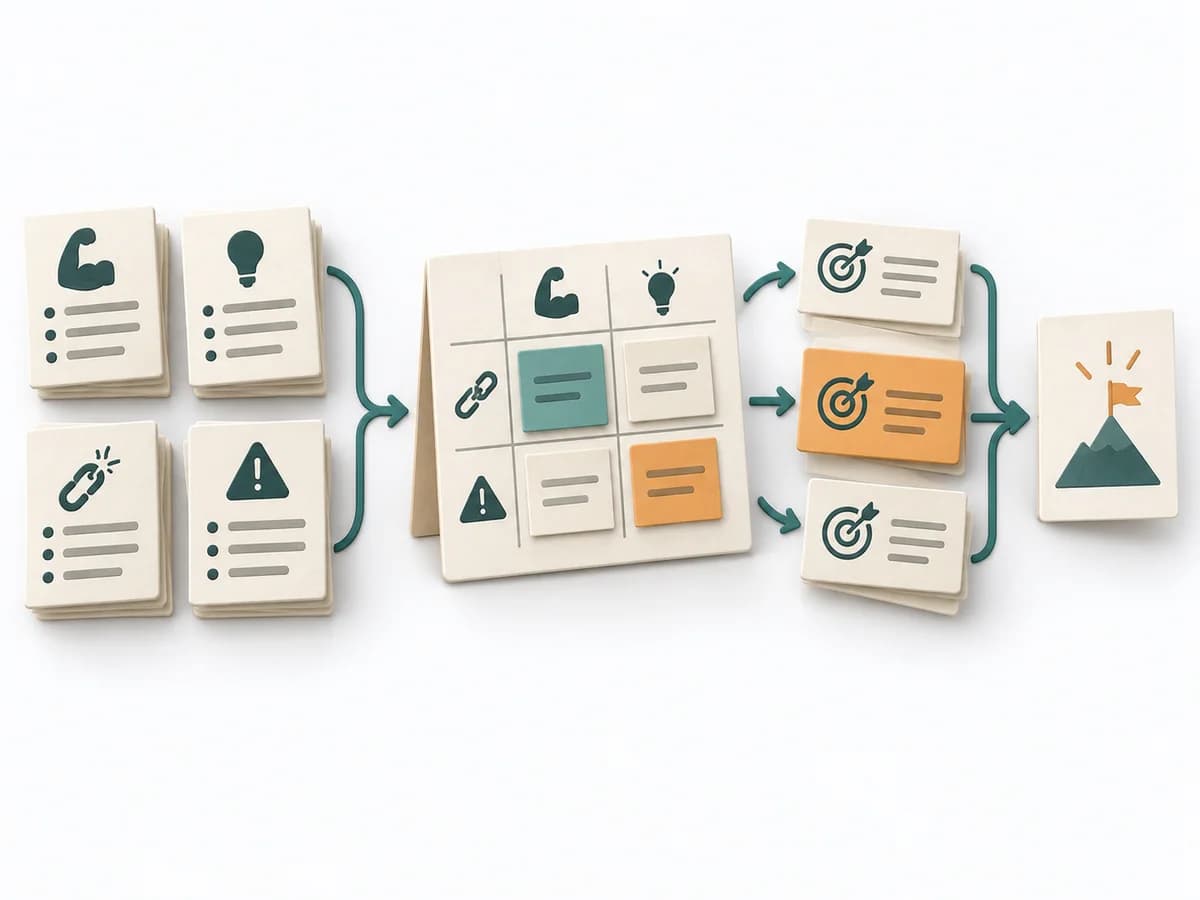 Business Strategy TOWS Matrix |  Decision Making Assumption Surfacing |  Systems Thinking Leverage Points |
|---|---|---|---|---|
Purposedifferent | Intervention Mapping translates a need for change into a planned, evaluable program. The method connects target group, determinants, actions, and measurement into a traceable chain. | The TOWS Matrix connects internal strengths and weaknesses with external opportunities and threats into action-oriented strategies. It goes a step further than a pure stocktaking. | Plans often contain assumptions that were never openly stated and remain dangerous precisely because of that. Assumption Surfacing makes these silent premises visible and prioritizes which of them carry the initiative or could sink it. | Leverage Points show exactly where interventions in a system produce a disproportionate effect. It draws relationships, patterns, and feedback loops. The result is captured as a leverage map and action strategy. |
Complexitydifferent | High | Medium | Low | High |
Timedifferent | 1-5 Tage | 1-2 h | 45-90 min | Half day |
Participantsdifferent | 4-12 | 3-10 | 2-8 | 3-12 |
Formatdifferent | Workshop + async | Workshop | Workshop + async | Workshop |
Outputdifferent | Logic Model, Change Objectives, Intervention Components, Evaluation Plan | TOWS Matrix, Strategic Options, Priority Actions | Assumption List, Critical Assumptions, Learning Plan | Leverage Map, Action Strategy |
Tagsno overlap | ChangeSystems thinkingCapability | StrategyAnalysisOptions | AssumptionsRiskDecisionDiscovery | Systems thinkingChangeStrategy |