View methods side by side.
Choose up to four methods. Add them using the search and share the comparison by copying its link.
| Criterion |  Systems Thinking Intervention Mapping | 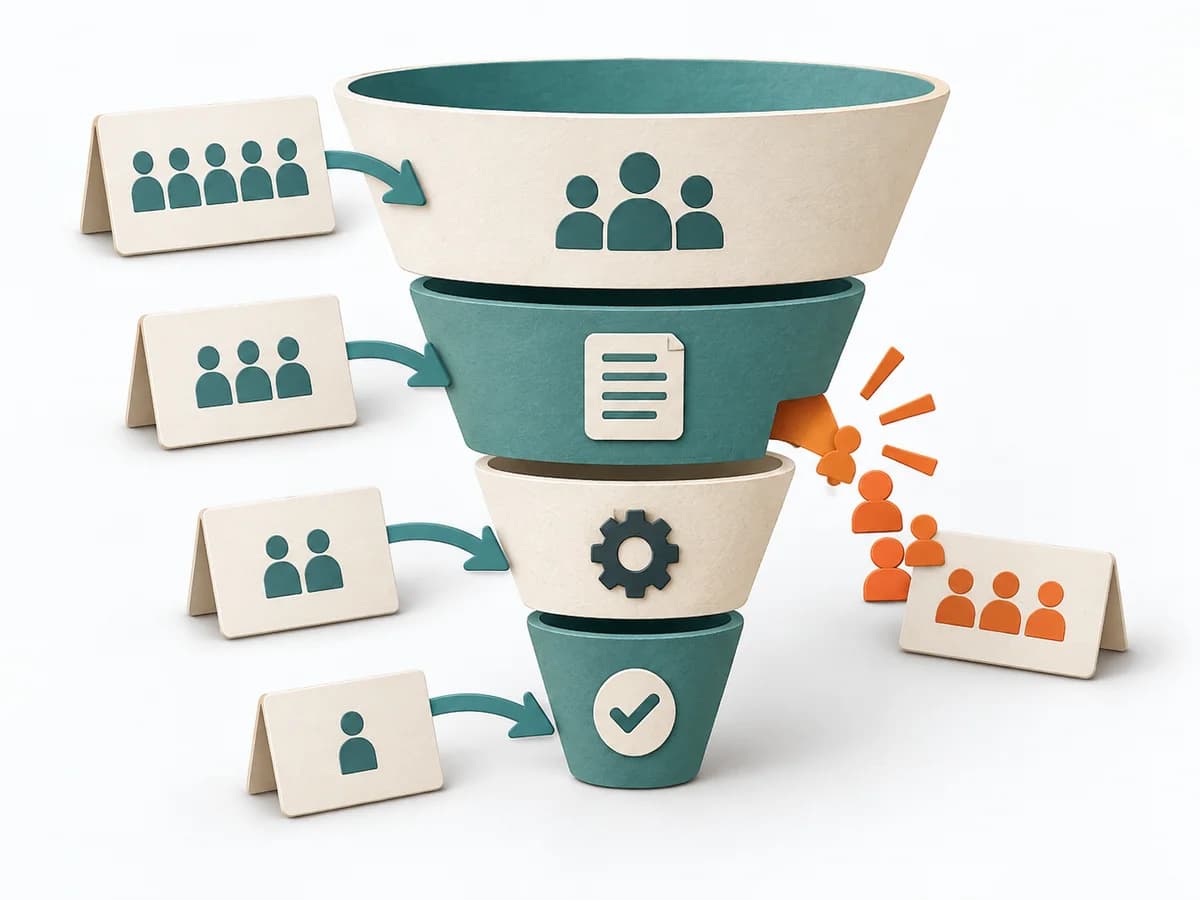 Growth Funnel Analysis |  Decision Making Assumption Surfacing |  Product Strategy DIBB |
|---|---|---|---|---|
Purposedifferent | Intervention Mapping translates a need for change into a planned, evaluable program. The method connects target group, determinants, actions, and measurement into a traceable chain. | When many visitors or users drop off along the way, the reason behind the number often stays hidden. Funnel Analysis exposes these transitions and makes visible exactly where the path collapses. | Plans often contain assumptions that were never openly stated and remain dangerous precisely because of that. Assumption Surfacing makes these silent premises visible and prioritizes which of them carry the initiative or could sink it. | DIBB helps clarify target groups, value, goals, and priorities by making the logic behind a decision explicit. It captures results as a DIBB document, belief list, bet list, and learning report. |
Complexitydifferent | High | Medium | Low | Low |
Timedifferent | 1-5 Tage | 1-3 h | 45-90 min | 1-2 h |
Participantsdifferent | 4-12 | 1-5 | 2-8 | 2-8 |
Formatdifferent | Workshop + async | Async | Workshop + async | Workshop + async |
Outputdifferent | Logic Model, Change Objectives, Intervention Components, Evaluation Plan | Funnel report, Drop-off analysis, Optimization hypotheses | Assumption List, Critical Assumptions, Learning Plan | DIBB document, Belief list, Bet list, Learning report |
Tagsno overlap | ChangeSystems thinkingCapability | AnalyticsConversionGrowth | AssumptionsRiskDecisionDiscovery | StrategyDecisionAssumptionsHypothesis |