View methods side by side.
Choose up to four methods. Add them using the search and share the comparison by copying its link.
| Criterion |  Knowledge Modeling IBIS |  Agile Specification by Example |  Decision Making Decision Tree | 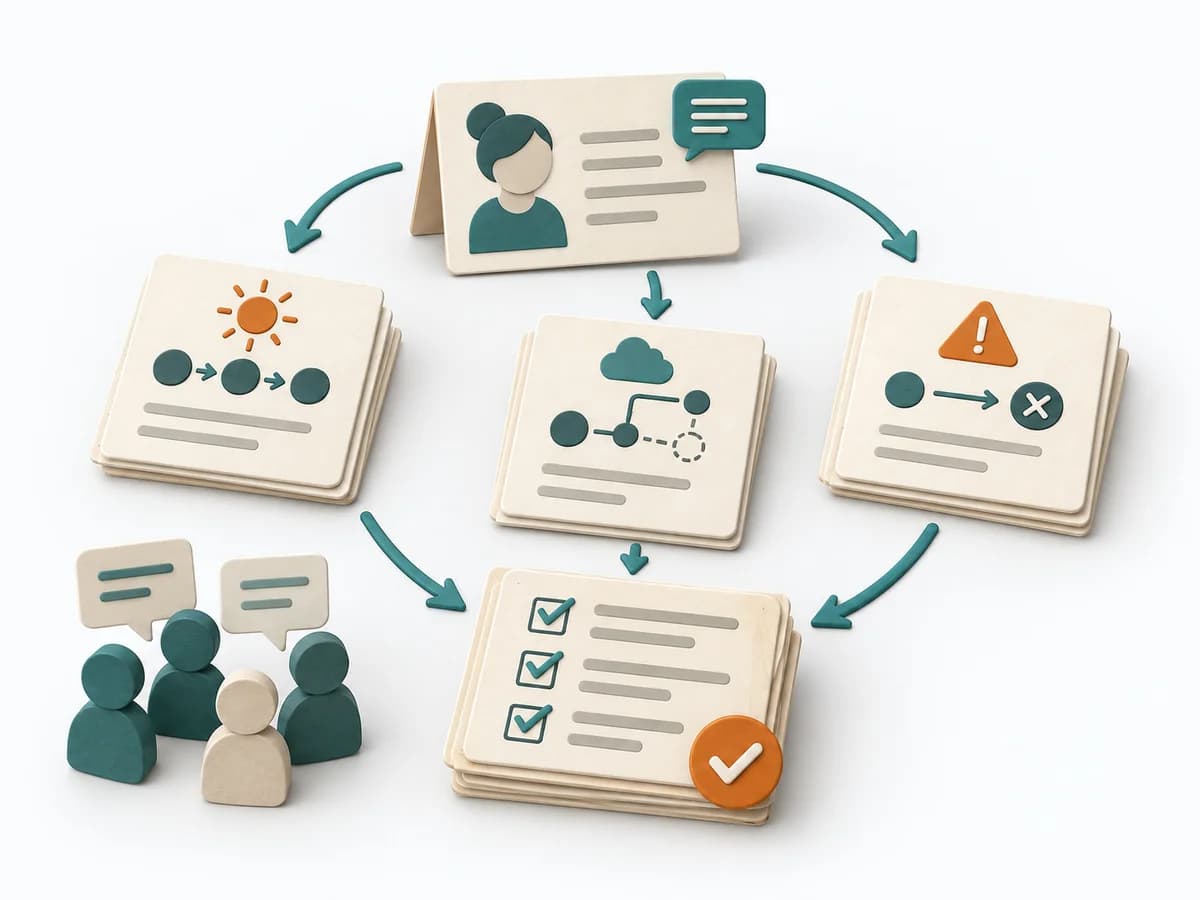 Agile Acceptance Criteria Workshop |
|---|---|---|---|---|
Purposedifferent | IBIS structures thinking about complex questions as a sequence of issues, ideas, and arguments. The method keeps discussions open without forcing them into premature consensus. | When business rules need to become precise, it ties language, example, and test together. It sorts work by value, risk, and delivery ability. The result is captured as an Example Table and Acceptance Tests. | For decisions with follow-on paths and dependencies, a linear comparison is often not enough. A Decision Tree shows how options branch under conditions and which consequences hang on each branch. | When a story needs clear checkpoints before implementation, it sharpens expectation and scope together. It sorts work by value, risk, and delivery ability. The result is captured as Acceptance Criteria and a Story Update. |
Complexitydifferent | Medium | Medium | Medium | Low |
Timedifferent | 1-3 h | 60-90 min pro Feature | 30-90 min | 20-40 min pro Story |
Participantsdifferent | 2-8 | 3-6 | 1-6 | 3-6 |
Formatdifferent | Workshop + async | Workshop | Workshop + async | Workshop |
Outputdifferent | Issue Map, Positions, Argument Notes | Example Table, Acceptance Tests | Decision Tree, Option Map, Assumption List | Acceptance Criteria, Story Update |
Tagsno overlap | RationaleKnowledgeDecision | AgileRequirementsExamplesBehavior-Driven Development | DecisionTreeOptions | AgileRequirementsRefinementBehavior-Driven Development |