View methods side by side.
Choose up to four methods. Add them using the search and share the comparison by copying its link.
| Criterion |  Knowledge Modeling IBIS | 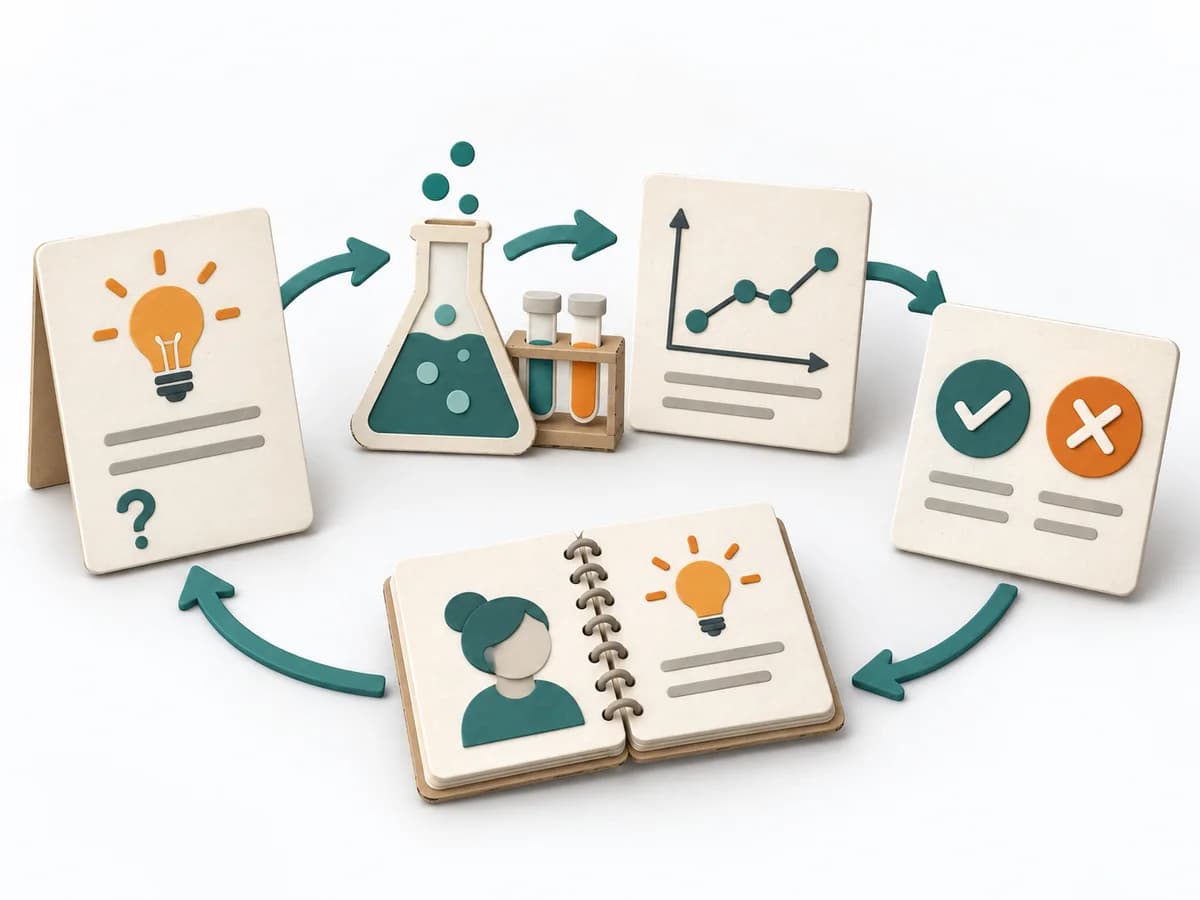 Growth Growth Experiment |  Product Discovery Assumption Mapping |  Product Discovery Learning Card |
|---|---|---|---|---|
Purposedifferent | IBIS structures thinking about complex questions as a sequence of issues, ideas, and arguments. The method keeps discussions open without forcing them into premature consensus. | When growth ideas surface quickly, the temptation to build immediately instead of learning is high. A Growth Experiment frames an assumption so target group, lever, and measurement are clear before the first deployment. | When assumptions still sit unordered in the room, it weighs uncertainty against leverage. It makes visible which hypotheses should be checked first. | The Learning Card connects traceable test results to a reasoned next action while keeping the limits of the insight visible. |
Complexitydifferent | Medium | Medium | Medium | Low |
Timedifferent | 1-3 h | 1-2 Wochen | 45-60 min | 25-40 min |
Participantsdifferent | 2-8 | 1-6 | 2-8 | 1-5 |
Formatsame | Workshop + async | Workshop + async | Workshop + async | Workshop + async |
Outputdifferent | Issue Map, Positions, Argument Notes | Experiment card, Result summary, Next bet | Assumption map, Test backlog, Risk ranking | Learning Card with evidence and next action |
Tagsno overlap | RationaleKnowledgeDecision | MarketingGrowthExperimentsLearning | AssumptionsRiskExperimentsValidation | ExperimentsValidationDiscoveryLearning |