View methods side by side.
Choose up to four methods. Add them using the search and share the comparison by copying its link.
| Criterion | 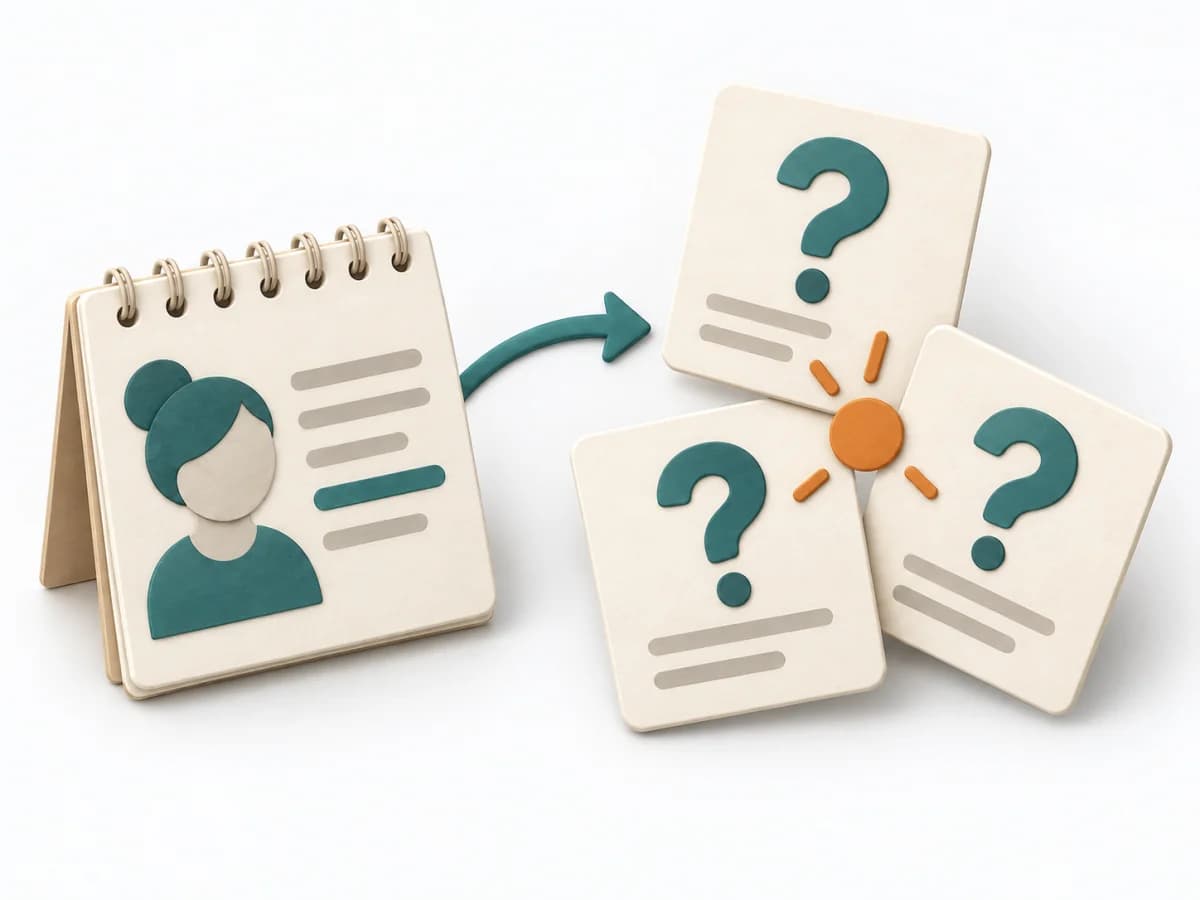 Innovation How Might We |  Decision Making Decision Tree |  Facilitation 1-2-4-All |  Facilitation Decision Jam |
|---|---|---|---|---|
Purposedifferent | With a stuck problem carrying many implicit assumptions, the method translates observations into open, workable questions. It sharpens the problem frame without pre-thinking the solution, turning frustration or fuzziness into a search space with clear direction. | For decisions with follow-on paths and dependencies, a linear comparison is often not enough. A Decision Tree shows how options branch under conditions and which consequences hang on each branch. | When many people in a group too rarely get to speak, 1-2-4-All distributes thinking time more fairly. The format builds participation step by step and makes quiet or still-unformed thoughts usable faster. | When a decision is stuck, Decision Jam loosens the knot through structured separation of problem, idea, and selection. The format creates movement without jumping prematurely at the first seemingly elegant answer. |
Complexitydifferent | Low | Medium | Low | Low |
Timedifferent | 30–45 min | 30-90 min | 10-20 min | 60-90 min |
Participantsdifferent | 1-10 | 1-6 | 4-100+ | 4-10 |
Formatdifferent | Workshop + async | Workshop + async | Workshop | Workshop |
Outputdifferent | HMW Questions, Challenge Framing, Idea Prompts | Decision Tree, Option Map, Assumption List | Idea List, Shared Insights, Emergent Themes | Problem Cluster, Prioritized Challenge, Experiment |
Tagsno overlap | FramingOpportunityIdeationQuestions | DecisionTreeOptions | FacilitationInclusionIdeation | FacilitationDecisionProblem solvingWorkshop |