View methods side by side.
Choose up to four methods. Add them using the search and share the comparison by copying its link.
| Criterion |  Growth Hooked Model |  Business Strategy PESTLE Analysis | 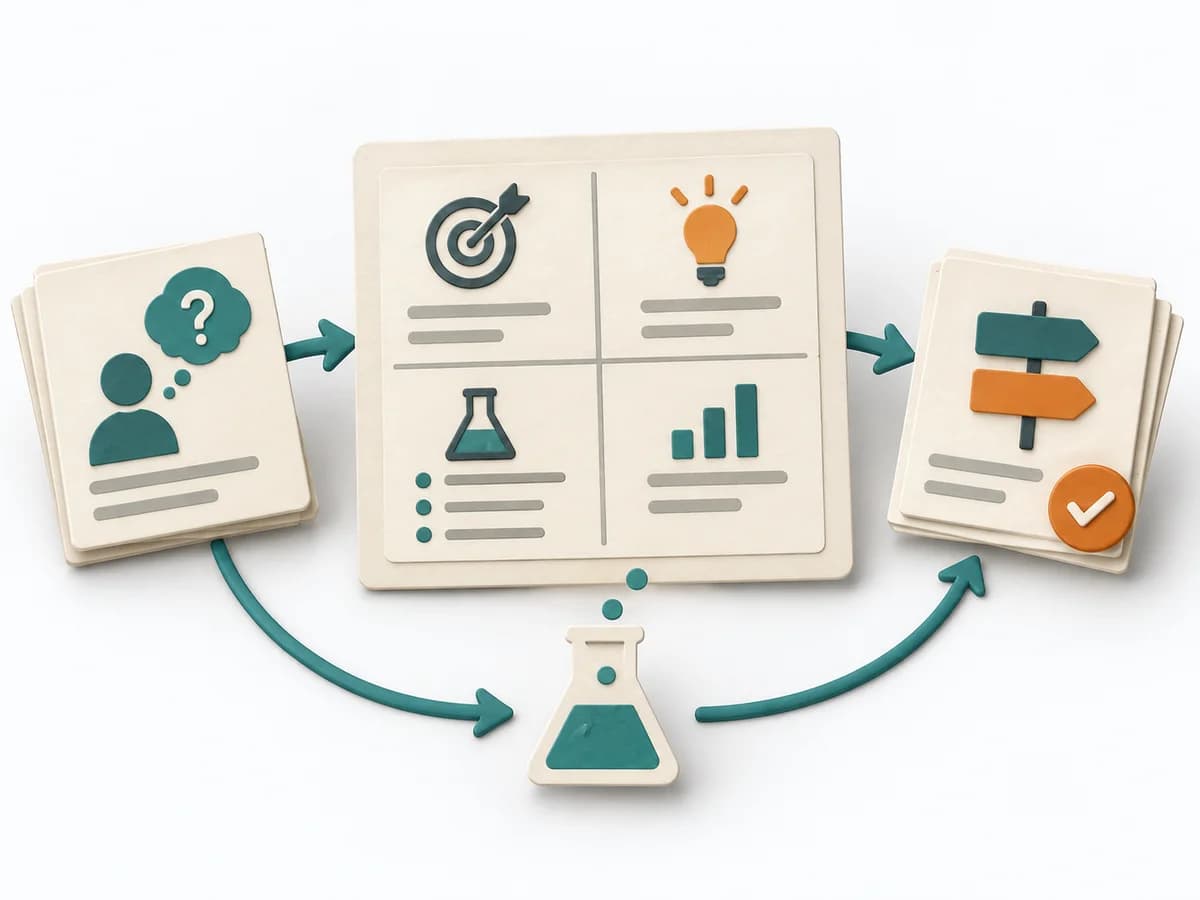 Product Discovery Experiment Canvas |  Product Discovery Test Card |
|---|---|---|---|---|
Purposedifferent | The Hooked Model helps clarify engagement loops, user behavior, and experiments. It makes repeat behavior measurable and captures the result as a hooked loop, trigger map, and reward design. | PESTLE Analysis makes political, economic, social, technological, legal, and environmental influences visible. The environment of an initiative is thereby read systematically instead of through isolated trends. | When experiments become unreadable after the fact, it arranges hypothesis, signal, and learning goal on a single canvas. It separates problem, assumption, solution, and evidence. The result is captured as a Completed Experiment Canvas and a Success Metric. | The Test Card turns a critical assumption into a testable claim and specifies in advance which result counts as success. |
Complexitydifferent | Medium | Medium | Low | Low |
Timedifferent | Multiple workshops over several weeks | 1-3 h | 30-60 min | 20-35 min |
Participantsdifferent | 2-8 | 2-10 | 1-5 | 1-5 |
Formatsame | Workshop + async | Workshop + async | Workshop + async | Workshop + async |
Outputdifferent | Hooked loop, Trigger map, Reward design, Ethics check | PESTLE Map, External Risks, Strategic Questions | Completed Experiment Canvas, Success Metric | Test Card with a pre-set threshold |
Tagsno overlap | GrowthBehaviorRetention | StrategyMarketAnalysis | ExperimentsValidationDiscoveryHypothesis | ExperimentsValidationDiscoveryHypothesis |