View methods side by side.
Choose up to four methods. Add them using the search and share the comparison by copying its link.
| Criterion |  Growth Hooked Model |  Systems Thinking Leverage Points | 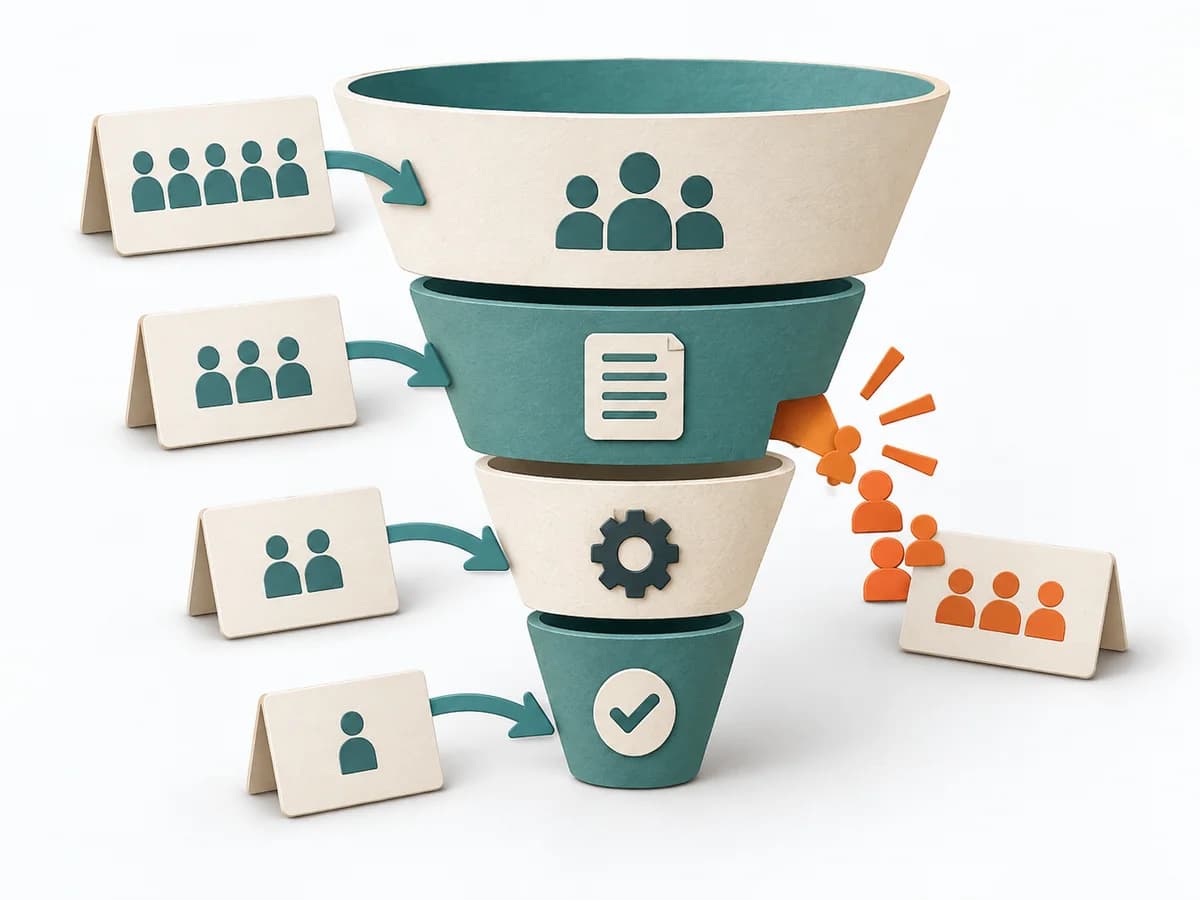 Growth Funnel Analysis |  Decision Making Force Field Analysis |
|---|---|---|---|---|
Purposedifferent | The Hooked Model helps clarify engagement loops, user behavior, and experiments. It makes repeat behavior measurable and captures the result as a hooked loop, trigger map, and reward design. | Leverage Points show exactly where interventions in a system produce a disproportionate effect. It draws relationships, patterns, and feedback loops. The result is captured as a leverage map and action strategy. | When many visitors or users drop off along the way, the reason behind the number often stays hidden. Funnel Analysis exposes these transitions and makes visible exactly where the path collapses. | In change initiatives, supporting and restraining forces sit at the table at the same time. Force Field Analysis makes these tensions explicit and shows where change can be pushed forward by strengthening or relieving. |
Complexitydifferent | Medium | High | Medium | Low |
Timedifferent | Multiple workshops over several weeks | Half day | 1-3 h | 45-90 min |
Participantsdifferent | 2-8 | 3-12 | 1-5 | 3-12 |
Formatdifferent | Workshop + async | Workshop | Async | Workshop |
Outputdifferent | Hooked loop, Trigger map, Reward design, Ethics check | Leverage Map, Action Strategy | Funnel report, Drop-off analysis, Optimization hypotheses | Force Field Map, Change Levers, Risk Notes |
Tagsno overlap | GrowthBehaviorRetention | Systems thinkingChangeStrategy | AnalyticsConversionGrowth | ChangeDecisionStrategy |