View methods side by side.
Choose up to four methods. Add them using the search and share the comparison by copying its link.
| Criterion |  Growth Hooked Model | 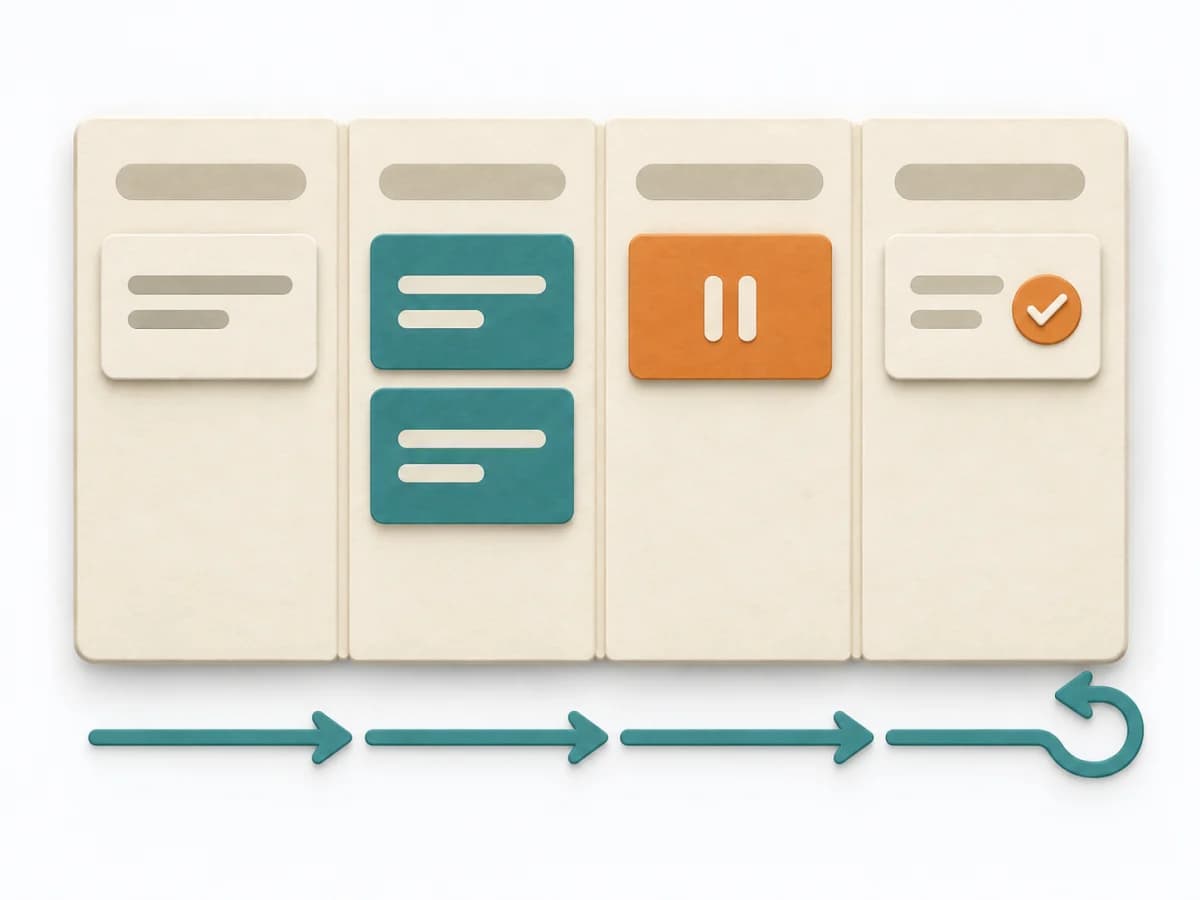 Engineering Kanban |  Product Discovery Assumption Mapping |  Product Discovery Smoke Test |
|---|---|---|---|---|
Purposedifferent | The Hooked Model helps clarify engagement loops, user behavior, and experiments. It makes repeat behavior measurable and captures the result as a hooked loop, trigger map, and reward design. | When work sits in too many parallel streams, throughput suffers and no one sees the bottlenecks. Kanban makes the flow of work visible and limits overload so a system becomes calmer and more predictable. | When assumptions still sit unordered in the room, it weighs uncertainty against leverage. It makes visible which hypotheses should be checked first. | When demand only needs to be roughly verified, it tests interest with minimal effort. It measures whether people would take a next step at all. |
Complexitydifferent | Medium | Medium | Medium | Low |
Timedifferent | Multiple workshops over several weeks | Ongoing | 45-60 min | 1-5 Tage |
Participantsdifferent | 2-8 | 2-12 | 2-8 | Nutzertraffic |
Formatdifferent | Workshop + async | Workshop + async | Workshop + async | Async |
Outputdifferent | Hooked loop, Trigger map, Reward design, Ethics check | Kanban board, WIP policies, Flow metrics | Assumption map, Test backlog, Risk ranking | Interest Metrics, Conversion Signal, Learning Note |
Tagsno overlap | GrowthBehaviorRetention | FlowVisual managementDelivery | AssumptionsRiskExperimentsValidation | ValidationExperimentsDemandGrowth |