View methods side by side.
Choose up to four methods. Add them using the search and share the comparison by copying its link.
| Criterion |  Growth Hooked Model |  Growth Growth Experiment |  Decision Making Force Field Analysis | 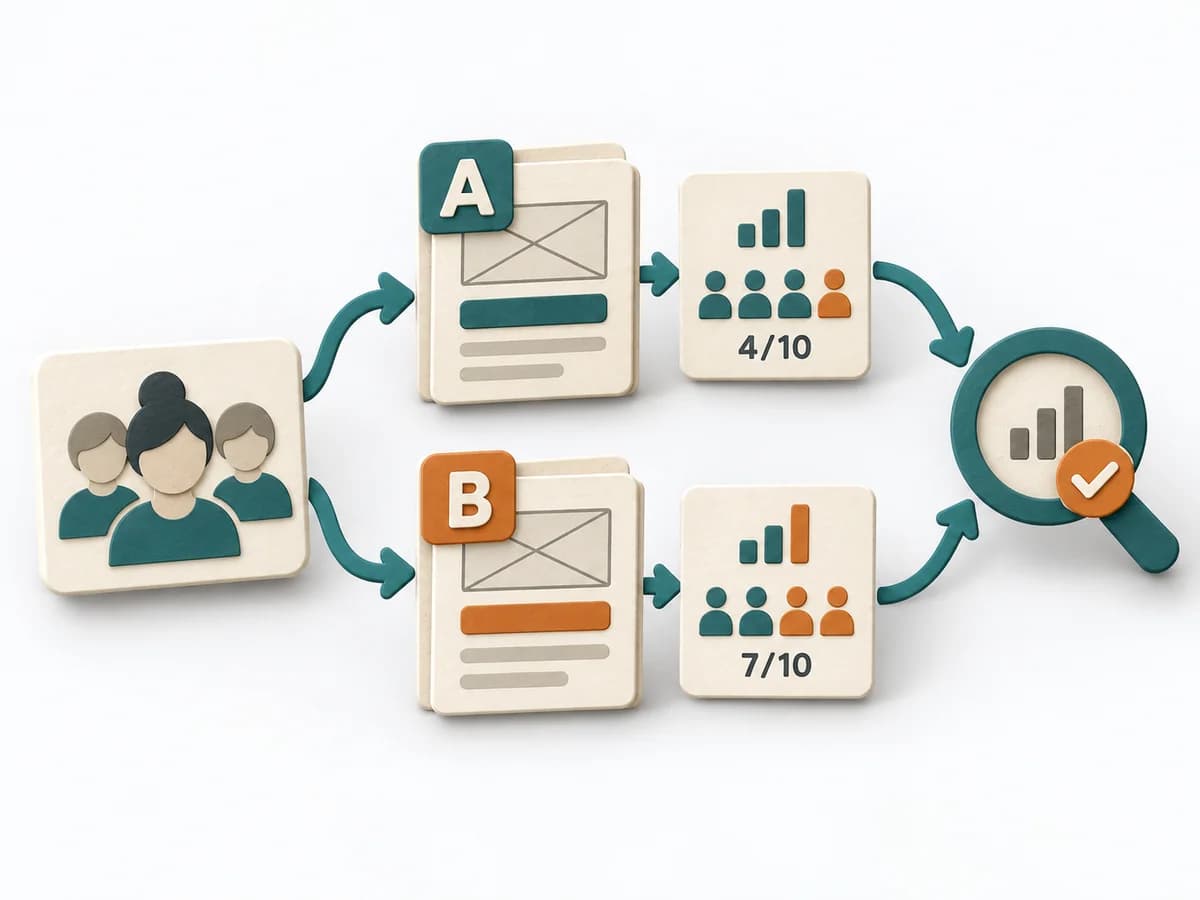 Growth A/B Testing |
|---|---|---|---|---|
Purposedifferent | The Hooked Model helps clarify engagement loops, user behavior, and experiments. It makes repeat behavior measurable and captures the result as a hooked loop, trigger map, and reward design. | When growth ideas surface quickly, the temptation to build immediately instead of learning is high. A Growth Experiment frames an assumption so target group, lever, and measurement are clear before the first deployment. | In change initiatives, supporting and restraining forces sit at the table at the same time. Force Field Analysis makes these tensions explicit and shows where change can be pushed forward by strengthening or relieving. | When two variants compete, discussions quickly decide by taste rather than effect. A/B Testing checks behavior under controlled conditions and separates real improvement from chance or expectation effects. |
Complexitydifferent | Medium | Medium | Low | High |
Timedifferent | Multiple workshops over several weeks | 1-2 Wochen | 45-90 min | 1-4 Wochen |
Participantsdifferent | 2-8 | 1-6 | 3-12 | 1-6 |
Formatdifferent | Workshop + async | Workshop + async | Workshop | Async |
Outputdifferent | Hooked loop, Trigger map, Reward design, Ethics check | Experiment card, Result summary, Next bet | Force Field Map, Change Levers, Risk Notes | Experiment results, Decision log, Learning summary |
Tagsno overlap | GrowthBehaviorRetention | MarketingGrowthExperimentsLearning | ChangeDecisionStrategy | ExperimentsGrowthAnalyticsValidation |