View methods side by side.
Choose up to four methods. Add them using the search and share the comparison by copying its link.
| Criterion |  Growth Hooked Model |  Operations Family Tree Analysis |  Operations Barrier Analysis | 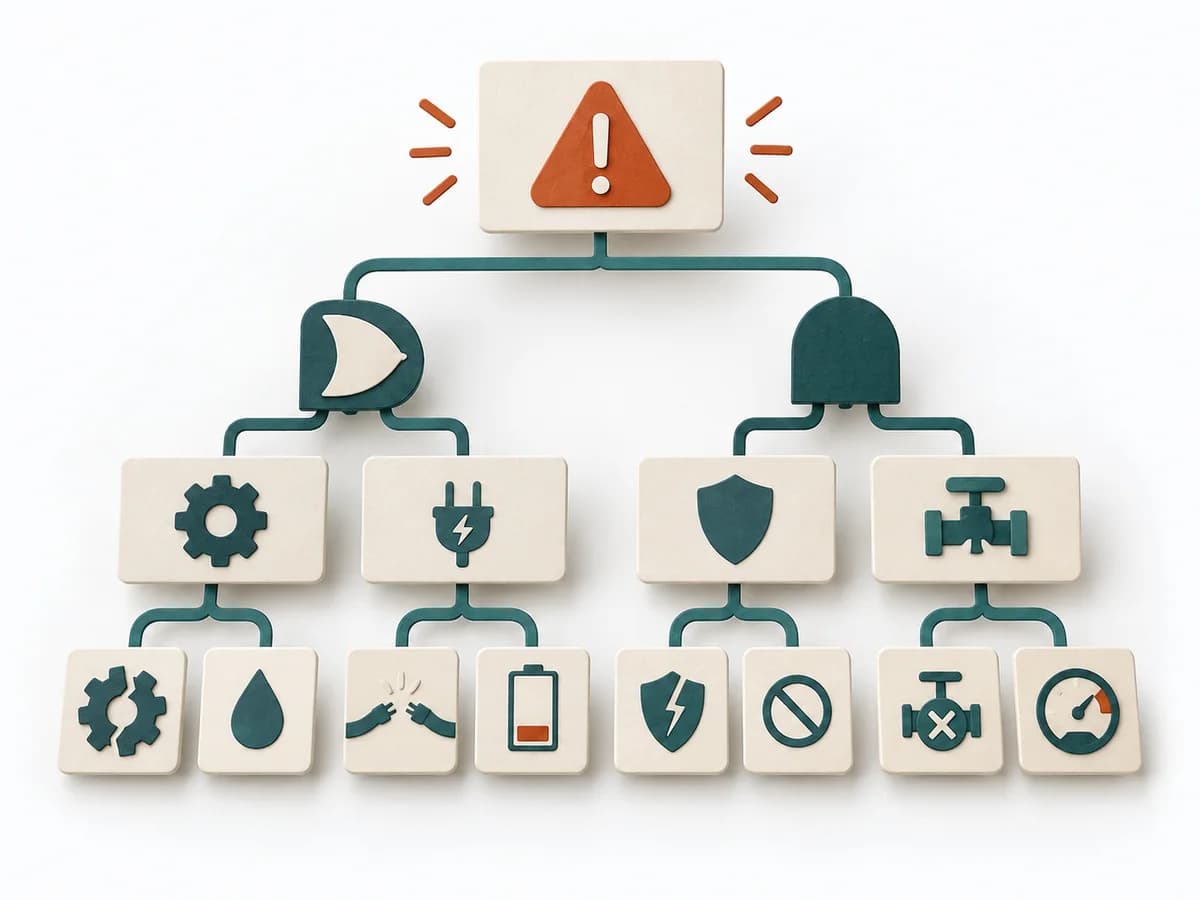 Operations Fault Tree Analysis |
|---|---|---|---|---|
Purposedifferent | The Hooked Model helps clarify engagement loops, user behavior, and experiments. It makes repeat behavior measurable and captures the result as a hooked loop, trigger map, and reward design. | For a series of incidents with a similar pattern, the method arranges individual events as branches of a common origin. It makes visible which conditions keep recurring. | For a risk that can only be managed through multiple layers of protection, the method examines the effectiveness of each barrier. It shows where safeguards are missing, too weak, or fail under real conditions. | For a critical top event with several possible triggers, the method logically models failure paths. It makes visible which combinations of conditions can lead to damage. |
Complexitydifferent | Medium | Medium | Medium | High |
Timedifferent | Multiple workshops over several weeks | 2-4 h | 2-4 h | 2-6 h |
Participantsdifferent | 2-8 | 2-6 | 2-6 | 3-8 |
Formatsame | Workshop + async | Workshop + async | Workshop + async | Workshop + async |
Outputdifferent | Hooked loop, Trigger map, Reward design, Ethics check | Family Tree Diagram, Pattern Notes, Systemic Measures | Barrier Inventory, Failure Analysis per Barrier, Action Backlog | Fault Tree, Critical Paths, Cause Hypotheses, Control Actions |
Tagsno overlap | GrowthBehaviorRetention | Root causePatternsIncidentSystemic | Root causeSafetyIncident | RiskRoot causeSafety |