View methods side by side.
Choose up to four methods. Add them using the search and share the comparison by copying its link.
| Criterion |  Growth Hooked Model |  Operations Change Analysis |  Operations Failure Mode and Effects Analysis | 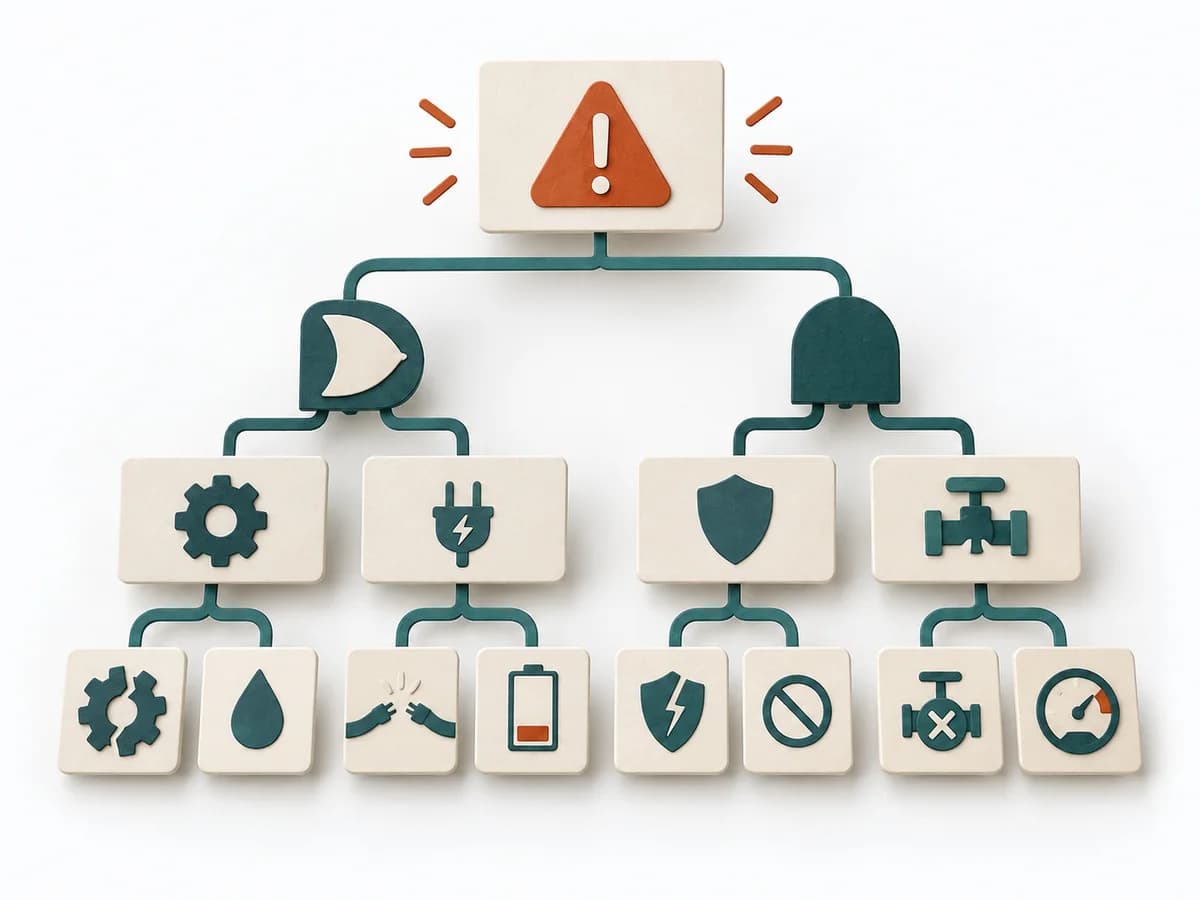 Operations Fault Tree Analysis |
|---|---|---|---|---|
Purposedifferent | The Hooked Model helps clarify engagement loops, user behavior, and experiments. It makes repeat behavior measurable and captures the result as a hooked loop, trigger map, and reward design. | For a deviation after a change, the method isolates the influence of the altered condition. It narrows down which differences are relevant and which are just accompanying noise. | For a process, product, or service with noticeable failure risks, the method assesses possible failure modes in advance. It directs attention to combinations of occurrence, effect, and detectability. | For a critical top event with several possible triggers, the method logically models failure paths. It makes visible which combinations of conditions can lead to damage. |
Complexitydifferent | Medium | Medium | High | High |
Timedifferent | Multiple workshops over several weeks | 45-120 min | 2-6 h | 2-6 h |
Participantsdifferent | 2-8 | 2-6 | 3-10 | 3-8 |
Formatdifferent | Workshop + async | Workshop + async | Workshop | Workshop + async |
Outputdifferent | Hooked loop, Trigger map, Reward design, Ethics check | Change Matrix, Cause Hypotheses, Validation Questions, Action List | FMEA Table, Risk Priority, Mitigation Actions | Fault Tree, Critical Paths, Cause Hypotheses, Control Actions |
Tagsno overlap | GrowthBehaviorRetention | ChangeRoot causeTroubleshootingComparison | RiskQualityOperationsRoot cause | RiskRoot causeSafety |