View methods side by side.
Choose up to four methods. Add them using the search and share the comparison by copying its link.
| Criterion |  Growth Hooked Model |  Architecture ARID (Active Reviews for Intermediate Designs) | 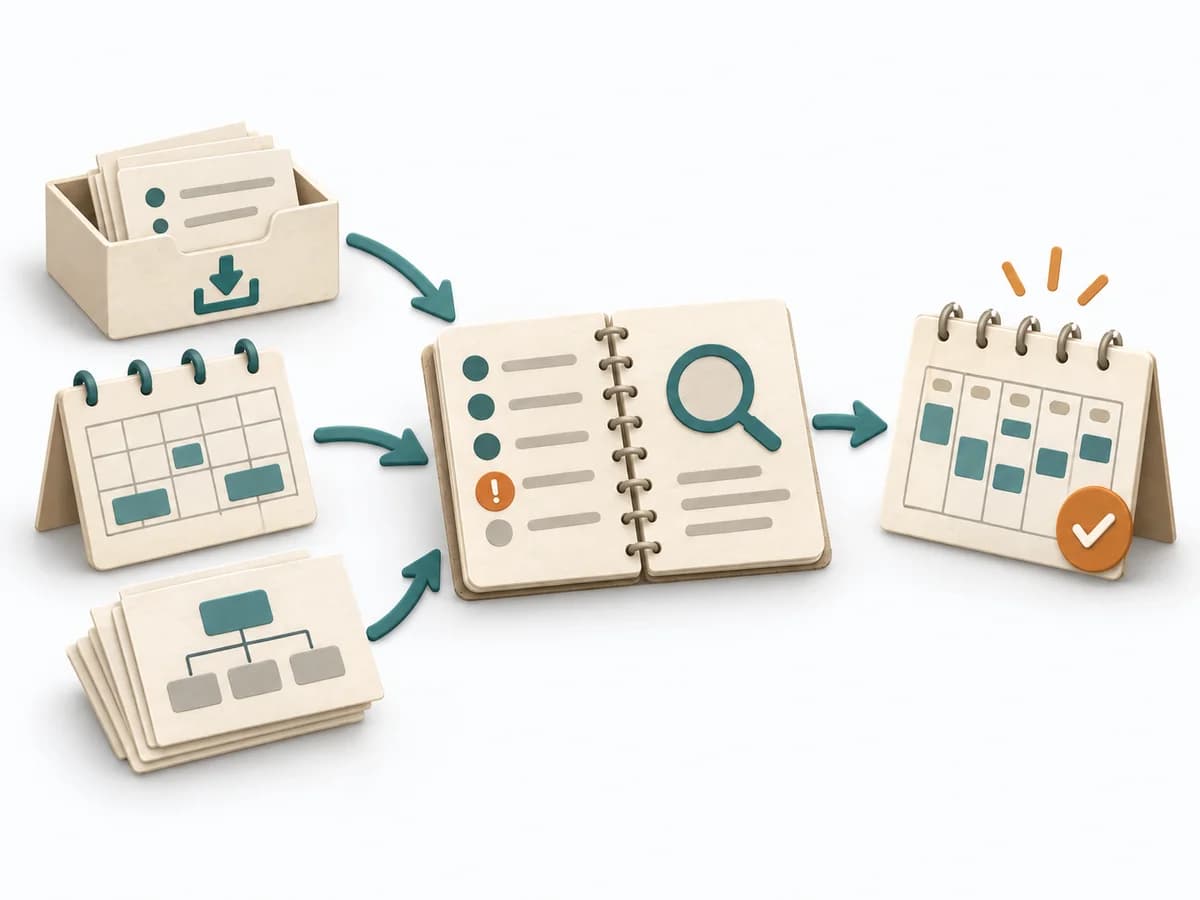 Operations Weekly Review |  Operations Eat the Frog |
|---|---|---|---|---|
Purposedifferent | The Hooked Model helps clarify engagement loops, user behavior, and experiments. It makes repeat behavior measurable and captures the result as a hooked loop, trigger map, and reward design. | ARID examines how well developers can work with a technical design. It focuses on a part of the system that can still be revised, between the architecture overview and the detailed specification. | In a week with many open loops, the method creates distance from operational noise. It organizes commitments, calendar, and projects so the next week becomes workable. | The method protects energy and attention for the task that creates the largest progress and is often postponed. |
Complexitydifferent | Medium | Medium | Low | Low |
Timedifferent | Multiple workshops over several weeks | 2–4 h review as a planning range; preparation and evaluation additional | 30-60 min | 15-90 min daily |
Participantsdifferent | 2-8 | Designers, developers as users, and facilitation | 1 | 1 |
Formatdifferent | Workshop + async | Workshop + async | Async | Async |
Outputdifferent | Hooked loop, Trigger map, Reward design, Ethics check | Prioritized development tasks, Jointly produced code or pseudocode, Observed difficulties and open design questions, Proposed design revisions | Updated Task System, Weekly Focus, Next Actions | Priority Task, Completion Note, Daily Focus |
Tagsno overlap | GrowthBehaviorRetention | ArchitectureEngineeringFeedbackValidationTasks | ProductivityExecutionPlanning | PrioritizationProductivityFocusExecution |