View methods side by side.
Choose up to four methods. Add them using the search and share the comparison by copying its link.
| Criterion | 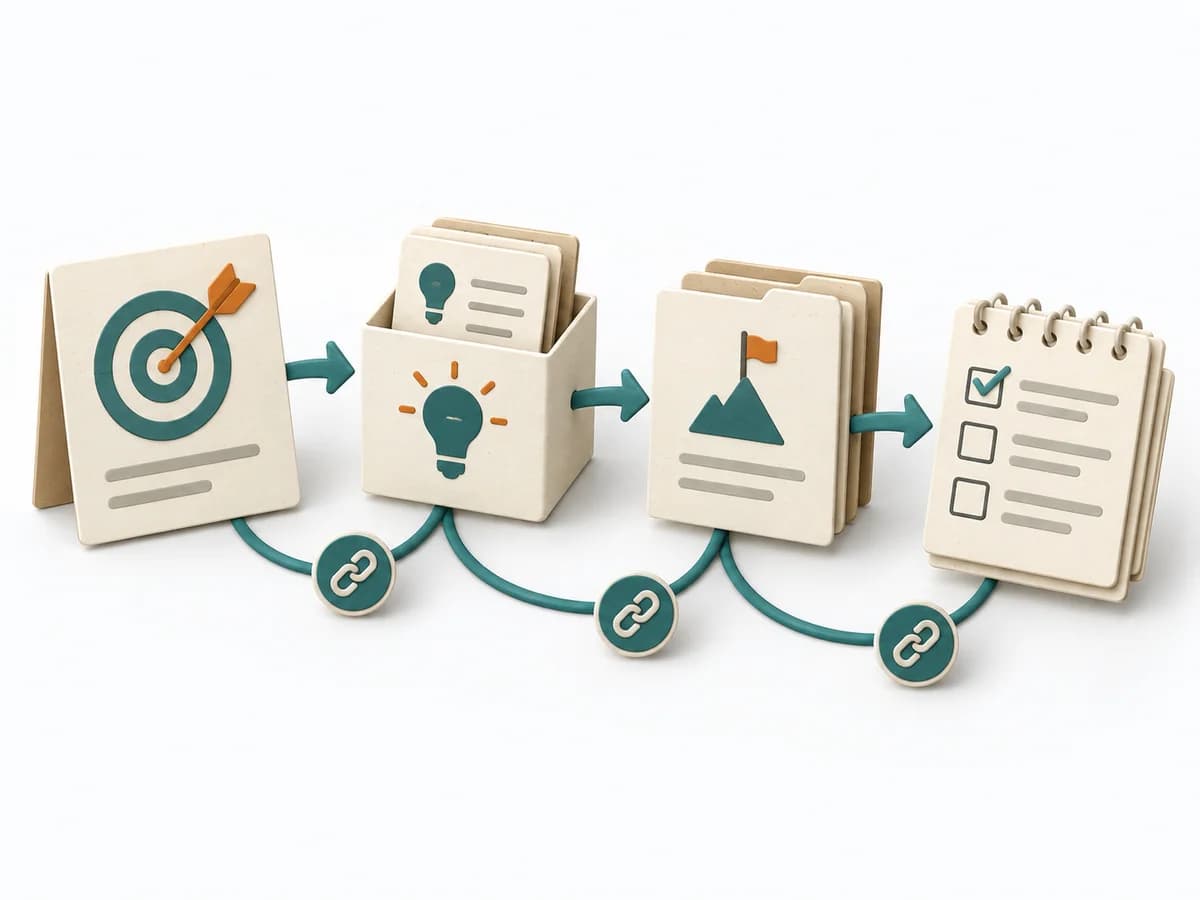 Product Strategy GIST Planning |  Growth Flywheel |  Product Discovery Smoke Test |  Product Discovery Experiment Canvas |
|---|---|---|---|---|
Purposedifferent | GIST Planning helps clarify target groups, value, goals, and priorities. It links customer value, product logic, and decision priorities, and captures the result as goals, an idea bank, and a step-project list. | Growth often breaks down where a reinforcing mechanism builds up too much friction. A Flywheel shows the cycle of value, repetition, and reinforcement meant to sustain growth. | When demand only needs to be roughly verified, it tests interest with minimal effort. It measures whether people would take a next step at all. | When experiments become unreadable after the fact, it arranges hypothesis, signal, and learning goal on a single canvas. It separates problem, assumption, solution, and evidence. The result is captured as a Completed Experiment Canvas and a Success Metric. |
Complexitydifferent | Medium | Medium | Low | Low |
Timedifferent | Wochen bis Monate je Goal | 60-120 min | 1-5 Tage | 30-60 min |
Participantsdifferent | 3-10 | 3-8 | Nutzertraffic | 1-5 |
Formatdifferent | Workshop + async | Workshop | Async | Workshop + async |
Outputdifferent | Goals, Idea bank, Step-project list, Tasks, Learning reports | Flywheel Map, Friction Points, Growth Levers, Experiment Backlog | Interest Metrics, Conversion Signal, Learning Note | Completed Experiment Canvas, Success Metric |
Tagsno overlap | RoadmapOutcomesPlanningExperiments | GrowthRetentionConversion | ValidationExperimentsDemandGrowth | ExperimentsValidationDiscoveryHypothesis |