View methods side by side.
Choose up to four methods. Add them using the search and share the comparison by copying its link.
| Criterion |  Operations Gemba Walk | 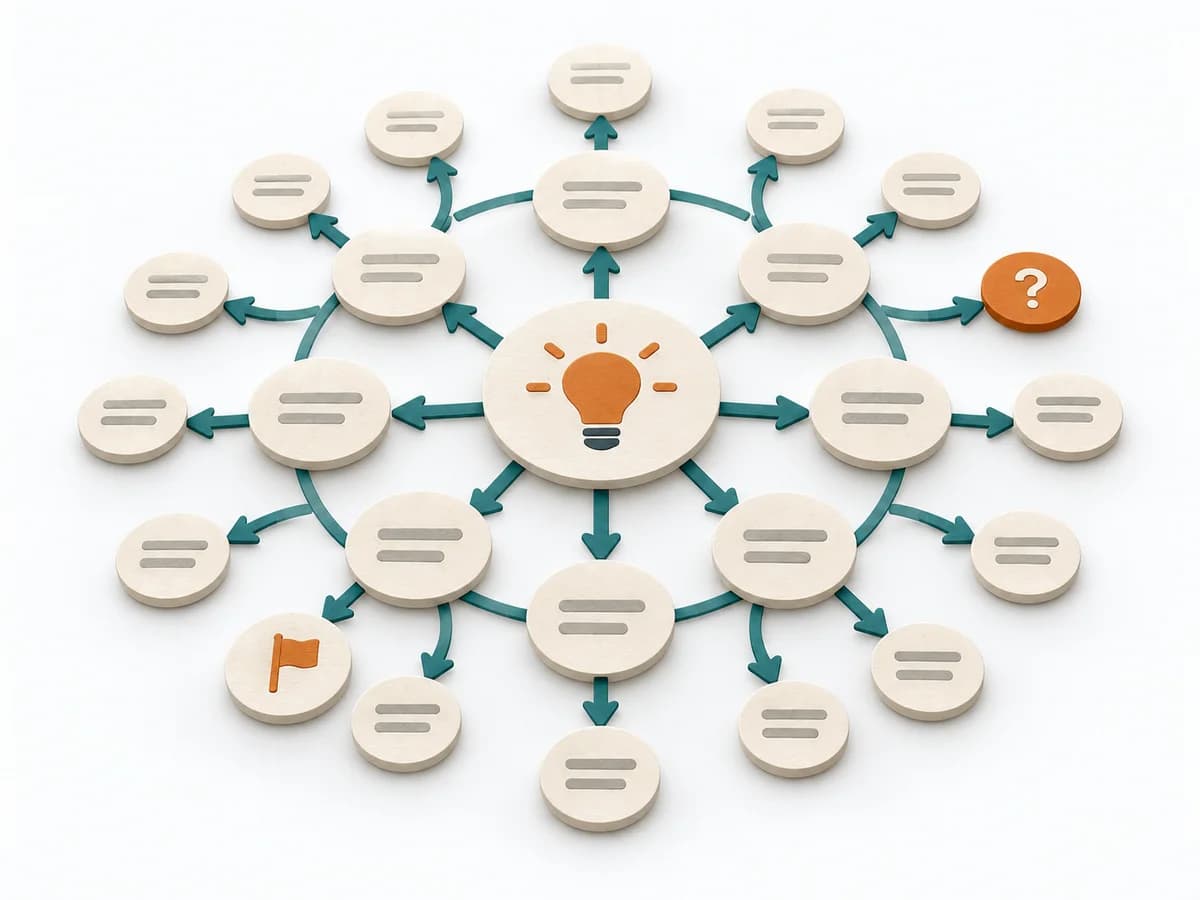 Systems Thinking Futures Wheel |  Decision Making OODA Loop |  Systems Thinking Leverage Points |
|---|---|---|---|---|
Purposedifferent | When there is uncertainty about the real course of a process, the method brings observation to the place where work happens. It combines perception, follow-up questions, and process knowledge so decisions rest on actual workflows instead of assumptions. | The Futures Wheel helps explore the consequences of a decision, a trend, or a strategic move in a structured way. It makes visible which first, second, and third-order effects could arise from an event. | In dynamic situations, decisions become outdated faster than they can be prepared. The OODA Loop holds observing, orienting, deciding, and acting together as a recurring rhythm so reaction does not slide into inertia. | Leverage Points show exactly where interventions in a system produce a disproportionate effect. It draws relationships, patterns, and feedback loops. The result is captured as a leverage map and action strategy. |
Complexitydifferent | Low | Medium | Medium | High |
Timedifferent | 30-120 min | 60-120 min | 15-60 min je Zyklus | Half day |
Participantsdifferent | 2-6 | 3-10 | 1-8 | 3-12 |
Formatdifferent | Workshop | Workshop + async | Workshop + async | Workshop |
Outputdifferent | Observation Notes, Improvement Ideas | Futures Wheel, Consequence Chains, Strategic Signals | Situation Assessment, Decision Loop, Action Updates | Leverage Map, Action Strategy |
Tagsno overlap | LeanObservationProcessOperations | ForesightSystems thinkingSignals | DecisionChangeLearningStrategy | Systems thinkingChangeStrategy |