View methods side by side.
Choose up to four methods. Add them using the search and share the comparison by copying its link.
| Criterion |  Business Strategy GAP Analysis |  Business Strategy Scenario Planning |  Agile Example Mapping | 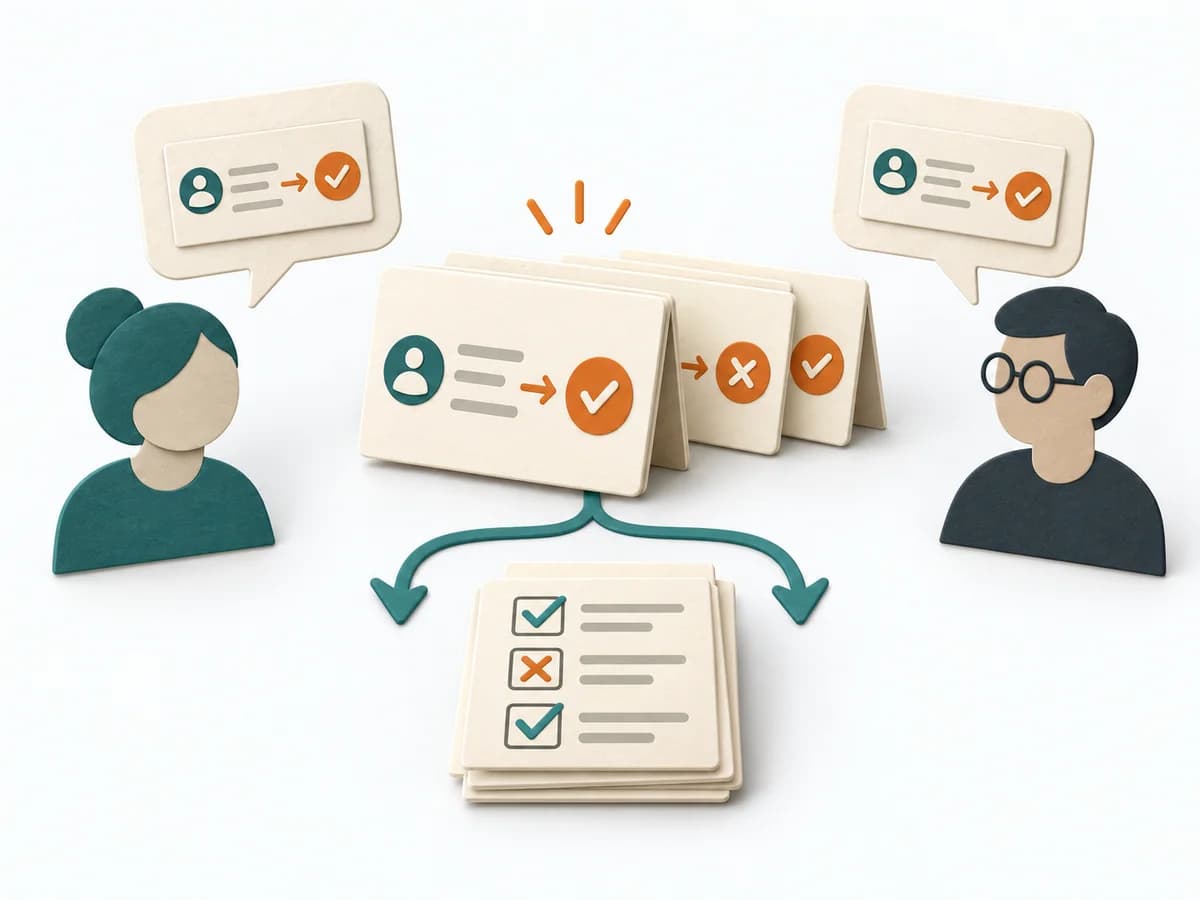 Agile Specification by Example |
|---|---|---|---|---|
Purposedifferent | GAP Analysis compares the current state with a target picture and makes the distance manageable. It becomes useful when, ahead of new initiatives, it must become clear which capabilities, processes, or resources are missing. | Scenario Planning opens the view to several plausible futures instead of a single forecast. The method protects strategies from depending on too narrow an expected path. | When a story carries business rules and exceptions, it brings clarity before implementation. It makes examples, open questions, and boundaries visible enough that the logic becomes jointly sound. | When business rules need to become precise, it ties language, example, and test together. It sorts work by value, risk, and delivery ability. The result is captured as an Example Table and Acceptance Tests. |
Complexitydifferent | Medium | High | Low | Medium |
Timedifferent | 1-3 h | 0.5-2 Tage | 30-60 min | 60-90 min pro Feature |
Participantsdifferent | 2-8 | 4-12 | 3-7 | 3-6 |
Formatdifferent | Workshop + async | Workshop | Workshop | Workshop |
Outputdifferent | Gap Matrix, Action Plan, Risk Notes | Scenario Set, Strategic Implications, Robust Options | Example Map, Acceptance Criteria, Open Questions | Example Table, Acceptance Tests |
Tagsno overlap | StrategyAnalysisPlanning | StrategyUncertaintyPlanning | Behavior-Driven DevelopmentRequirementsExamplesRefinement | AgileRequirementsExamplesBehavior-Driven Development |