View methods side by side.
Choose up to four methods. Add them using the search and share the comparison by copying its link.
| Criterion |  Business Strategy GAP Analysis |  Growth Hooked Model | 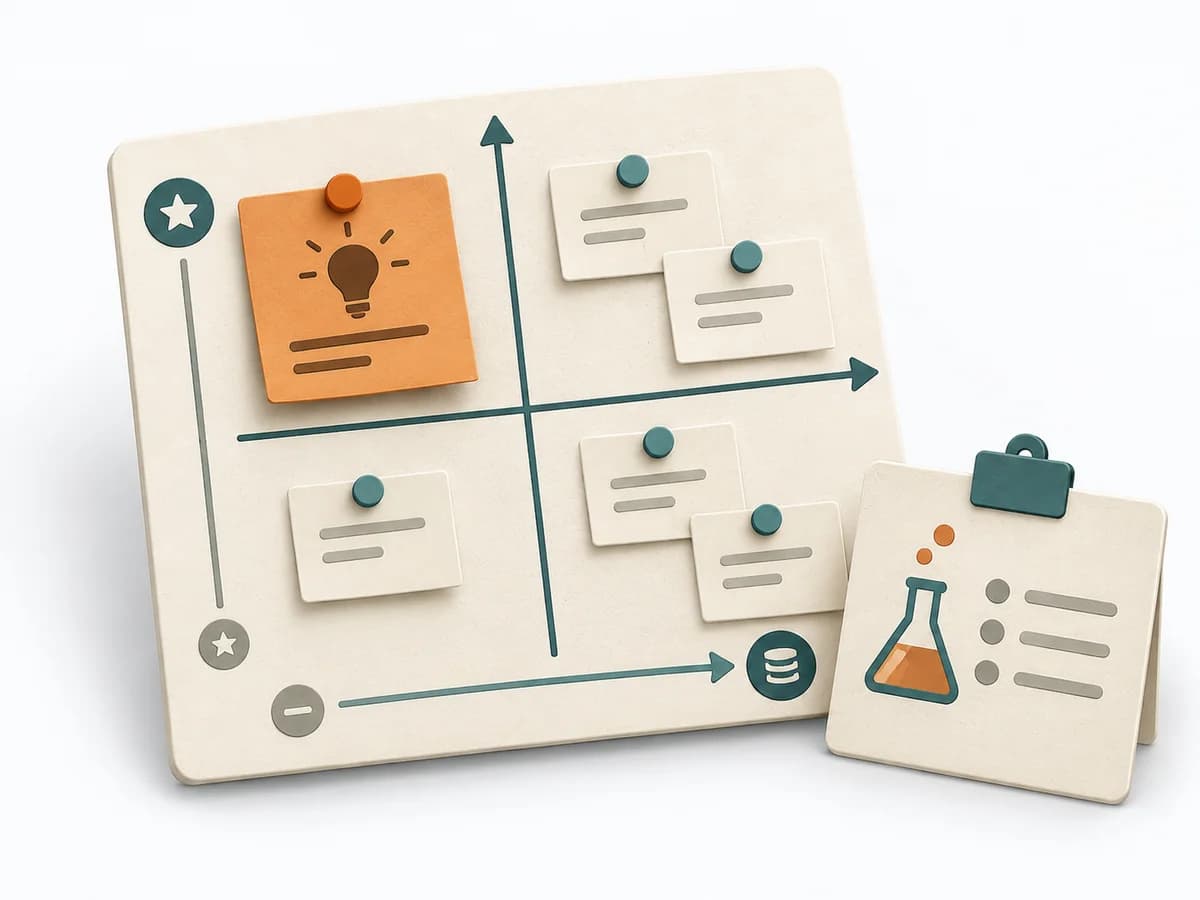 Product Discovery Assumption Mapping |  Product Strategy Impact Mapping |
|---|---|---|---|---|
Purposedifferent | GAP Analysis compares the current state with a target picture and makes the distance manageable. It becomes useful when, ahead of new initiatives, it must become clear which capabilities, processes, or resources are missing. | The Hooked Model helps clarify engagement loops, user behavior, and experiments. It makes repeat behavior measurable and captures the result as a hooked loop, trigger map, and reward design. | When assumptions still sit unordered in the room, it weighs uncertainty against leverage. It makes visible which hypotheses should be checked first. | When a goal needs to be connected to several possible paths, it shows chains of impact instead of feature lists. It connects business goal, behavior change, and measures. |
Complexitysame | Medium | Medium | Medium | Medium |
Timedifferent | 1-3 h | Multiple workshops over several weeks | 45-60 min | 45-90 min |
Participantsdifferent | 2-8 | 2-8 | 2-8 | 3-8 |
Formatdifferent | Workshop + async | Workshop + async | Workshop + async | Workshop |
Outputdifferent | Gap Matrix, Action Plan, Risk Notes | Hooked loop, Trigger map, Reward design, Ethics check | Assumption map, Test backlog, Risk ranking | Impact Map, Outcome Hypotheses, Delivery Options |
Tagsno overlap | StrategyAnalysisPlanning | GrowthBehaviorRetention | AssumptionsRiskExperimentsValidation | OutcomesStrategyBehaviorPlanning |