View methods side by side.
Choose up to four methods. Add them using the search and share the comparison by copying its link.
| Criterion |  Business Strategy GAP Analysis |  Decision Making Assumption Surfacing | 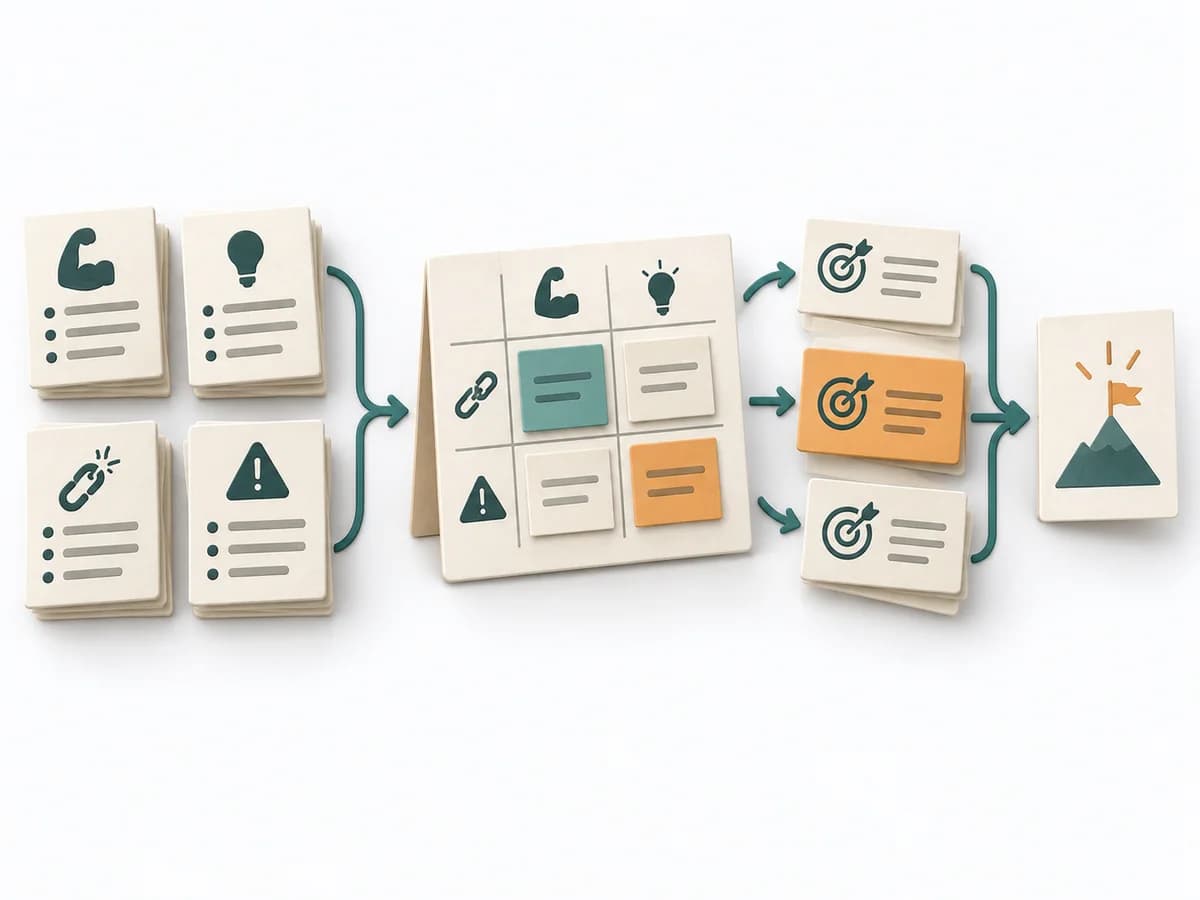 Business Strategy TOWS Matrix |  Product Strategy DIBB |
|---|---|---|---|---|
Purposedifferent | GAP Analysis compares the current state with a target picture and makes the distance manageable. It becomes useful when, ahead of new initiatives, it must become clear which capabilities, processes, or resources are missing. | Plans often contain assumptions that were never openly stated and remain dangerous precisely because of that. Assumption Surfacing makes these silent premises visible and prioritizes which of them carry the initiative or could sink it. | The TOWS Matrix connects internal strengths and weaknesses with external opportunities and threats into action-oriented strategies. It goes a step further than a pure stocktaking. | DIBB helps clarify target groups, value, goals, and priorities by making the logic behind a decision explicit. It captures results as a DIBB document, belief list, bet list, and learning report. |
Complexitydifferent | Medium | Low | Medium | Low |
Timedifferent | 1-3 h | 45-90 min | 1-2 h | 1-2 h |
Participantsdifferent | 2-8 | 2-8 | 3-10 | 2-8 |
Formatdifferent | Workshop + async | Workshop + async | Workshop | Workshop + async |
Outputdifferent | Gap Matrix, Action Plan, Risk Notes | Assumption List, Critical Assumptions, Learning Plan | TOWS Matrix, Strategic Options, Priority Actions | DIBB document, Belief list, Bet list, Learning report |
Tagsno overlap | StrategyAnalysisPlanning | AssumptionsRiskDecisionDiscovery | StrategyAnalysisOptions | StrategyDecisionAssumptionsHypothesis |