View methods side by side.
Choose up to four methods. Add them using the search and share the comparison by copying its link.
| Criterion | 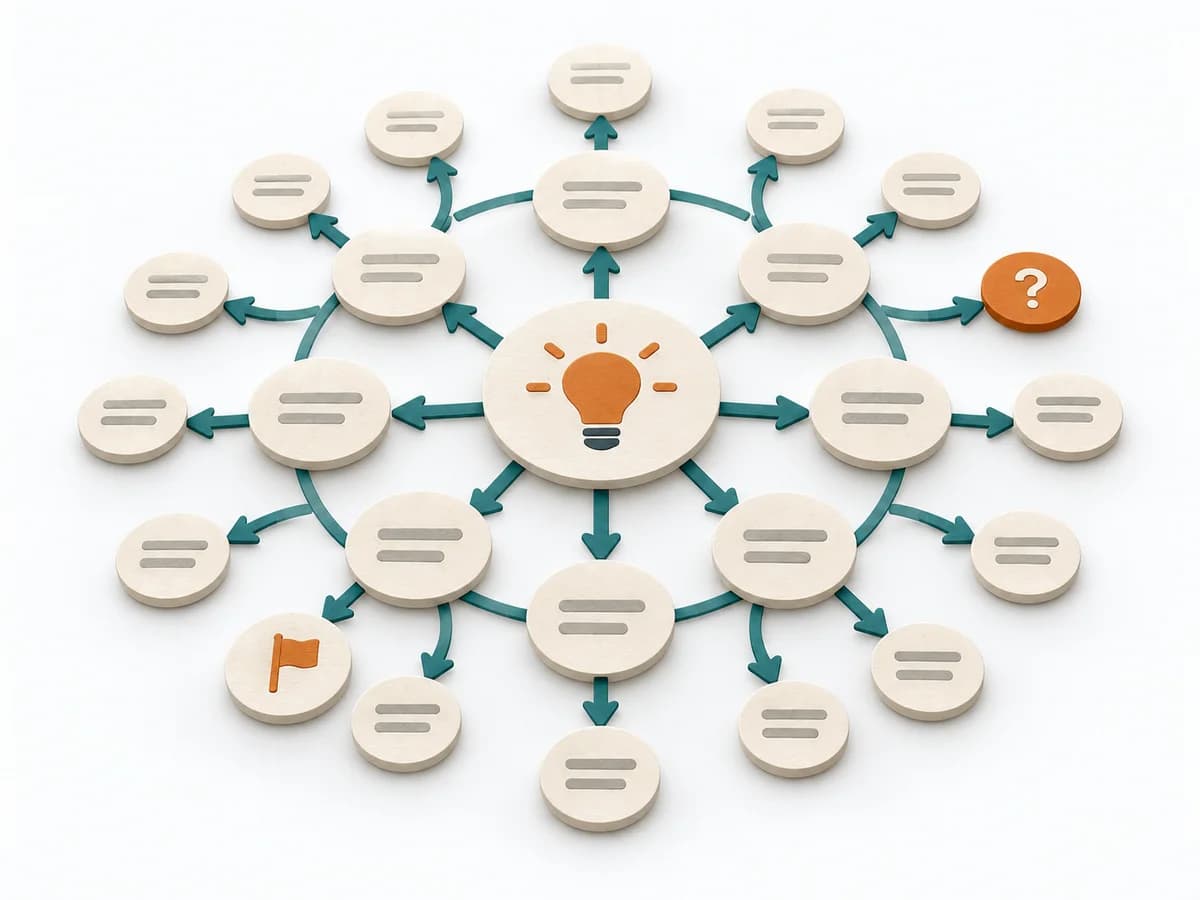 Systems Thinking Futures Wheel |  Decision Making Delphi Method |  Facilitation Stakeholder Salience Model |  Decision Making Decision Rights Mapping |
|---|---|---|---|---|
Purposedifferent | The Futures Wheel helps explore the consequences of a decision, a trend, or a strategic move in a structured way. It makes visible which first, second, and third-order effects could arise from an event. | When knowledge is distributed and direct dominance should be avoided, groups quickly fall under the sway of their opinion leaders. The Delphi Method gathers assessments iteratively and gradually brings expert judgments closer together. | When stakeholders appear to matter very differently, the Stakeholder Salience Model rates their actual priority through power, legitimacy, and urgency. It turns individual contributions into a visible selection. The result is captured as a Salience diagram and a class-based strategy. | In organizations with many stakeholders, it often blurs who actually decides and who is merely consulted. It separates options, evaluation criteria, and open risks. The result is captured as a Decision Rights matrix and an agreement. |
Complexitydifferent | Medium | High | Medium | Medium |
Timedifferent | 60-120 min | 1-4 Wochen | 60-90 min | 90-180 min |
Participantsdifferent | 3-10 | 6-30 Experten | 3-6 | 4-12 |
Formatdifferent | Workshop + async | Async | Workshop | Workshop |
Outputdifferent | Futures Wheel, Consequence Chains, Strategic Signals | Expert Forecast, Consensus Range, Assumption Notes | Salience Diagram, Strategy per Class | Decision Rights Matrix, Agreement |
Tagsno overlap | ForesightSystems thinkingSignals | ForecastingExpertsDecisionStrategy | StakeholdersFacilitationAlignmentGovernance | DecisionGovernanceAlignmentResponsibility |