View methods side by side.
Choose up to four methods. Add them using the search and share the comparison by copying its link.
| Criterion | 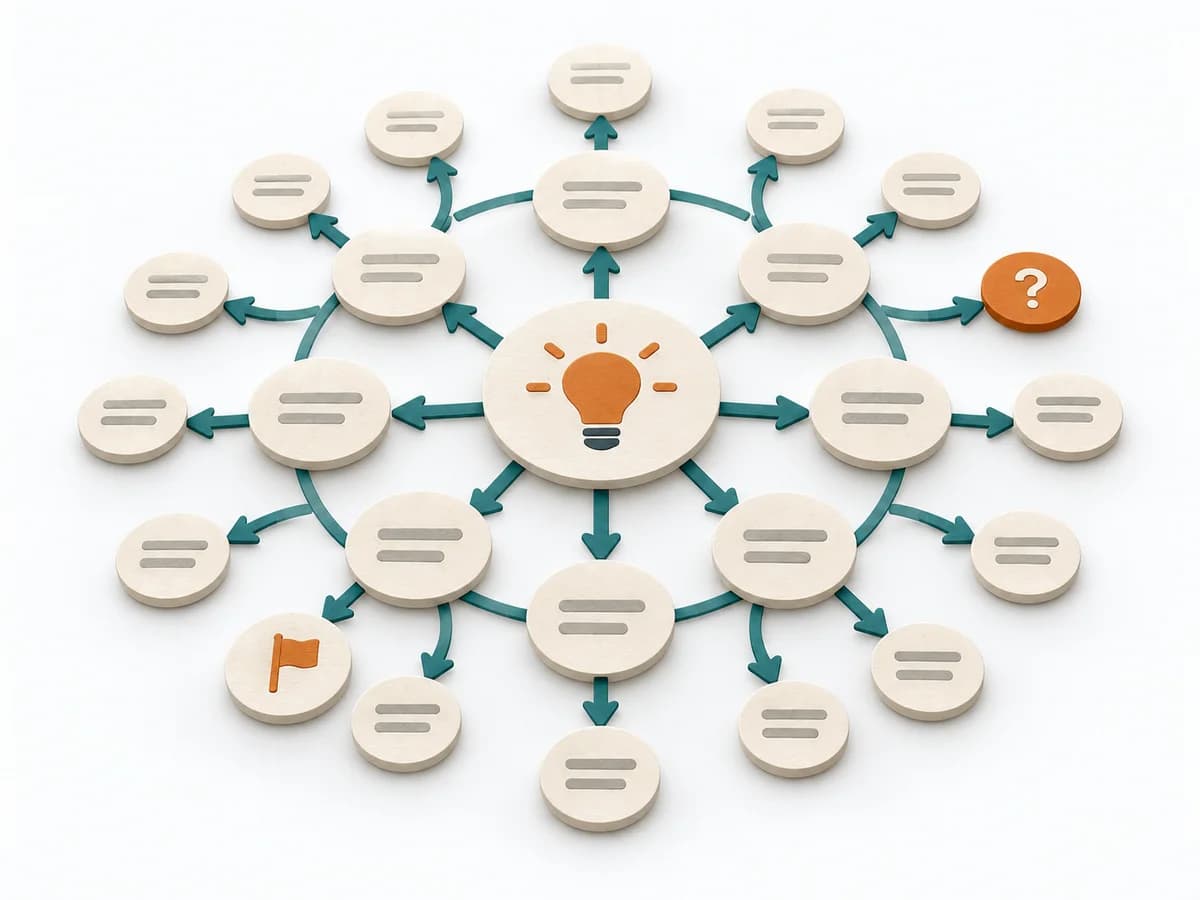 Systems Thinking Futures Wheel |  Decision Making Decision Tree |  Operations ALPEN Method |  Operations Kepner-Tregoe |
|---|---|---|---|---|
Purposedifferent | The Futures Wheel helps explore the consequences of a decision, a trend, or a strategic move in a structured way. It makes visible which first, second, and third-order effects could arise from an event. | For decisions with follow-on paths and dependencies, a linear comparison is often not enough. A Decision Tree shows how options branch under conditions and which consequences hang on each branch. | With an overloaded day full of too many tasks, a realistic picture of the day emerges. The method connects estimating, deciding, and buffer thinking so planning fits available energy and time. | For a disturbance that's hard to pin down, the method cleanly separates problem, cause, and decision. It reduces mixing when symptoms allow several interpretations. |
Complexitydifferent | Medium | Medium | Low | High |
Timedifferent | 60-120 min | 30-90 min | 10-20 min daily | 2-8 h |
Participantsdifferent | 3-10 | 1-6 | 1 | 2-8 |
Formatdifferent | Workshop + async | Workshop + async | Async | Workshop + async |
Outputdifferent | Futures Wheel, Consequence Chains, Strategic Signals | Decision Tree, Option Map, Assumption List | Daily Plan, Time Estimates, Review Notes | Problem Analysis, Decision Analysis, Risk Plan |
Tagsno overlap | ForesightSystems thinkingSignals | DecisionTreeOptions | PlanningTime managementProductivityOperations | Problem solvingRoot causeDecisionOperations |