View methods side by side.
Choose up to four methods. Add them using the search and share the comparison by copying its link.
| Criterion | 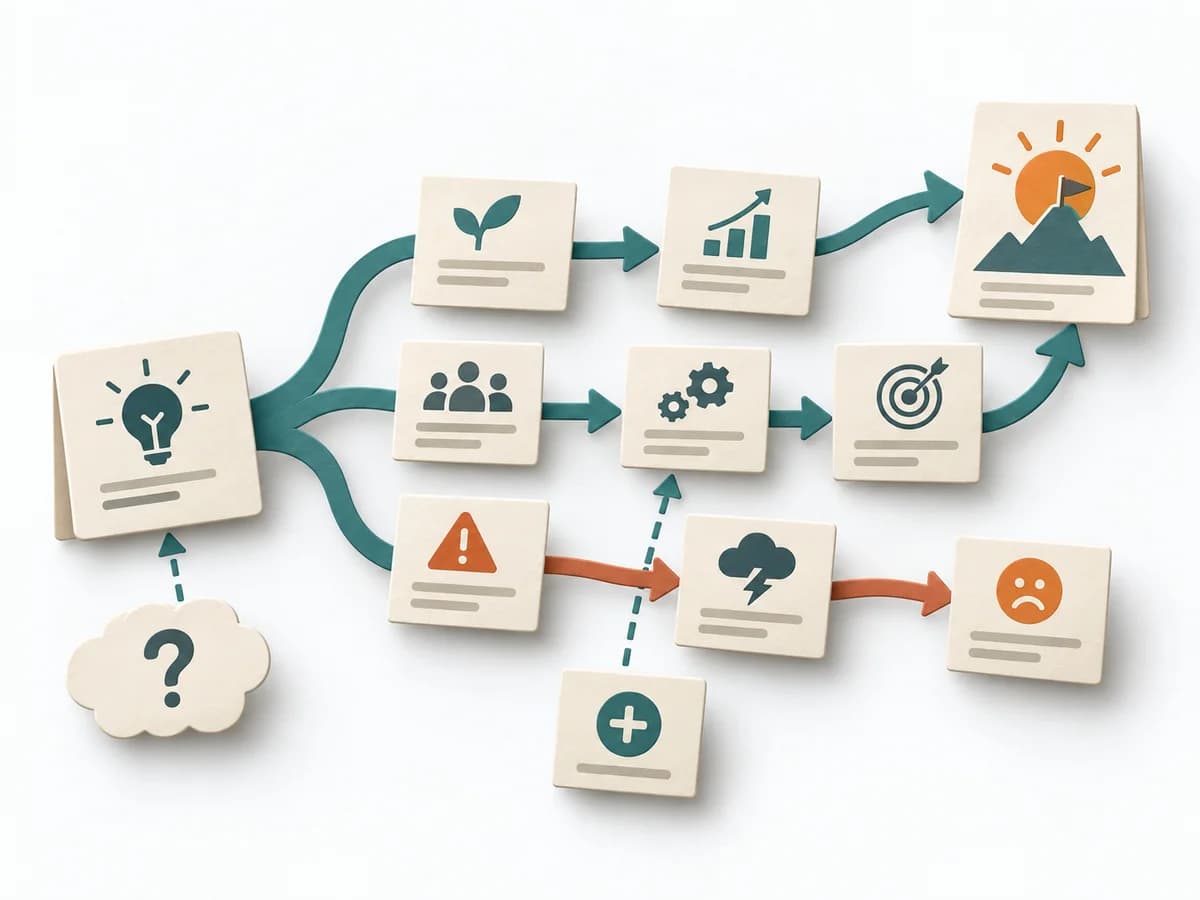 Systems Thinking Future Reality Tree |  UX Research Surveys |  Decision Making OODA Loop |  Product Strategy DIBB |
|---|---|---|---|---|
Purposedifferent | A Future Reality Tree shows how desired actions are meant to lead to a better system state. The method checks whether a path of change holds together logically before time flows into implementation. | When a topic needs to be validated broadly and many people can answer the same question, surveys gather structured feedback in a scalable form. Answers become comparable and segmentable instead of remaining merely anecdotal. | In dynamic situations, decisions become outdated faster than they can be prepared. The OODA Loop holds observing, orienting, deciding, and acting together as a recurring rhythm so reaction does not slide into inertia. | DIBB helps clarify target groups, value, goals, and priorities by making the logic behind a decision explicit. It captures results as a DIBB document, belief list, bet list, and learning report. |
Complexitydifferent | High | Medium | Medium | Low |
Timedifferent | 2-4 h | 3-14 Tage | 15-60 min je Zyklus | 1-2 h |
Participantsdifferent | 3-8 | 50+ | 1-8 | 2-8 |
Formatdifferent | Workshop | Async | Workshop + async | Workshop + async |
Outputdifferent | Future Reality Tree, Negative Branches, Assumption List, Improved Injections | Survey Results, Charts, Segment Insights | Situation Assessment, Decision Loop, Action Updates | DIBB document, Belief list, Bet list, Learning report |
Tagsno overlap | Theory of ConstraintsSystems thinkingChange | QuantitativeResearchValidation | DecisionChangeLearningStrategy | StrategyDecisionAssumptionsHypothesis |