View methods side by side.
Choose up to four methods. Add them using the search and share the comparison by copying its link.
| Criterion | 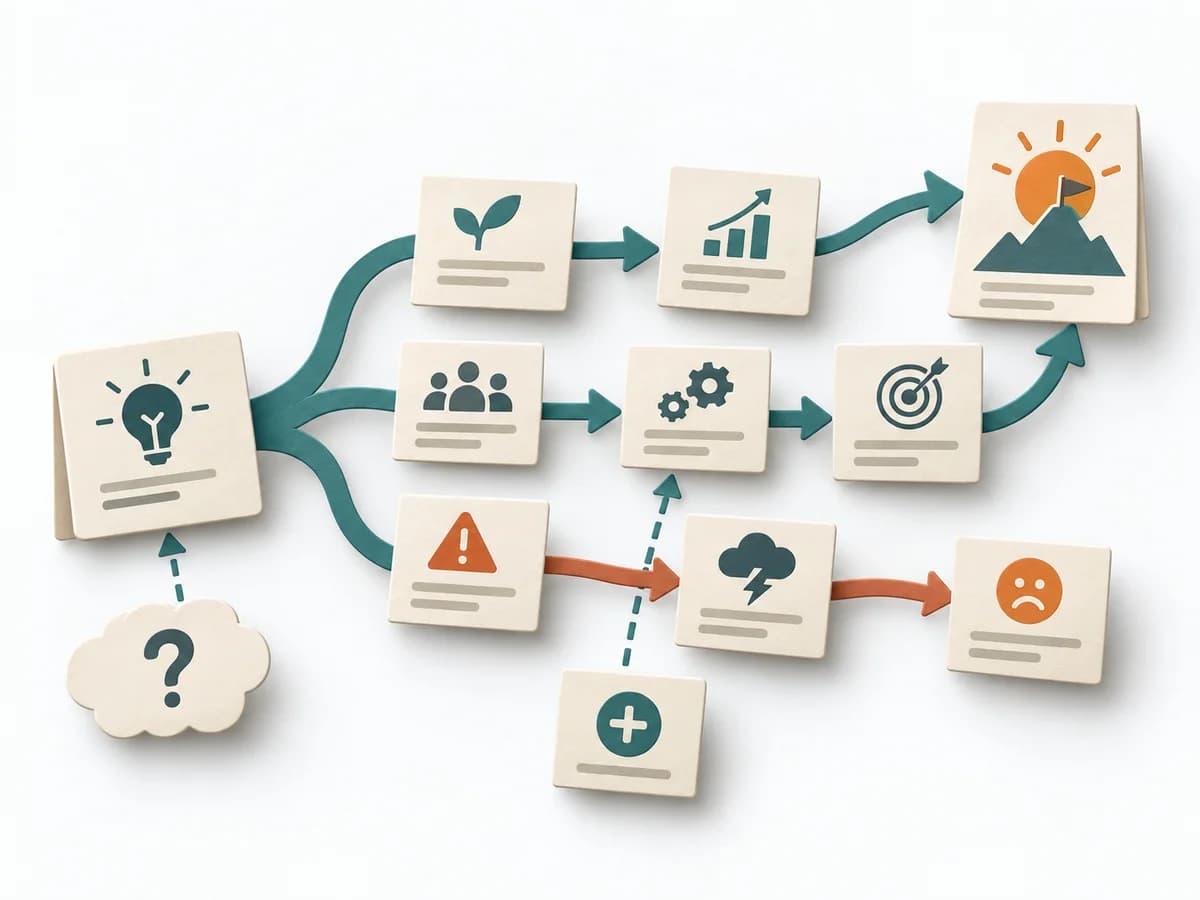 Systems Thinking Future Reality Tree |  Facilitation Stakeholder Salience Model |  Facilitation Power Interest Grid |  Systems Thinking CATWOE Analysis |
|---|---|---|---|---|
Purposedifferent | A Future Reality Tree shows how desired actions are meant to lead to a better system state. The method checks whether a path of change holds together logically before time flows into implementation. | When stakeholders appear to matter very differently, the Stakeholder Salience Model rates their actual priority through power, legitimacy, and urgency. It turns individual contributions into a visible selection. The result is captured as a Salience diagram and a class-based strategy. | When many stakeholders compete for attention at once, the Power Interest Grid sorts them by influence and stake. It turns individual contributions into a visible selection. The result is captured as a Power Interest Grid and a stakeholder-specific strategy. | CATWOE structures a problem from six viewpoints and prevents too narrow a view of the situation. Different experiences of the system become comparably discussable this way. |
Complexitydifferent | High | Medium | Low | Medium |
Timedifferent | 2-4 h | 60-90 min | 30-60 min | 45-90 min |
Participantsdifferent | 3-8 | 3-6 | 2-8 | 3-8 |
Formatdifferent | Workshop | Workshop | Workshop | Workshop + async |
Outputdifferent | Future Reality Tree, Negative Branches, Assumption List, Improved Injections | Salience Diagram, Strategy per Class | Power Interest Grid, Strategy per Stakeholder | CATWOE Canvas, Root Definition, Stakeholder Perspectives, Constraints |
Tagsno overlap | Theory of ConstraintsSystems thinkingChange | StakeholdersFacilitationAlignmentGovernance | StakeholdersFacilitationAlignmentPlanning | Systems thinkingFramingStakeholders |