View methods side by side.
Choose up to four methods. Add them using the search and share the comparison by copying its link.
| Criterion | 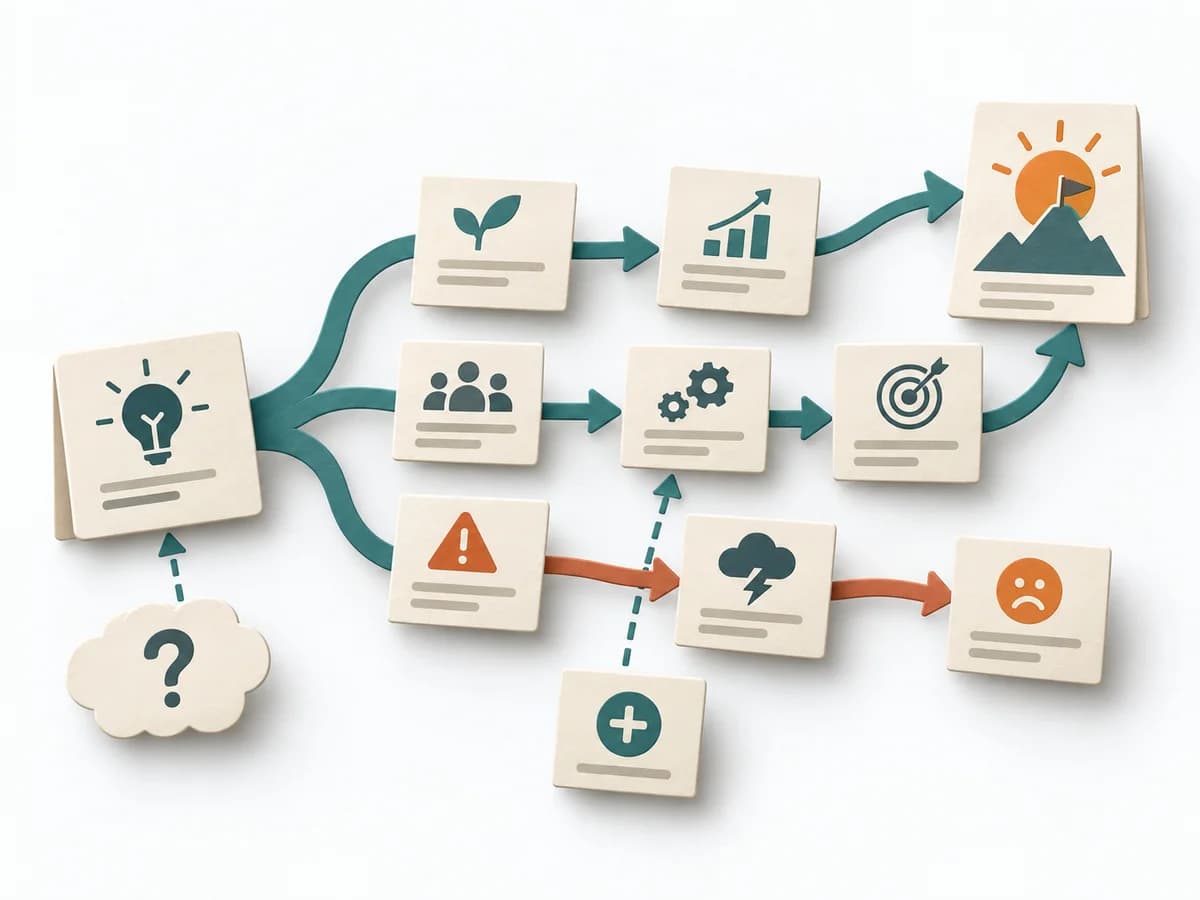 Systems Thinking Future Reality Tree |  Systems Thinking Leverage Points |  Innovation Reverse Brainstorming |  Innovation Rolestorming |
|---|---|---|---|---|
Purposedifferent | A Future Reality Tree shows how desired actions are meant to lead to a better system state. The method checks whether a path of change holds together logically before time flows into implementation. | Leverage Points show exactly where interventions in a system produce a disproportionate effect. It draws relationships, patterns, and feedback loops. The result is captured as a leverage map and action strategy. | For persistent errors or blockages, the method shifts the view to the opposite of the desired effect. It exposes the mechanics of failure and makes hidden causes easier to grasp. This makes improvement more concrete and the problem clearer. | When a search for ideas stalls, switching roles helps people step outside their own perspective and activate new logics of action. The method reduces habit because contributions arise from a different stance. This brings unfamiliar, often fitting solution approaches into play. |
Complexitydifferent | High | High | Low | Low |
Timedifferent | 2-4 h | Half day | 30-60 min | 30-60 min |
Participantsdifferent | 3-8 | 3-12 | 3-12 | 3-12 |
Formatsame | Workshop | Workshop | Workshop | Workshop |
Outputdifferent | Future Reality Tree, Negative Branches, Assumption List, Improved Injections | Leverage Map, Action Strategy | Reverse Ideas, Risk Themes, Solution Ideas | Rollenkarten, Ideenpool pro Rolle, Konsolidierte Shortlist |
Tagsno overlap | Theory of ConstraintsSystems thinkingChange | Systems thinkingChangeStrategy | BrainstormingIdeationCreativityRisk | BrainstormingIdeationCreativity |