View methods side by side.
Choose up to four methods. Add them using the search and share the comparison by copying its link.
| Criterion | 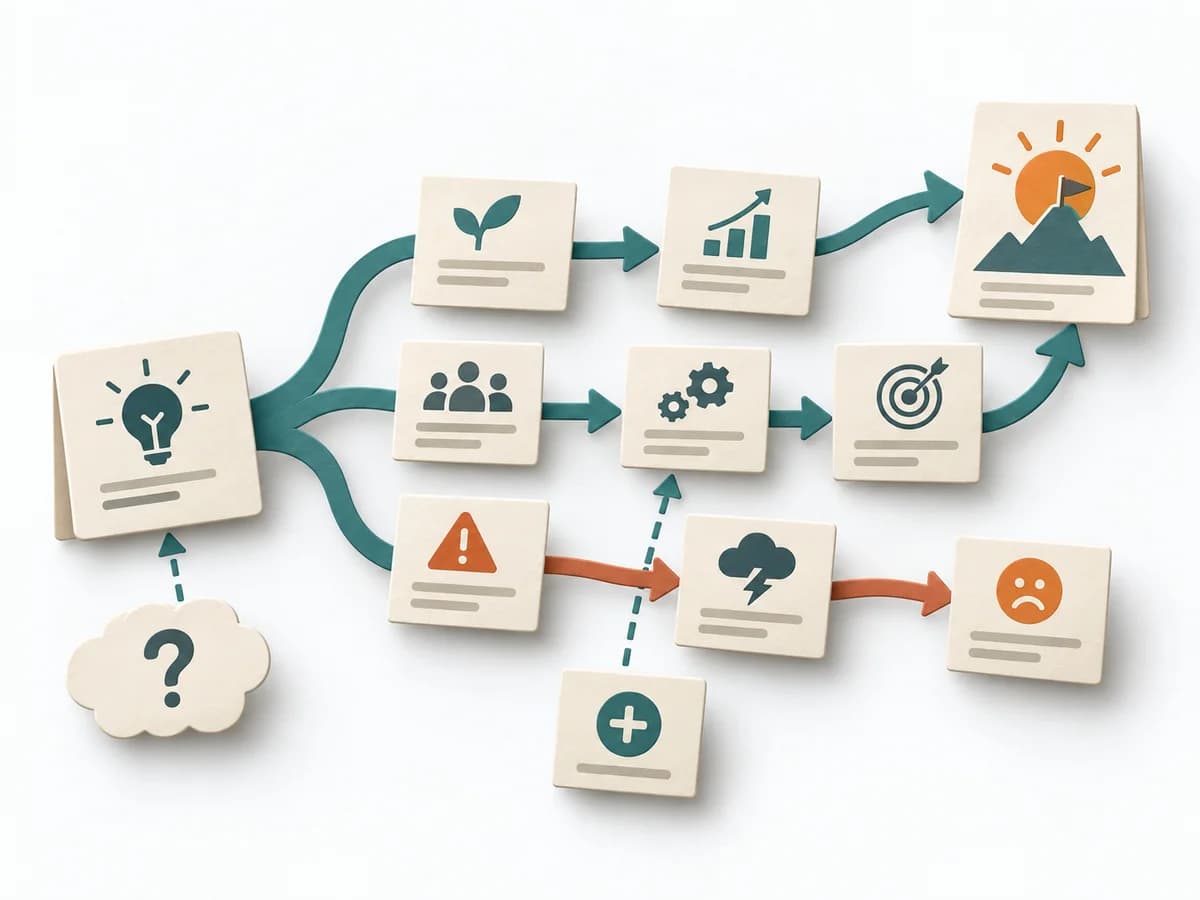 Systems Thinking Future Reality Tree |  Innovation Design Thinking |  Innovation Reverse Brainstorming |  Innovation Lotus Blossom |
|---|---|---|---|---|
Purposedifferent | A Future Reality Tree shows how desired actions are meant to lead to a better system state. The method checks whether a path of change holds together logically before time flows into implementation. | For complex user problems with an uncertain cause, the method connects observation, interpretation, and experiment into a learning cycle. It keeps the focus on real needs and avoids premature solution language. This produces robust decisions for product and service. | For persistent errors or blockages, the method shifts the view to the opposite of the desired effect. It exposes the mechanics of failure and makes hidden causes easier to grasp. This makes improvement more concrete and the problem clearer. | When a central question feels too large, the method breaks it into neighboring topic fields with their own depth of ideation. It holds structure and openness at the same time, so adjacent perspectives don't get lost. This grows an idea space out of a core problem. |
Complexitydifferent | High | High | Low | Low |
Timedifferent | 2-4 h | 1 Tag bis mehrere Wochen | 30-60 min | 45-90 min |
Participantsdifferent | 3-8 | 4-10 | 3-12 | 3-10 |
Formatsame | Workshop | Workshop | Workshop | Workshop |
Outputdifferent | Future Reality Tree, Negative Branches, Assumption List, Improved Injections | Problem Statement, Prototype, Test Learnings | Reverse Ideas, Risk Themes, Solution Ideas | Lotus Diagram, Idea Themes, Shortlist |
Tagsno overlap | Theory of ConstraintsSystems thinkingChange | InnovationPrototypeResearch | BrainstormingIdeationCreativityRisk | BrainstormingIdeationCreativityDivergenceWorkshop |