View methods side by side.
Choose up to four methods. Add them using the search and share the comparison by copying its link.
| Criterion | 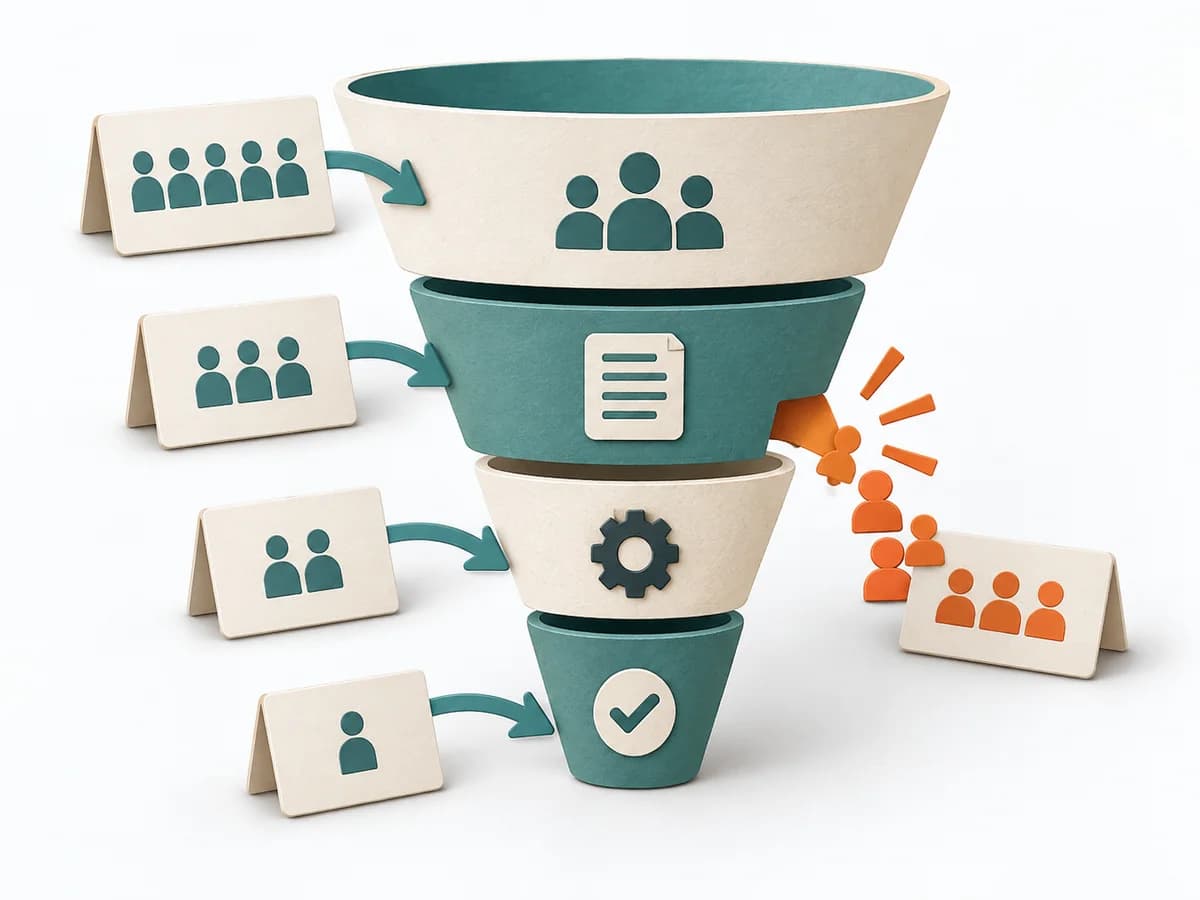 Growth Funnel Analysis |  Growth Hooked Model |  DevOps Blameless Postmortem |  DevOps Incident Command |
|---|---|---|---|---|
Purposedifferent | When many visitors or users drop off along the way, the reason behind the number often stays hidden. Funnel Analysis exposes these transitions and makes visible exactly where the path collapses. | The Hooked Model helps clarify engagement loops, user behavior, and experiments. It makes repeat behavior measurable and captures the result as a hooked loop, trigger map, and reward design. | After an incident with damage or a near miss, the method creates a sober field for learning without assigning blame. It directs attention to the course of events, conditions, and effective countermeasures. | During an acute incident with several people involved, the method creates a clear leadership and communication structure. It reduces chaos when fast coordination and clean situational awareness are both needed at once. |
Complexitysame | Medium | Medium | Medium | Medium |
Timedifferent | 1-3 h | Multiple workshops over several weeks | 30-90 min | As needed |
Participantsdifferent | 1-5 | 2-8 | 3-12 | 4-15 |
Formatdifferent | Async | Workshop + async | Workshop + async | Workshop + async |
Outputdifferent | Funnel report, Drop-off analysis, Optimization hypotheses | Hooked loop, Trigger map, Reward design, Ethics check | Postmortem Doc, Action Items, Timeline | Incident Log, Action Tracker, Stakeholder Updates |
Tagsno overlap | AnalyticsConversionGrowth | GrowthBehaviorRetention | Site Reliability EngineeringIncidentLearningReliability | IncidentOperationsReliability |