View methods side by side.
Choose up to four methods. Add them using the search and share the comparison by copying its link.
| Criterion | 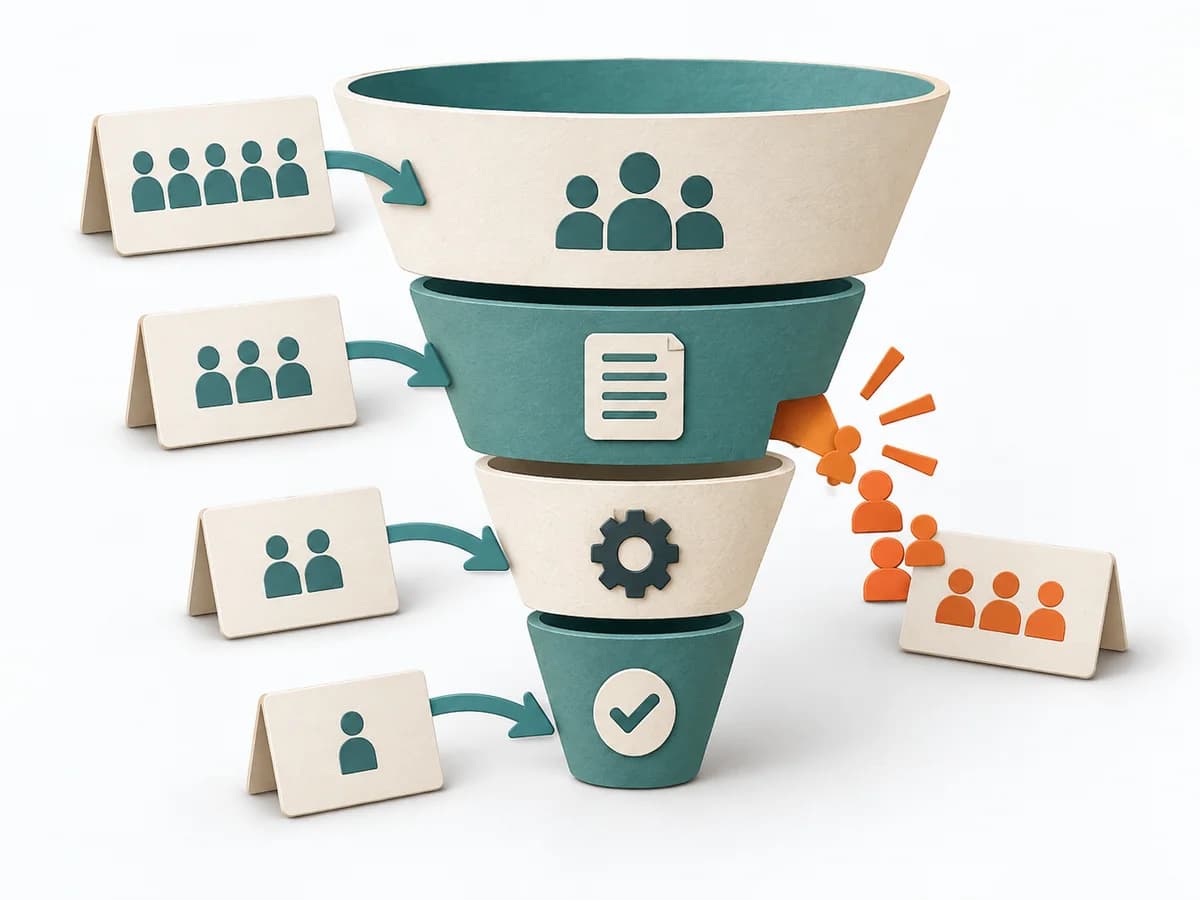 Growth Funnel Analysis |  Growth Flywheel |  Facilitation Alignment Mapping |  Facilitation Stakeholder Salience Model |
|---|---|---|---|---|
Purposedifferent | When many visitors or users drop off along the way, the reason behind the number often stays hidden. Funnel Analysis exposes these transitions and makes visible exactly where the path collapses. | Growth often breaks down where a reinforcing mechanism builds up too much friction. A Flywheel shows the cycle of value, repetition, and reinforcement meant to sustain growth. | When several people work toward one goal but hold different mental maps, Alignment Mapping makes the discrepancies visible. It arranges goals, assumptions, and priorities so shared direction becomes verifiable. | When stakeholders appear to matter very differently, the Stakeholder Salience Model rates their actual priority through power, legitimacy, and urgency. It turns individual contributions into a visible selection. The result is captured as a Salience diagram and a class-based strategy. |
Complexitysame | Medium | Medium | Medium | Medium |
Timedifferent | 1-3 h | 60-120 min | 1-2 h | 60-90 min |
Participantsdifferent | 1-5 | 3-8 | 4-12 | 3-6 |
Formatdifferent | Async | Workshop | Workshop | Workshop |
Outputdifferent | Funnel report, Drop-off analysis, Optimization hypotheses | Flywheel Map, Friction Points, Growth Levers, Experiment Backlog | Alignment Map, Open Issues, Decision Questions | Salience Diagram, Strategy per Class |
Tagsno overlap | AnalyticsConversionGrowth | GrowthRetentionConversion | AlignmentStakeholdersStrategyFacilitation | StakeholdersFacilitationAlignmentGovernance |