View methods side by side.
Choose up to four methods. Add them using the search and share the comparison by copying its link.
| Criterion |  Decision Making Force Field Analysis |  Business Strategy McKinsey 7S |  Decision Making Risk Matrix | 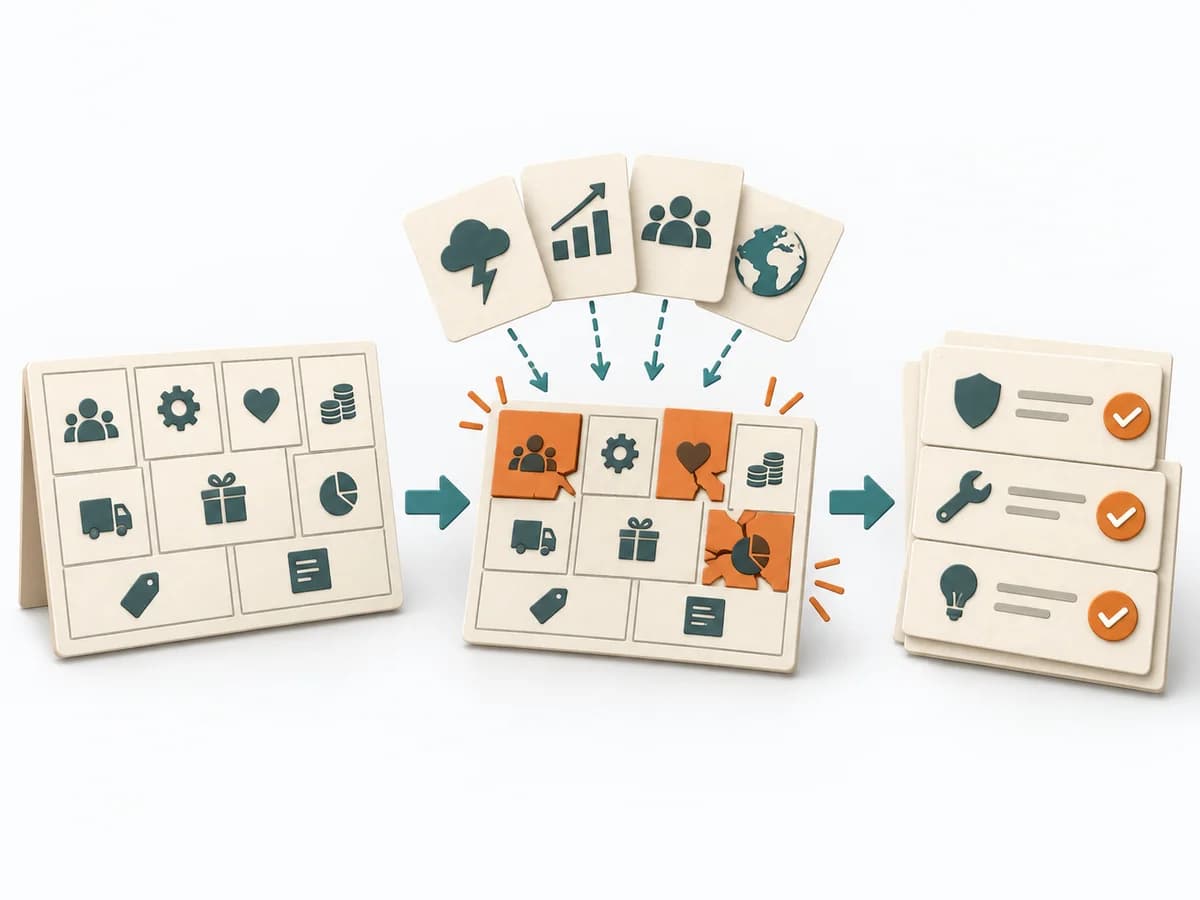 Business Strategy Business Model Stress Test |
|---|---|---|---|---|
Purposedifferent | In change initiatives, supporting and restraining forces sit at the table at the same time. Force Field Analysis makes these tensions explicit and shows where change can be pushed forward by strengthening or relieving. | McKinsey 7S checks whether Strategy, Structure, Systems, Shared Values, Skills, Style, and Staff fit together. Organizational misalignments become visible across multiple levers as a result. | When a project faces many possible disruptions, it quickly becomes unclear which risks deserve attention first. It separates options, evaluation criteria, and open risks. The result is captured as a Risk Matrix and a Top Risk List. | A Business Model Stress Test checks how well a business model holds up under pressure and headwinds. It compares strengths, risks, market logic, and courses of action. The result is captured as a stress-test report and action plan per scenario. |
Complexitydifferent | Low | Medium | Low | High |
Timedifferent | 45-90 min | 2-4 h | 30-60 min | Half day |
Participantsdifferent | 3-12 | 3-12 | 3-10 | 3-8 |
Formatdifferent | Workshop | Workshop | Workshop + async | Workshop |
Outputdifferent | Force Field Map, Change Levers, Risk Notes | 7S Assessment, Alignment Gaps, Change Actions | Risk Matrix, Top Risk List | Stress Test Report, Action Plan per Scenario |
Tagsno overlap | ChangeDecisionStrategy | OrganizationStrategyAlignmentChange | RiskDecisionPrioritizationAssessment | StrategyBusiness modelRiskDiagnosis |