View methods side by side.
Choose up to four methods. Add them using the search and share the comparison by copying its link.
| Criterion |  Decision Making Force Field Analysis | 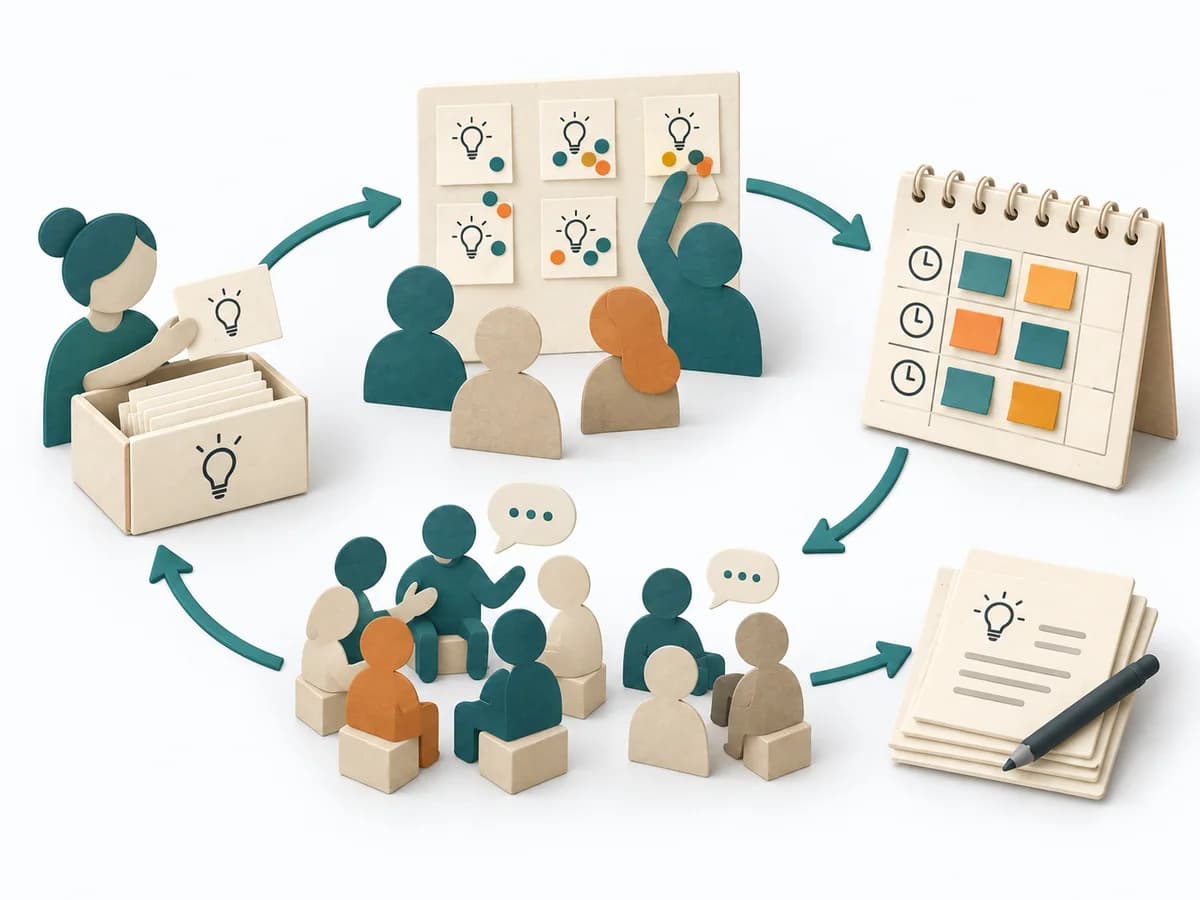 Facilitation Barcamp |  Facilitation Nominal Group Technique |  Decision Making OODA Loop |
|---|---|---|---|---|
Purposedifferent | In change initiatives, supporting and restraining forces sit at the table at the same time. Force Field Analysis makes these tensions explicit and shows where change can be pushed forward by strengthening or relieving. | When many people can contribute knowledge and the flow should stay open, Barcamp provides a framework for self-organized sessions. The format channels energy without defining the content too narrowly in advance. | When loud voices could dominate a round, Nominal Group Technique protects individual thinking time from group effects. It collects ideas separately first and only then enables shared weighting. | In dynamic situations, decisions become outdated faster than they can be prepared. The OODA Loop holds observing, orienting, deciding, and acting together as a recurring rhythm so reaction does not slide into inertia. |
Complexitydifferent | Low | Medium | Medium | Medium |
Timedifferent | 45-90 min | Halber Tag bis 2 Tage | 60-120 min | 15-60 min je Zyklus |
Participantsdifferent | 3-12 | 15-200 | 5-12 | 1-8 |
Formatdifferent | Workshop | Workshop | Workshop | Workshop + async |
Outputdifferent | Force Field Map, Change Levers, Risk Notes | Session Board, Session Notes, Community Learnings | Ranked Ideas, Clarified Options, Group Priority | Situation Assessment, Decision Loop, Action Updates |
Tagsno overlap | ChangeDecisionStrategy | FacilitationLarge groupLearning | FacilitationPrioritizationVotingInclusion | DecisionChangeLearningStrategy |