View methods side by side.
Choose up to four methods. Add them using the search and share the comparison by copying its link.
| Criterion |  Growth Flywheel |  Delivery MoSCoW |  Decision Making Constraint Analysis | 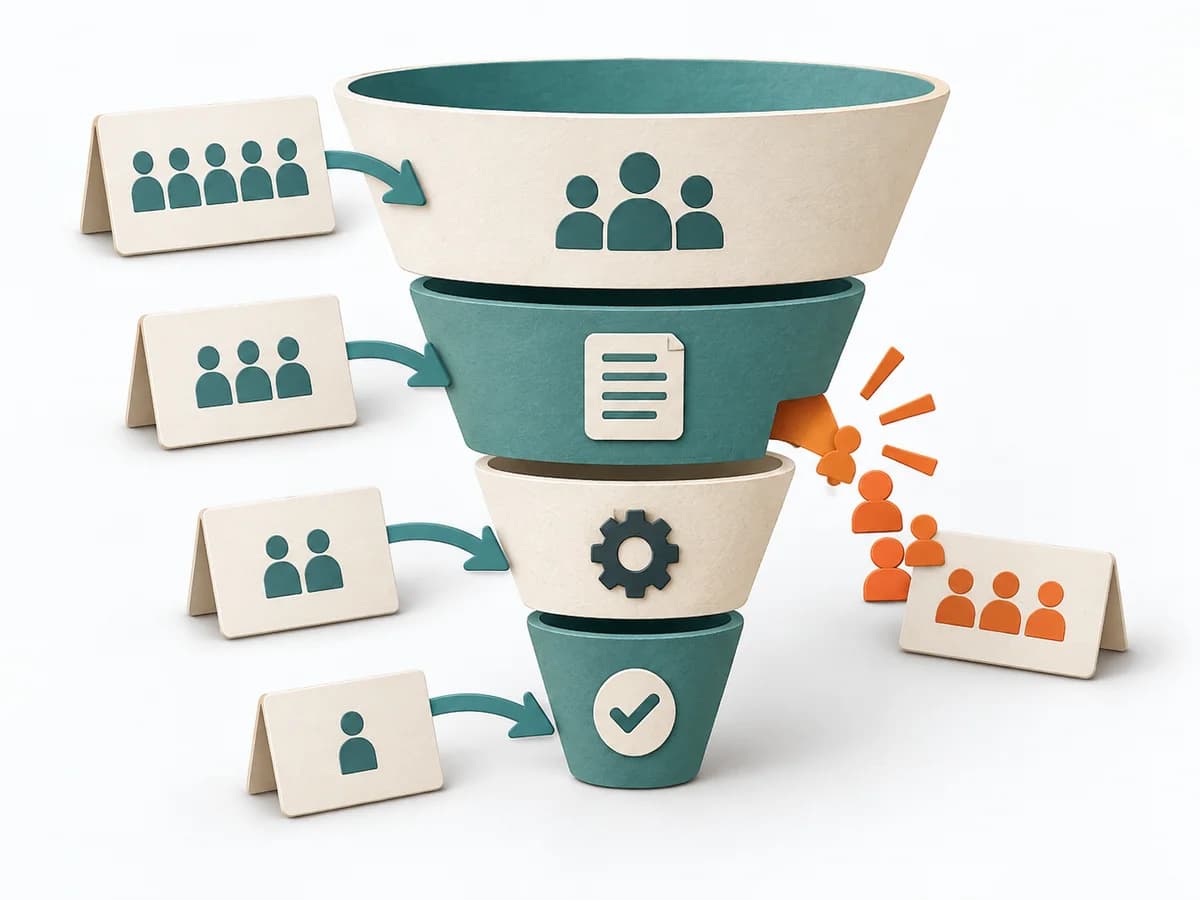 Growth Funnel Analysis |
|---|---|---|---|---|
Purposedifferent | Growth often breaks down where a reinforcing mechanism builds up too much friction. A Flywheel shows the cycle of value, repetition, and reinforcement meant to sustain growth. | When a release carries too many demands and priorities are only ever negotiated, MoSCoW creates clear boundaries for the next cut. Must, Should, Could, and Won't make commitment, room for maneuver, and trade-off logic visible to everyone involved. | When an initiative stalls, the limit often lies not in the idea but in hard or soft boundary conditions. Constraint Analysis separates these limits and shows which of them can actually be shaped. | When many visitors or users drop off along the way, the reason behind the number often stays hidden. Funnel Analysis exposes these transitions and makes visible exactly where the path collapses. |
Complexitydifferent | Medium | Low | Low | Medium |
Timedifferent | 60-120 min | 30-90 min | 30-90 min | 1-3 h |
Participantsdifferent | 3-8 | 3-12 | 2-8 | 1-5 |
Formatdifferent | Workshop | Workshop + async | Workshop + async | Async |
Outputdifferent | Flywheel Map, Friction Points, Growth Levers, Experiment Backlog | Prioritized Backlog, Release Scope, Tradeoff Notes | Constraint List, Hard/Soft Classification, Option Impact Notes, Decision Boundaries | Funnel report, Drop-off analysis, Optimization hypotheses |
Tagsno overlap | GrowthRetentionConversion | PrioritizationScopeDecision | ConstraintsDecisionPlanningOptions | AnalyticsConversionGrowth |