View methods side by side.
Choose up to four methods. Add them using the search and share the comparison by copying its link.
| Criterion |  Growth Flywheel |  Growth Hooked Model | 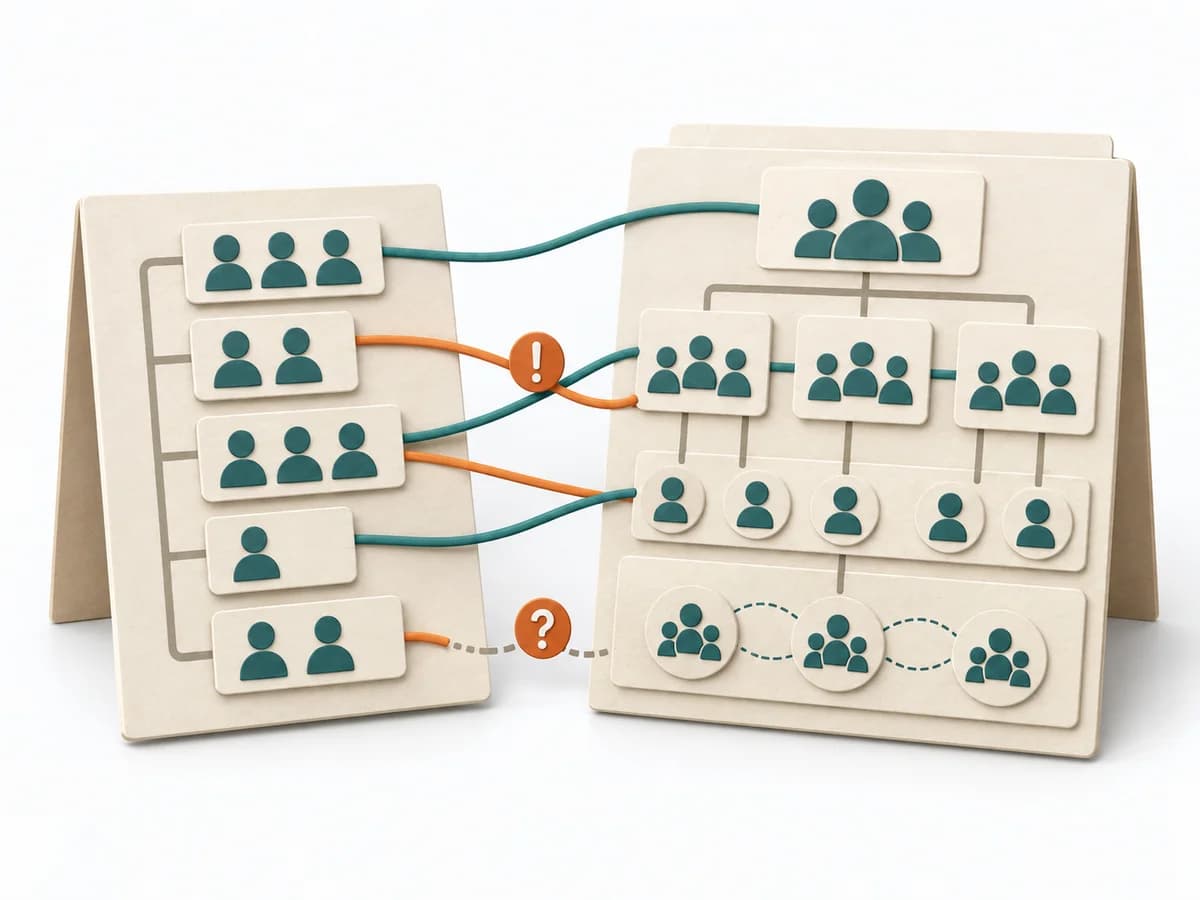 Team Design Spotify Model Mapping |  Team Design Team Topologies Interaction Modes |
|---|---|---|---|---|
Purposedifferent | Growth often breaks down where a reinforcing mechanism builds up too much friction. A Flywheel shows the cycle of value, repetition, and reinforcement meant to sustain growth. | The Hooked Model helps clarify engagement loops, user behavior, and experiments. It makes repeat behavior measurable and captures the result as a hooked loop, trigger map, and reward design. | When a team landscape has grown without clear grouping, it maps roles and relationships onto the Spotify model. It clarifies responsibility, interaction, and load between teams. The result is captured as a Spotify model map and action list. | When several teams collaborate repeatedly, it describes the right interaction mode for each interface between them. It clarifies responsibility, interaction, and load between teams. The result is captured as an interaction heat map and pairwise agreements. |
Complexitysame | Medium | Medium | Medium | Medium |
Timedifferent | 60-120 min | Multiple workshops over several weeks | 90-180 min | Half day |
Participantsdifferent | 3-8 | 2-8 | 5-15 | Team-Leads plus Architecture |
Formatdifferent | Workshop | Workshop + async | Workshop | Workshop |
Outputdifferent | Flywheel Map, Friction Points, Growth Levers, Experiment Backlog | Hooked loop, Trigger map, Reward design, Ethics check | Spotify Model Map, Action List | Interaction Heat Map, Agreements per Pair |
Tagsno overlap | GrowthRetentionConversion | GrowthBehaviorRetention | TeamOrganizationAlignmentDiagnosis | TeamAlignmentCollaborationOrganization |