View methods side by side.
Choose up to four methods. Add them using the search and share the comparison by copying its link.
| Criterion |  Growth Flywheel |  Operations Failure Mode and Effects Analysis | 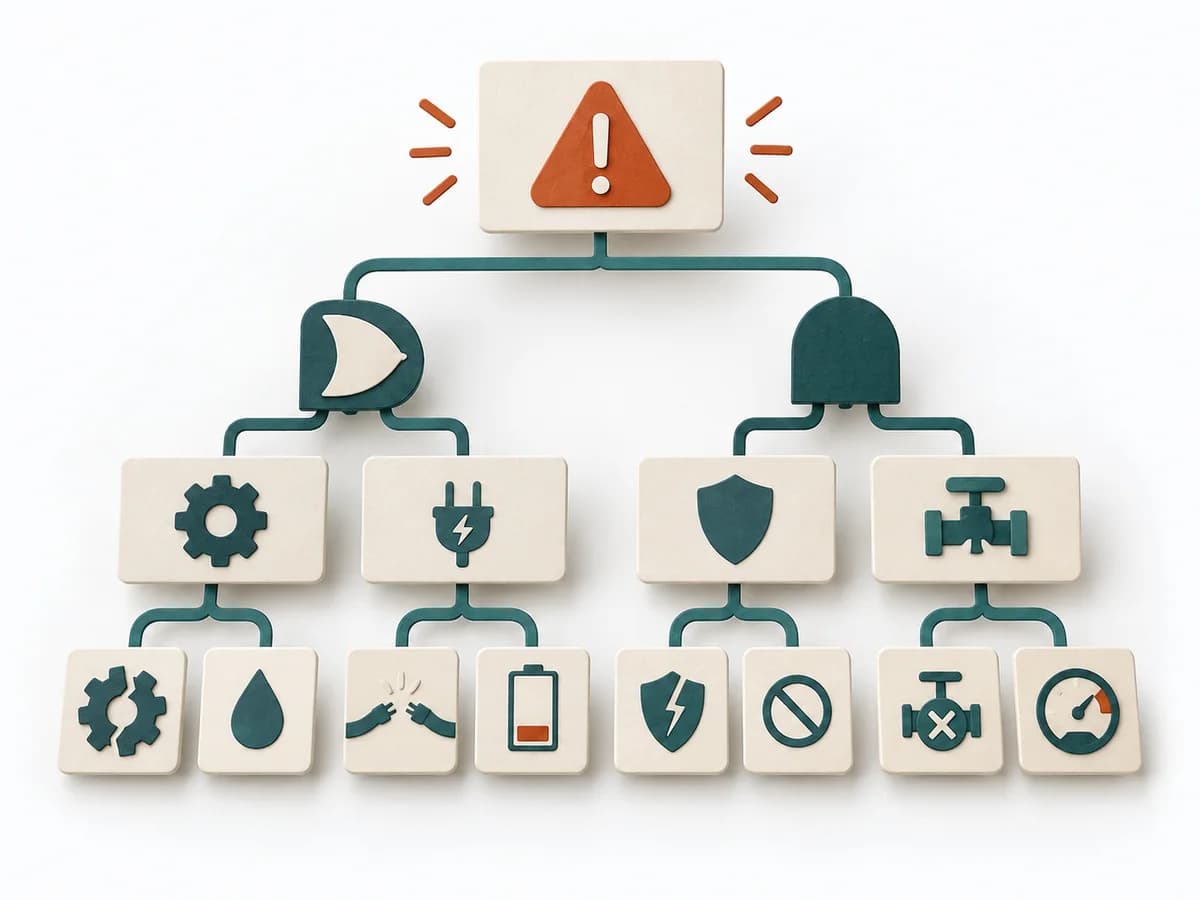 Operations Fault Tree Analysis |  Growth Funnel Analysis |
|---|---|---|---|---|
Purposedifferent | Growth often breaks down where a reinforcing mechanism builds up too much friction. A Flywheel shows the cycle of value, repetition, and reinforcement meant to sustain growth. | For a process, product, or service with noticeable failure risks, the method assesses possible failure modes in advance. It directs attention to combinations of occurrence, effect, and detectability. | For a critical top event with several possible triggers, the method logically models failure paths. It makes visible which combinations of conditions can lead to damage. | When many visitors or users drop off along the way, the reason behind the number often stays hidden. Funnel Analysis exposes these transitions and makes visible exactly where the path collapses. |
Complexitydifferent | Medium | High | High | Medium |
Timedifferent | 60-120 min | 2-6 h | 2-6 h | 1-3 h |
Participantsdifferent | 3-8 | 3-10 | 3-8 | 1-5 |
Formatdifferent | Workshop | Workshop | Workshop + async | Async |
Outputdifferent | Flywheel Map, Friction Points, Growth Levers, Experiment Backlog | FMEA Table, Risk Priority, Mitigation Actions | Fault Tree, Critical Paths, Cause Hypotheses, Control Actions | Funnel report, Drop-off analysis, Optimization hypotheses |
Tagsno overlap | GrowthRetentionConversion | RiskQualityOperationsRoot cause | RiskRoot causeSafety | AnalyticsConversionGrowth |