View methods side by side.
Choose up to four methods. Add them using the search and share the comparison by copying its link.
| Criterion | 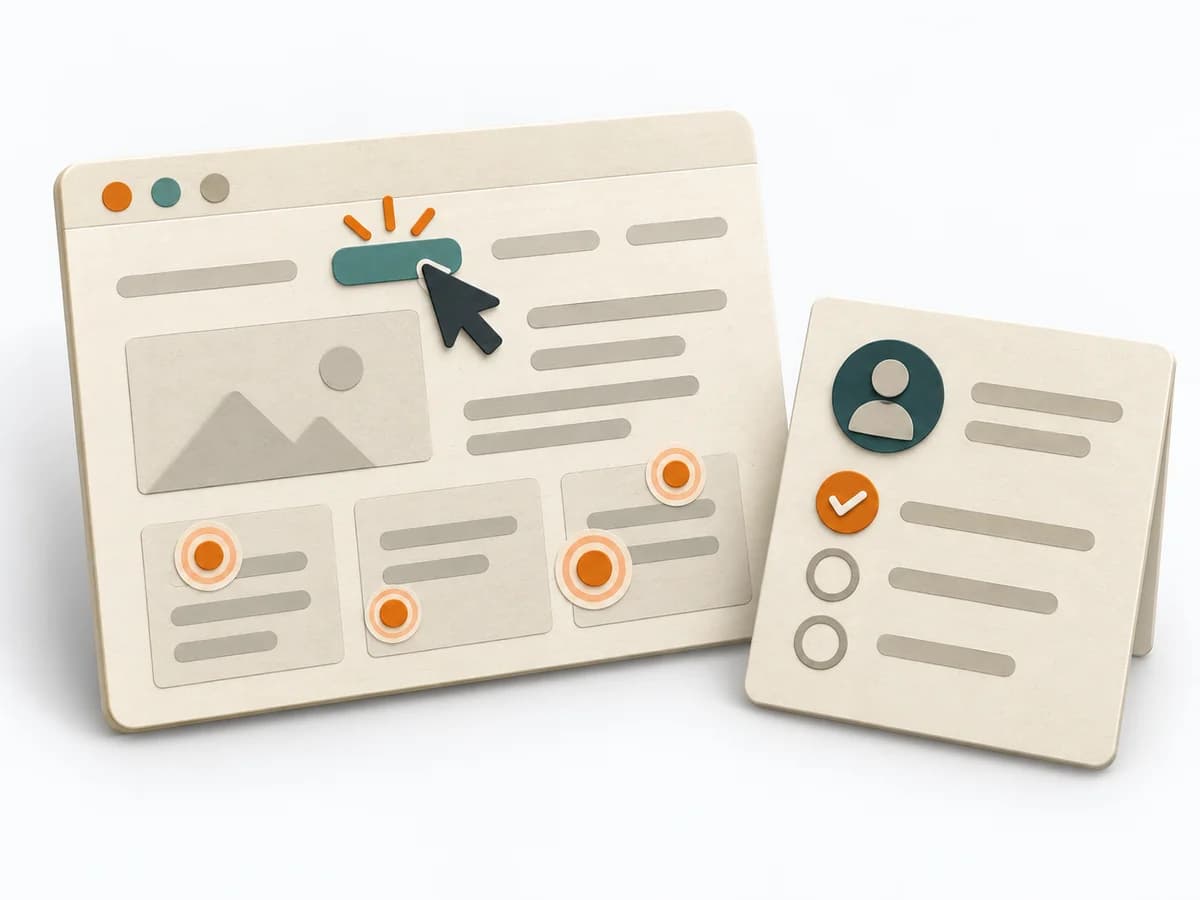 UX Research First-click Testing |  Product Discovery Assumption Mapping |  Operations Fault Tree Analysis |  Growth A/B Testing |
|---|---|---|---|---|
Purposedifferent | When users immediately turn the wrong way on a screen or wireframe, first click testing checks initial orientation at high speed. The first click shows early whether expectation, labeling, and wayfinding fit together. | When assumptions still sit unordered in the room, it weighs uncertainty against leverage. It makes visible which hypotheses should be checked first. | For a critical top event with several possible triggers, the method logically models failure paths. It makes visible which combinations of conditions can lead to damage. | When two variants compete, discussions quickly decide by taste rather than effect. A/B Testing checks behavior under controlled conditions and separates real improvement from chance or expectation effects. |
Complexitydifferent | Low | Medium | High | High |
Timedifferent | 1-2 Tage | 45-60 min | 2-6 h | 1-4 Wochen |
Participantsdifferent | 10-30 | 2-8 | 3-8 | 1-6 |
Formatdifferent | Async | Workshop + async | Workshop + async | Async |
Outputdifferent | Click Heatmap, Success Rate, Design Recommendations | Assumption map, Test backlog, Risk ranking | Fault Tree, Critical Paths, Cause Hypotheses, Control Actions | Experiment results, Decision log, Learning summary |
Tagsno overlap | UXNavigationFindabilityValidation | AssumptionsRiskExperimentsValidation | RiskRoot causeSafety | ExperimentsGrowthAnalyticsValidation |