View methods side by side.
Choose up to four methods. Add them using the search and share the comparison by copying its link.
| Criterion |  Knowledge Modeling Feynman Technique | 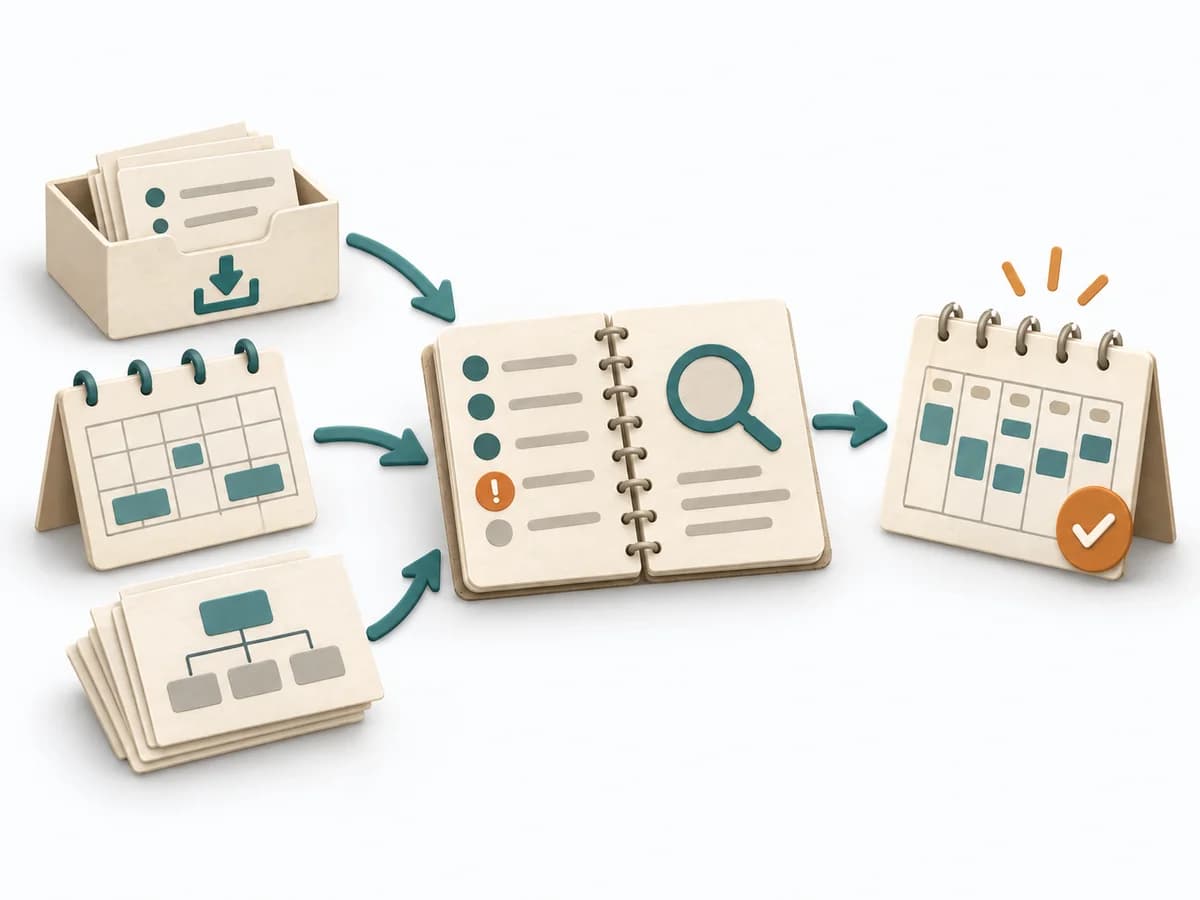 Operations Weekly Review |  Knowledge Modeling IBIS |  Decision Making Constraint Analysis |
|---|---|---|---|---|
Purposedifferent | The Feynman Technique checks understanding by explaining a topic so that it stays easy for others to understand. It makes knowledge gaps visible before they become costly in everyday work. | In a week with many open loops, the method creates distance from operational noise. It organizes commitments, calendar, and projects so the next week becomes workable. | IBIS structures thinking about complex questions as a sequence of issues, ideas, and arguments. The method keeps discussions open without forcing them into premature consensus. | When an initiative stalls, the limit often lies not in the idea but in hard or soft boundary conditions. Constraint Analysis separates these limits and shows which of them can actually be shaped. |
Complexitydifferent | Low | Low | Medium | Low |
Timedifferent | 20-60 min | 30-60 min | 1-3 h | 30-90 min |
Participantsdifferent | 1 | 1 | 2-8 | 2-8 |
Formatdifferent | Async | Async | Workshop + async | Workshop + async |
Outputdifferent | Plain-language Explanation, Knowledge Gaps, Study Notes | Updated Task System, Weekly Focus, Next Actions | Issue Map, Positions, Argument Notes | Constraint List, Hard/Soft Classification, Option Impact Notes, Decision Boundaries |
Tagsno overlap | LearningKnowledgeUnderstanding | ProductivityExecutionPlanning | RationaleKnowledgeDecision | ConstraintsDecisionPlanningOptions |