View methods side by side.
Choose up to four methods. Add them using the search and share the comparison by copying its link.
| Criterion |  Knowledge Modeling Feynman Technique |  Architecture ARID (Active Reviews for Intermediate Designs) | 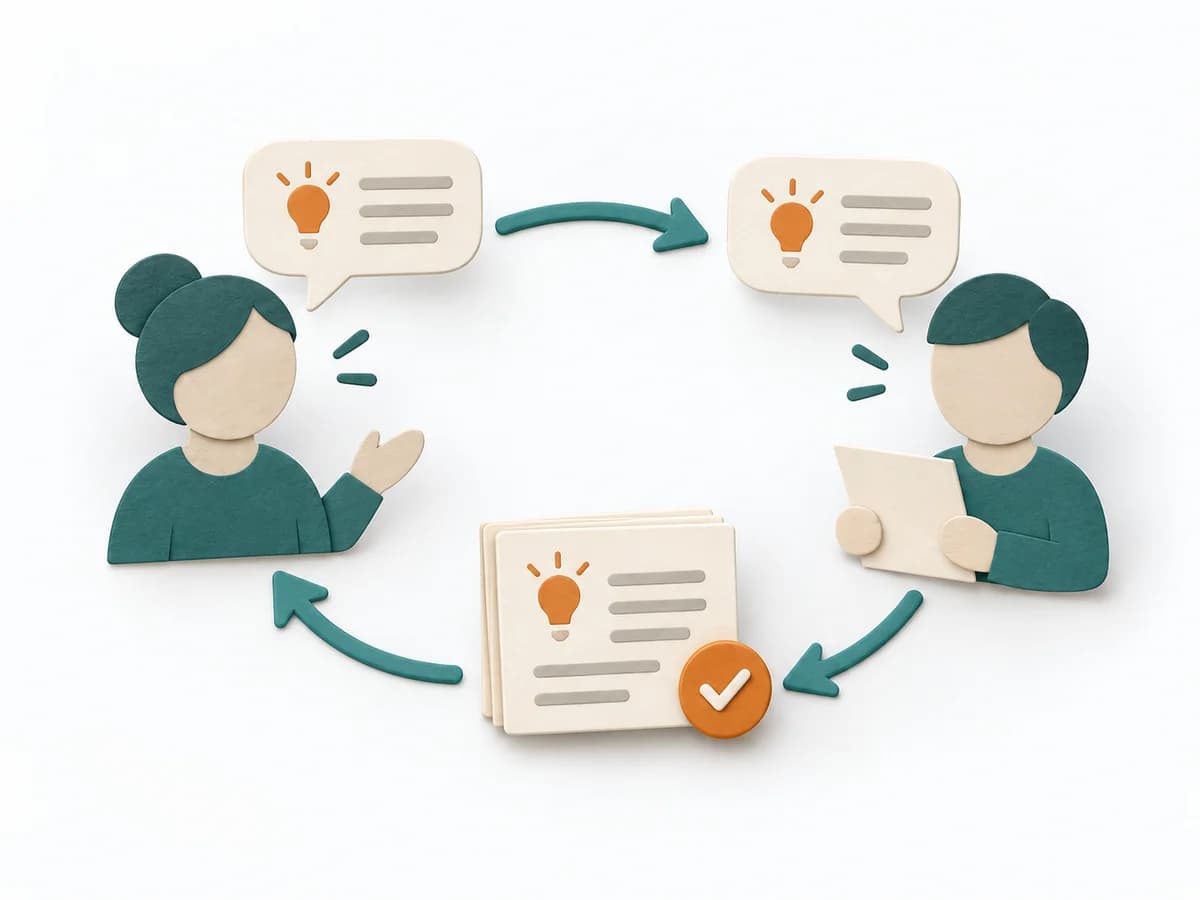 Knowledge Modeling Teach-back |  Architecture C4 Model |
|---|---|---|---|---|
Purposedifferent | The Feynman Technique checks understanding by explaining a topic so that it stays easy for others to understand. It makes knowledge gaps visible before they become costly in everyday work. | ARID examines how well developers can work with a technical design. It focuses on a part of the system that can still be revised, between the architecture overview and the detailed specification. | Teach-back checks whether an explanation actually got through to the other person. The method makes misunderstandings visible early and strengthens shared understanding in advisory and learning situations. | The C4 Model makes a system legible across several resolution levels, from context down to code. It suits situations where different audiences need to understand the same architecture from different altitudes. |
Complexitydifferent | Low | Medium | Low | Low |
Timedifferent | 20-60 min | 2–4 h review as a planning range; preparation and evaluation additional | 5-20 min | 1-4 h |
Participantsdifferent | 1 | Designers, developers as users, and facilitation | 2-8 | 1-5 |
Formatdifferent | Async | Workshop + async | Workshop + async | Workshop + async |
Outputdifferent | Plain-language Explanation, Knowledge Gaps, Study Notes | Prioritized development tasks, Jointly produced code or pseudocode, Observed difficulties and open design questions, Proposed design revisions | Understanding Check, Clarification Notes, Learning Gaps | Context Diagram, Container Diagram, Component Diagram |
Tagsno overlap | LearningKnowledgeUnderstanding | ArchitectureEngineeringFeedbackValidationTasks | LearningUnderstandingCommunication | ArchitectureCommunicationVisualization |