View methods side by side.
Choose up to four methods. Add them using the search and share the comparison by copying its link.
| Criterion | 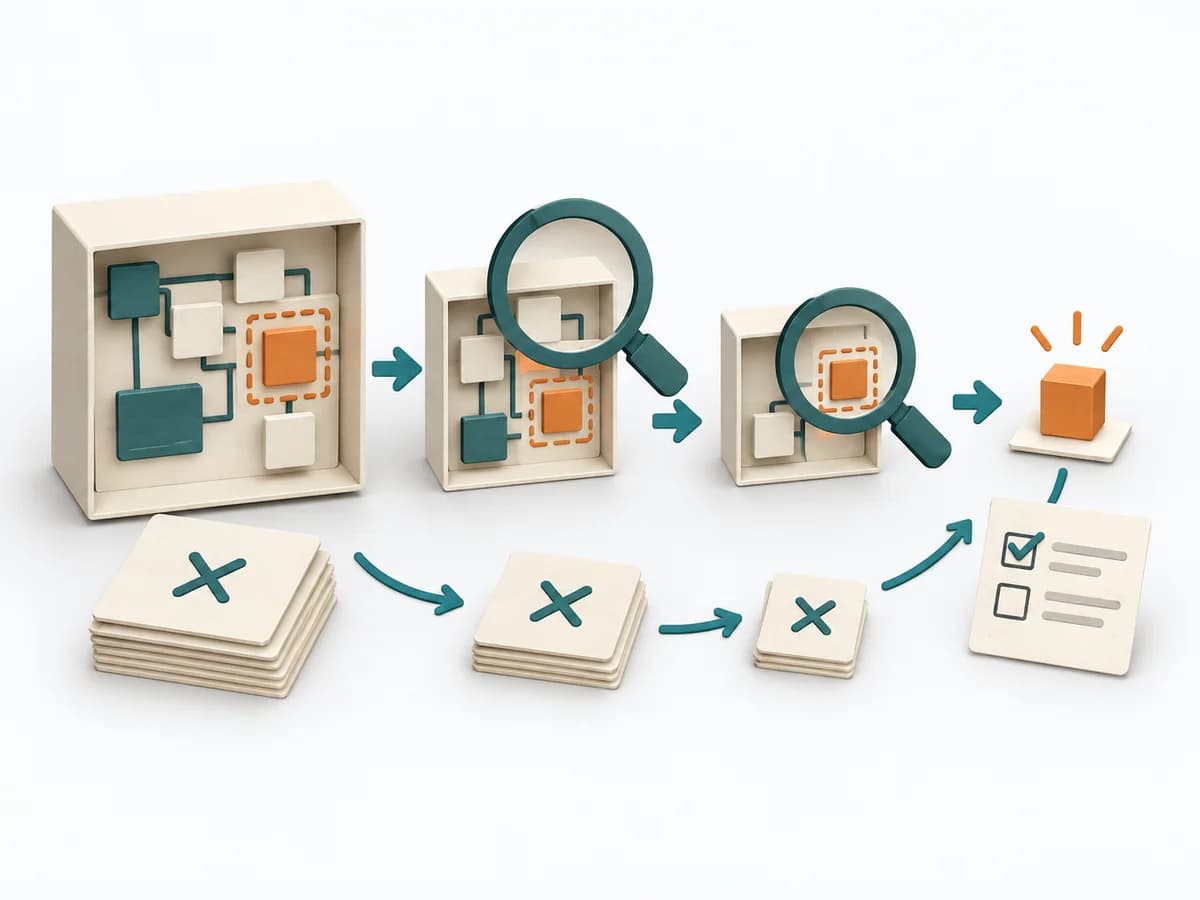 Engineering Fault Isolation |  Engineering Hypothesis-Driven Troubleshooting |  Product Discovery Fake Door Test |  Product Discovery Learning Card |
|---|---|---|---|---|
Purposedifferent | In technical failures, the visible symptom often gets mixed up with the actual cause. Fault Isolation narrows the fault space and progressively reduces which part of the system is truly affected. | When systems fail unexpectedly, spontaneous attempts often produce more noise than insight. Hypothesis-driven Troubleshooting translates symptoms into testable assumptions and makes troubleshooting learnable. | When demand is still unclear, it measures interest in a feature before it is built. It separates real behavior from polite agreement and deliberately keeps build effort small. | The Learning Card connects traceable test results to a reasoned next action while keeping the limits of the insight visible. |
Complexitydifferent | Medium | Medium | Medium | Low |
Timedifferent | 30-180 min | 30-240 min | 1-5 Tage | 25-40 min |
Participantsdifferent | 1-6 | 1-6 | Nutzertraffic | 1-5 |
Formatdifferent | Workshop + async | Workshop + async | Async | Workshop + async |
Outputdifferent | Fault Isolation Map, Test Log, Excluded Hypotheses, Narrowed Fault Area | Hypothesis Log, Test Plan, Evidence Notes, Diagnosis Summary | Click Data, Interest Signal, Learning Decision | Learning Card with evidence and next action |
Tagsno overlap | TroubleshootingDiagnosisEngineering | TroubleshootingProblem solvingDiagnosis | ValidationExperimentsDemandDiscovery | ExperimentsValidationDiscoveryLearning |