View methods side by side.
Choose up to four methods. Add them using the search and share the comparison by copying its link.
| Criterion | 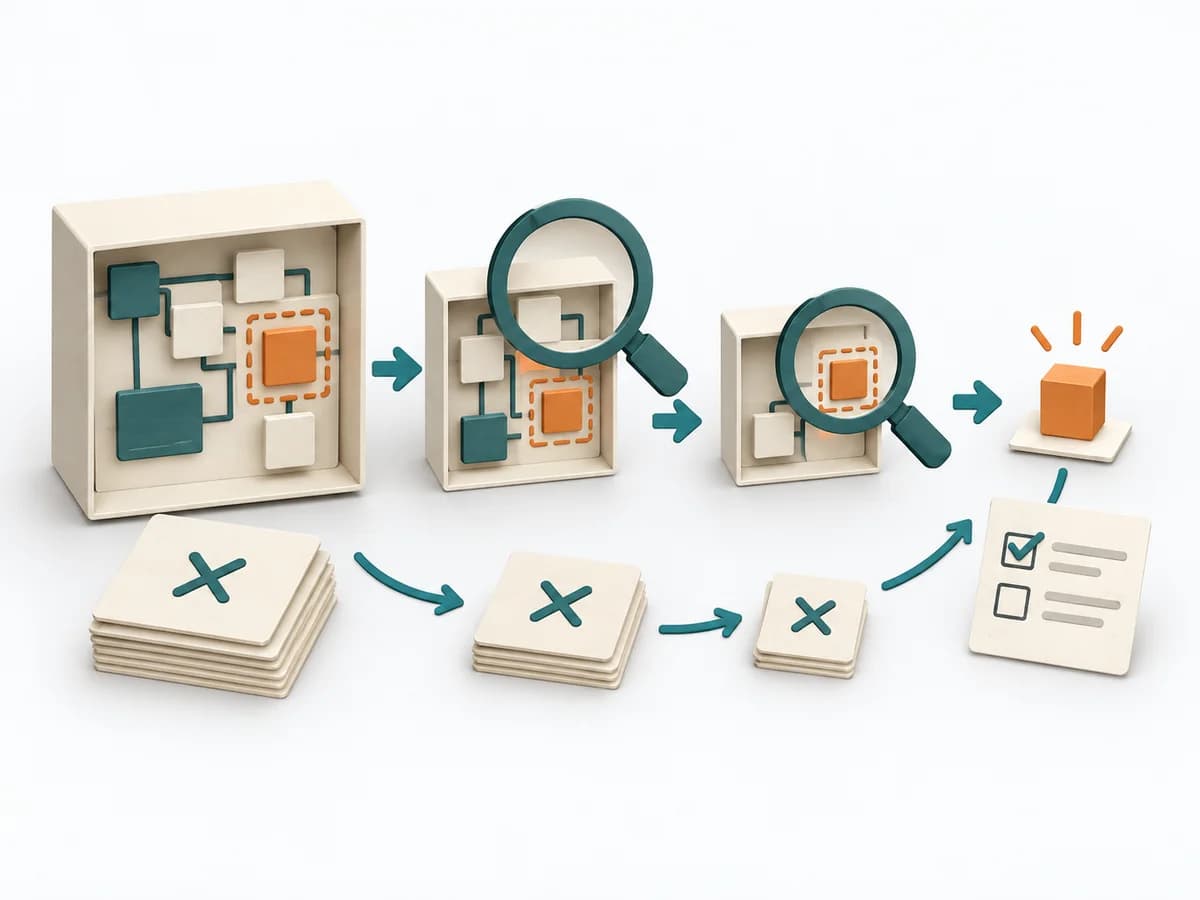 Engineering Fault Isolation |  Decision Making Force Field Analysis |  Operations Change Analysis |  Product Strategy DIBB |
|---|---|---|---|---|
Purposedifferent | In technical failures, the visible symptom often gets mixed up with the actual cause. Fault Isolation narrows the fault space and progressively reduces which part of the system is truly affected. | In change initiatives, supporting and restraining forces sit at the table at the same time. Force Field Analysis makes these tensions explicit and shows where change can be pushed forward by strengthening or relieving. | For a deviation after a change, the method isolates the influence of the altered condition. It narrows down which differences are relevant and which are just accompanying noise. | DIBB helps clarify target groups, value, goals, and priorities by making the logic behind a decision explicit. It captures results as a DIBB document, belief list, bet list, and learning report. |
Complexitydifferent | Medium | Low | Medium | Low |
Timedifferent | 30-180 min | 45-90 min | 45-120 min | 1-2 h |
Participantsdifferent | 1-6 | 3-12 | 2-6 | 2-8 |
Formatdifferent | Workshop + async | Workshop | Workshop + async | Workshop + async |
Outputdifferent | Fault Isolation Map, Test Log, Excluded Hypotheses, Narrowed Fault Area | Force Field Map, Change Levers, Risk Notes | Change Matrix, Cause Hypotheses, Validation Questions, Action List | DIBB document, Belief list, Bet list, Learning report |
Tagsno overlap | TroubleshootingDiagnosisEngineering | ChangeDecisionStrategy | ChangeRoot causeTroubleshootingComparison | StrategyDecisionAssumptionsHypothesis |