View methods side by side.
Choose up to four methods. Add them using the search and share the comparison by copying its link.
| Criterion |  Product Discovery Fake Door Test |  Product Discovery Learning Card |  Knowledge Modeling Linked Open Terms | 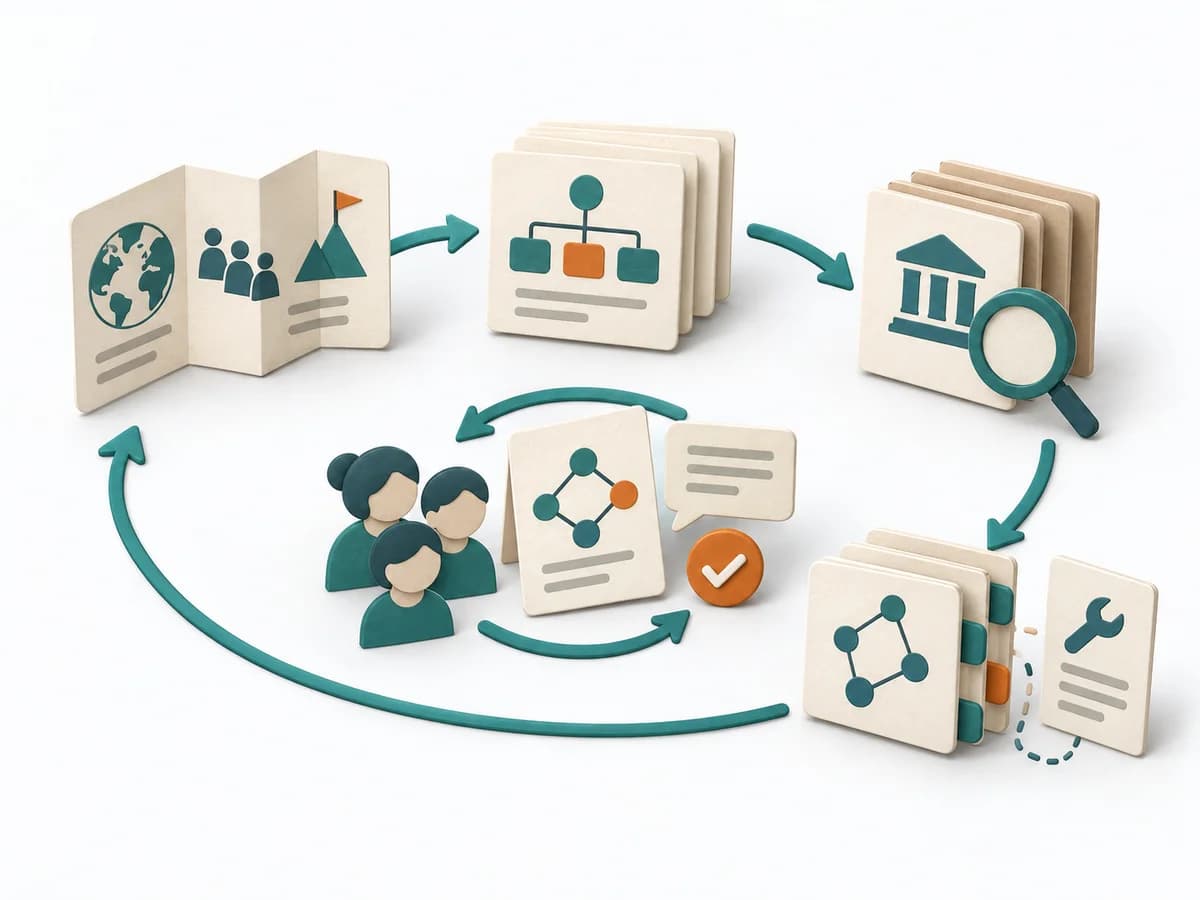 Knowledge Modeling NeOn Methodology |
|---|---|---|---|---|
Purposedifferent | When demand is still unclear, it measures interest in a feature before it is built. It separates real behavior from polite agreement and deliberately keeps build effort small. | The Learning Card connects traceable test results to a reasoned next action while keeping the limits of the insight visible. | Linked Open Terms connects terminology work with linked-data thinking and makes terminology technically connectable. Vocabulary, meanings, and references can thereby be maintained consistently. | The NeOn Methodology structures ontology work as a controlled process with reuse, scenarios, and reviews. It is useful when ontologies should not emerge ad hoc but modularly and reusably. |
Complexitydifferent | Medium | Low | Medium | High |
Timedifferent | 1-5 Tage | 25-40 min | Wochen bis Monate | Mehrere Wochen bis Monate |
Participantsdifferent | Nutzertraffic | 1-5 | 2-8 | 2-10 |
Formatdifferent | Async | Workshop + async | Workshop + async | Workshop + async |
Outputdifferent | Click Data, Interest Signal, Learning Decision | Learning Card with evidence and next action | Ontology Requirements, Conceptual Model, Published Ontology, Documentation, Maintenance Plan | Ontology Requirements Specification, Reuse Plan, Ontology Modules, Evaluation Report |
Tagsno overlap | ValidationExperimentsDemandDiscovery | ExperimentsValidationDiscoveryLearning | OntologyMethodologyAgileSemantic | OntologyMethodologyReuseSemanticEngineering |