View methods side by side.
Choose up to four methods. Add them using the search and share the comparison by copying its link.
| Criterion | 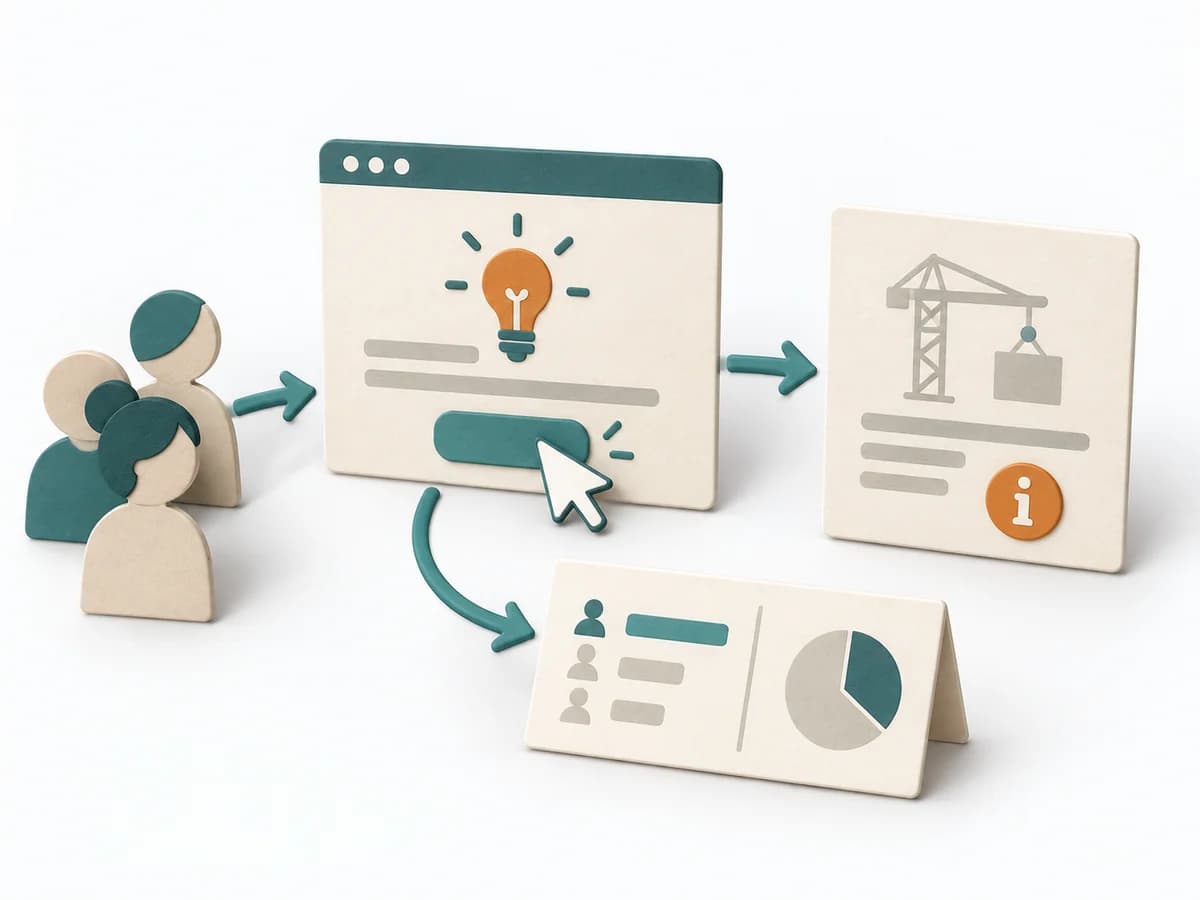 Product Discovery Fake Door Test |  Decision Making Force Field Analysis |  Product Discovery Assumption Mapping |  Product Discovery Experiment Canvas |
|---|---|---|---|---|
Purposedifferent | When demand is still unclear, it measures interest in a feature before it is built. It separates real behavior from polite agreement and deliberately keeps build effort small. | In change initiatives, supporting and restraining forces sit at the table at the same time. Force Field Analysis makes these tensions explicit and shows where change can be pushed forward by strengthening or relieving. | When assumptions still sit unordered in the room, it weighs uncertainty against leverage. It makes visible which hypotheses should be checked first. | When experiments become unreadable after the fact, it arranges hypothesis, signal, and learning goal on a single canvas. It separates problem, assumption, solution, and evidence. The result is captured as a Completed Experiment Canvas and a Success Metric. |
Complexitydifferent | Medium | Low | Medium | Low |
Timedifferent | 1-5 Tage | 45-90 min | 45-60 min | 30-60 min |
Participantsdifferent | Nutzertraffic | 3-12 | 2-8 | 1-5 |
Formatdifferent | Async | Workshop | Workshop + async | Workshop + async |
Outputdifferent | Click Data, Interest Signal, Learning Decision | Force Field Map, Change Levers, Risk Notes | Assumption map, Test backlog, Risk ranking | Completed Experiment Canvas, Success Metric |
Tagsno overlap | ValidationExperimentsDemandDiscovery | ChangeDecisionStrategy | AssumptionsRiskExperimentsValidation | ExperimentsValidationDiscoveryHypothesis |