View methods side by side.
Choose up to four methods. Add them using the search and share the comparison by copying its link.
Selected:Failure Scenario AnalysisFault Tree AnalysisLASR (Lightweight Approach for Software Reviews)
| Criterion | 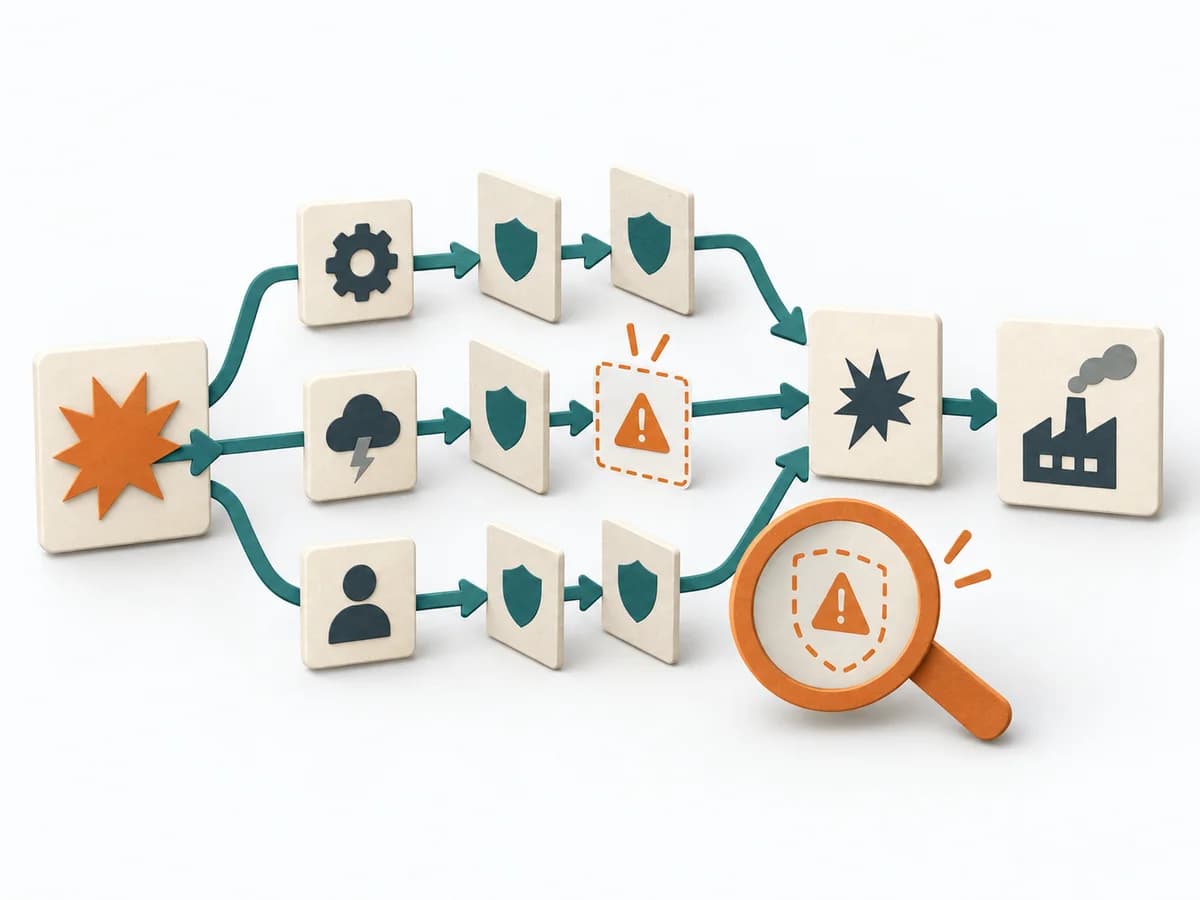 Engineering Failure Scenario Analysis |  Operations Fault Tree Analysis |  Architecture LASR (Lightweight Approach for Software Reviews) |
|---|---|---|---|
Purposedifferent | In critical processes, it is not enough to plan only for the normal case. Failure Scenario Analysis looks at the path into failure and shows which failures, chains, and control gaps cause the most damage. | For a critical top event with several possible triggers, the method logically models failure paths. It makes visible which combinations of conditions can lead to damage. | LASR helps development teams identify where their software falls short of important quality goals and which improvements to consider. A small group with existing system knowledge can make an initial assessment and investigate open questions in more detail. |
Complexitydifferent | Medium | High | Medium |
Timedifferent | 1-3 h | 2-6 h | 3–4 h for initial assessment; preparation and deeper analysis additional |
Participantsdifferent | 3-8 | 3-8 | 1 or a small team; particularly suitable for 3–4 people |
Formatdifferent | Workshop | Workshop + async | Workshop + async |
Outputdifferent | Failure Scenarios, Risk Notes, Control Gaps, Test and Response Actions | Fault Tree, Critical Paths, Cause Hypotheses, Control Actions | Lean Mission Statement describing the software’s purpose, Prioritized quality goals and evaluation criteria, Risks and estimated gaps against quality goals, More closely examined findings and open checks |
Tags1 shared | FailureResilienceRisk | RiskRoot causeSafety | ArchitectureQualityRiskAssessmentLean |
Often compared together
Methods with strong topical overlap with the current selection, not yet in the comparison.



