View methods side by side.
Choose up to four methods. Add them using the search and share the comparison by copying its link.
| Criterion |  Facilitation Expectation Mapping | 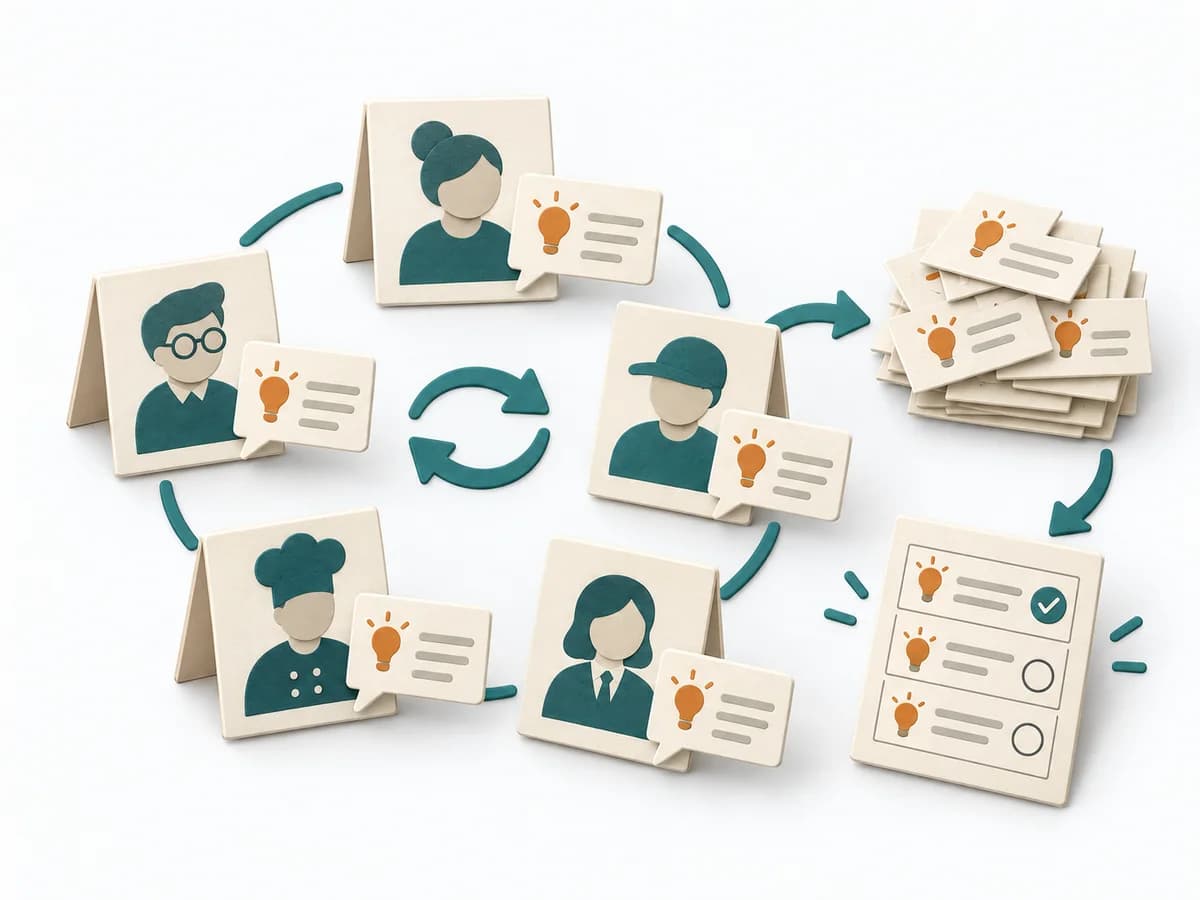 Innovation Rolestorming |  Innovation Rapid Ideation |  Innovation Reverse Brainstorming |
|---|---|---|---|---|
Purposedifferent | When roles, interfaces, or projects fail because of differing expectations, Expectation Mapping surfaces these differences. It shows what each side takes for granted and where the pictures diverge. | When a search for ideas stalls, switching roles helps people step outside their own perspective and activate new logics of action. The method reduces habit because contributions arise from a different stance. This brings unfamiliar, often fitting solution approaches into play. | When a decision needs to be prepared quickly, the method generates many solution-close variants in a short time. It deliberately relies on pace to undercut self-censorship and perfectionism. This quickly produces a usable field for prioritization and further work. | For persistent errors or blockages, the method shifts the view to the opposite of the desired effect. It exposes the mechanics of failure and makes hidden causes easier to grasp. This makes improvement more concrete and the problem clearer. |
Complexitysame | Low | Low | Low | Low |
Timedifferent | 45-90 min | 30-60 min | 5-20 min | 30-60 min |
Participantsdifferent | 3-12 | 3-12 | 1-20 | 3-12 |
Formatdifferent | Workshop | Workshop | Workshop + async | Workshop |
Outputdifferent | Expectation Map, Alignment Notes, Agreements | Rollenkarten, Ideenpool pro Rolle, Konsolidierte Shortlist | Ideenpool, Roh-Shortlist, Cluster | Reverse Ideas, Risk Themes, Solution Ideas |
Tagsno overlap | AlignmentStakeholdersTeam | BrainstormingIdeationCreativity | BrainstormingIdeationDivergenceSpeed | BrainstormingIdeationCreativityRisk |