View methods side by side.
Choose up to four methods. Add them using the search and share the comparison by copying its link.
| Criterion |  Domain Modeling EventStorming | 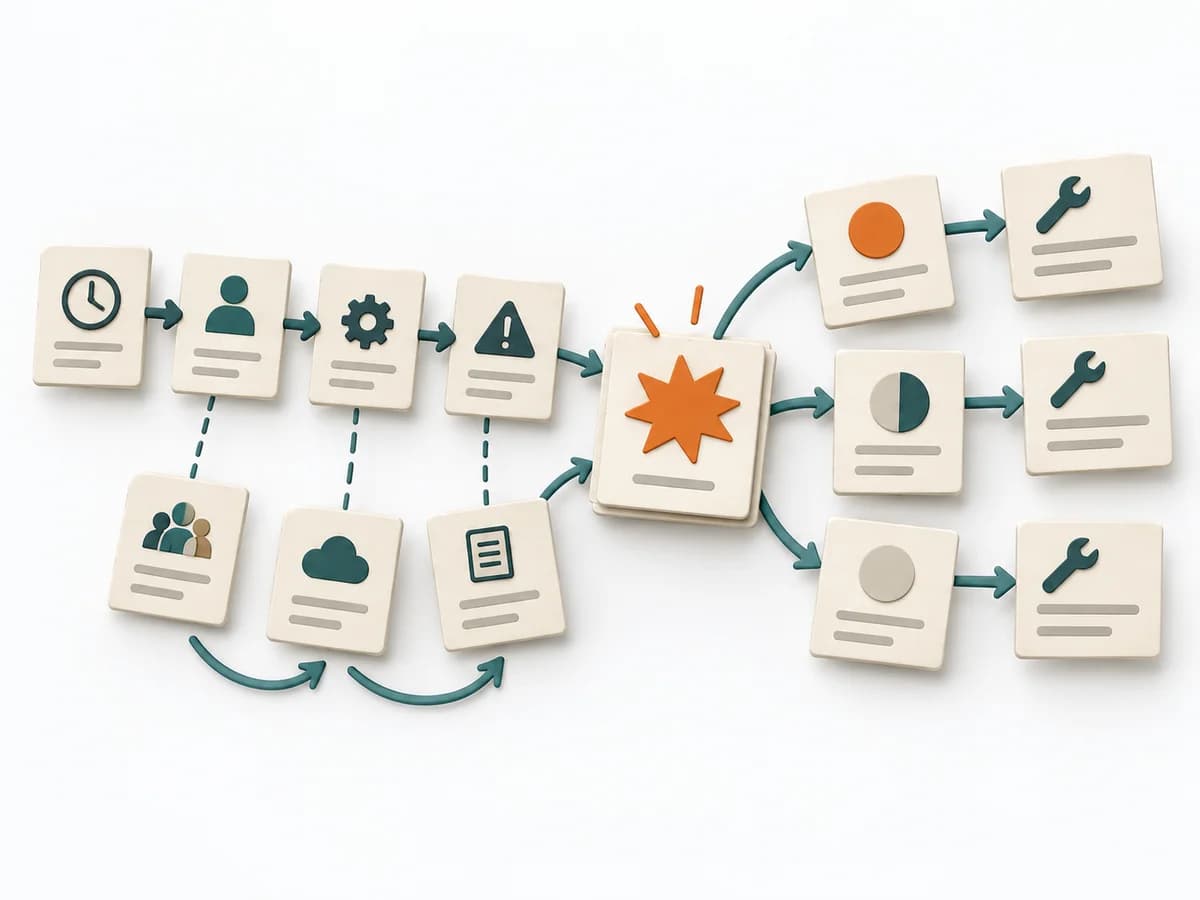 Operations Causal Factor Analysis |  Knowledge Modeling Event Modeling |  Systems Thinking Current Reality Tree |
|---|---|---|---|---|
Purposedifferent | When a domain consists of many events, rules, and states, it creates a shared modeling space for the team. It bundles language, flows, and boundaries before domain knowledge fragments into siloed views. | For an event with a complicated course, the method breaks down the contributing factors along the timeline. It shows how conditions, decisions, and reactions together produce a course of events. | Event Modeling connects business workflows with commands, events, and views into one coherent mental model. It helps design behavior, UI, and technical slices from the same underlying logic. | A Current Reality Tree condenses many symptoms into a few causal chains. The method makes visible which core problems drive several negative effects at once. |
Complexitydifferent | Medium | High | Medium | High |
Timedifferent | 2-8 h | 2-6 h | 2-6 h | 2-6 h |
Participantsdifferent | 5-12 | 3-10 | 2-8 | 3-8 |
Formatdifferent | Workshop | Workshop + async | Workshop + async | Workshop |
Outputdifferent | Event Timeline, Ubiquitous Language, Boundaries, Open Questions | Event Timeline, Causal Factor Chart, Cause List, Corrective Actions | Event Model, UI Flow, Commands, Read Models | Current Reality Tree, Core Problems, Intervention Ideas |
Tagsno overlap | Domain-Driven DesignEventsDiscoveryWorkshop | CausalityIncidentRoot causeTimeline | EventsBlueprintDomain-Driven DesignBehavior | Systems thinkingRoot causeConstraintsCausality |