View methods side by side.
Choose up to four methods. Add them using the search and share the comparison by copying its link.
| Criterion |  Domain Modeling EventStorming | 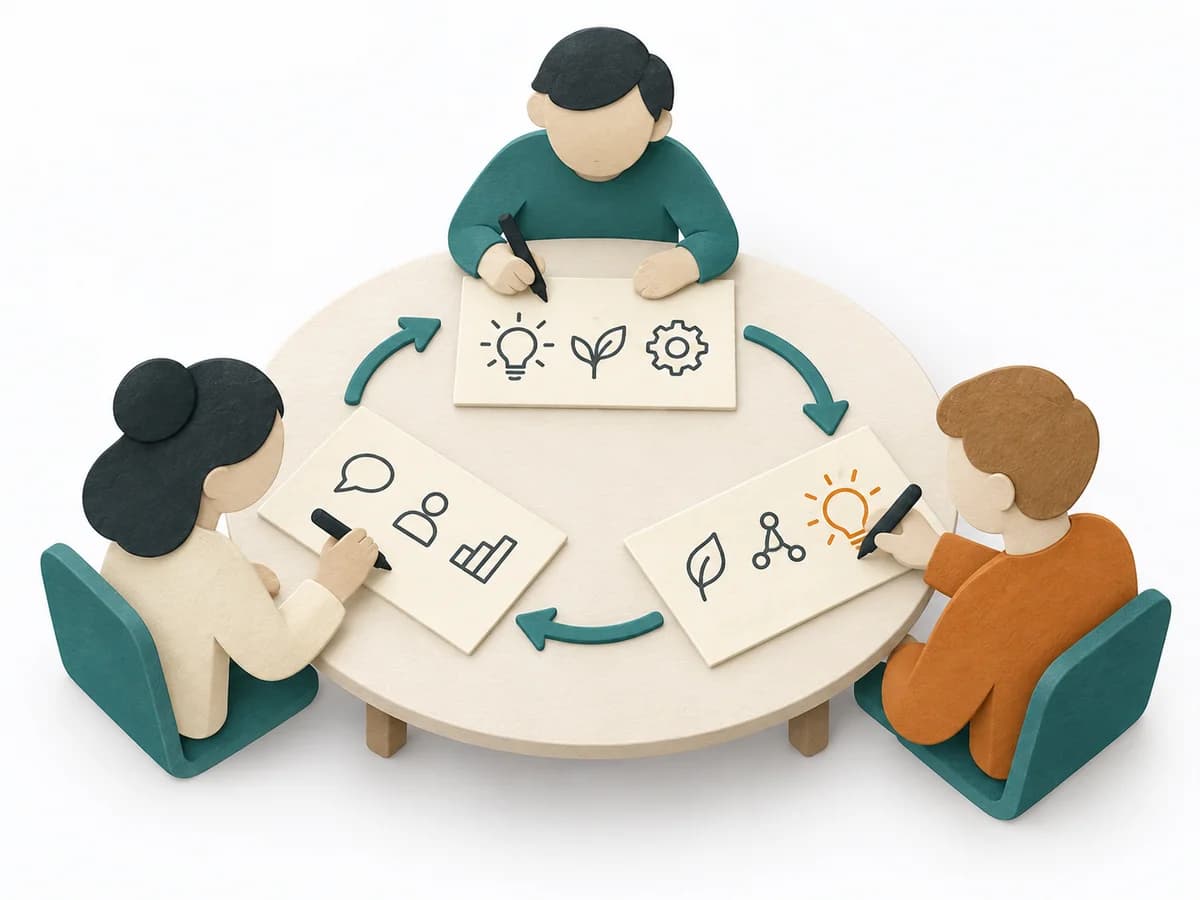 Innovation Brainwriting |  Domain Modeling Bounded Context Canvas |  Domain Modeling Context Map |
|---|---|---|---|---|
Purposedifferent | When a domain consists of many events, rules, and states, it creates a shared modeling space for the team. It bundles language, flows, and boundaries before domain knowledge fragments into siloed views. | When loud voices or hierarchy distort the idea search, the method creates a quiet entry into joint development. It gives everyone thinking space and gathers contributions without social brakes, making diversity more visible and easier to build on. | When a business context is still loosely outlined, it shapes language, responsibility, and integration space. It clarifies what belongs together and where a boundary needs to hold. | When several contexts need to talk to each other, it makes their relationships and dependencies legible. It helps sort integration pressure and responsibilities across system boundaries. |
Complexitydifferent | Medium | Low | Medium | Medium |
Timedifferent | 2-8 h | 15-30 min | 1-3 h | 1-3 h |
Participantsdifferent | 5-12 | 3-12 | 3-8 | 2-8 |
Formatdifferent | Workshop | Workshop + async | Workshop + async | Workshop + async |
Outputdifferent | Event Timeline, Ubiquitous Language, Boundaries, Open Questions | Idea sheets, Expanded concepts, Prioritized list | Context Canvas, Glossary, Integration Notes | Context Map, Integration Patterns, Boundary Notes |
Tagsno overlap | Domain-Driven DesignEventsDiscoveryWorkshop | BrainstormingCollaborationInclusionIdeas | Domain-Driven DesignBoundariesModeling | Domain-Driven DesignBoundariesStrategy |