View methods side by side.
Choose up to four methods. Add them using the search and share the comparison by copying its link.
| Criterion |  Knowledge Modeling Event Modeling |  Knowledge Modeling Knowledge Mapping | 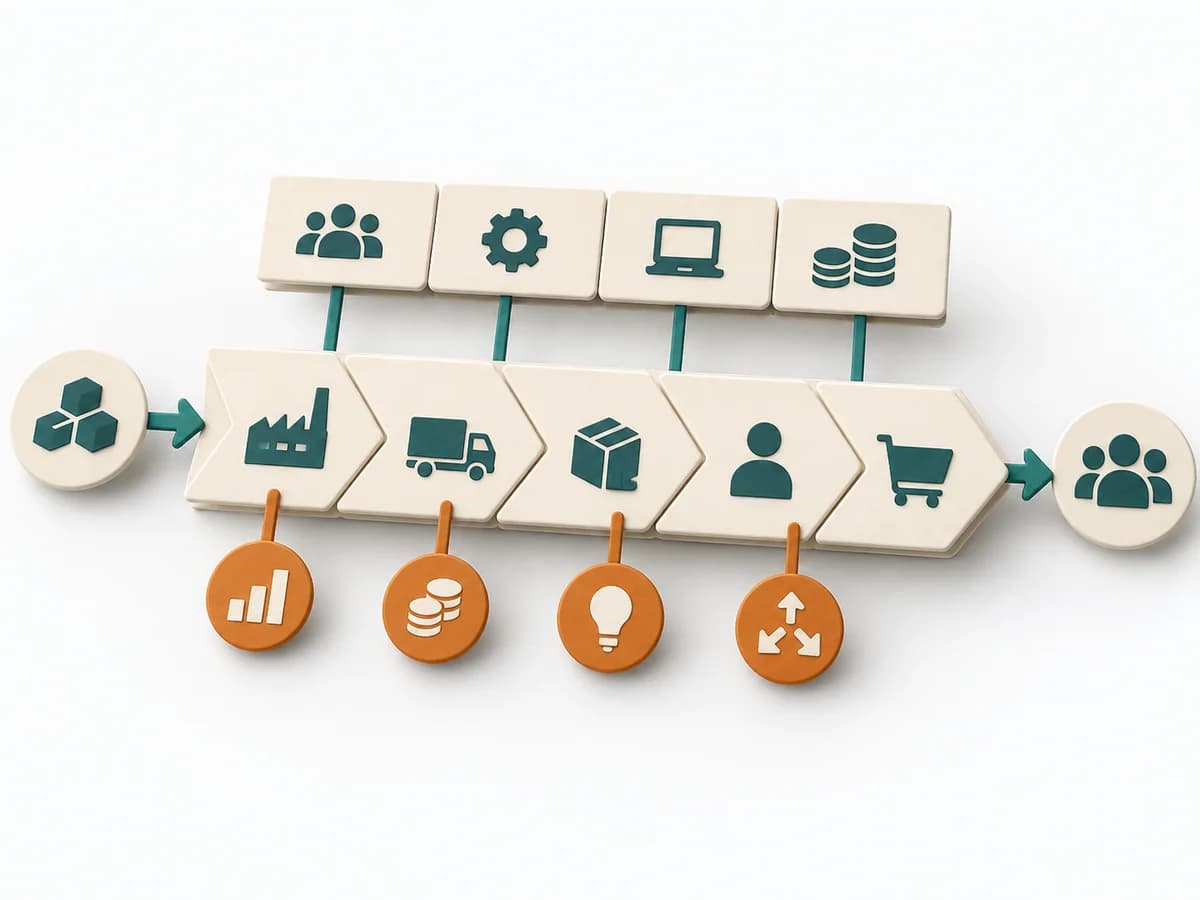 Business Strategy Value Chain Analysis |  Knowledge Modeling Concept Mapping |
|---|---|---|---|---|
Purposedifferent | Event Modeling connects business workflows with commands, events, and views into one coherent mental model. It helps design behavior, UI, and technical slices from the same underlying logic. | Knowledge Mapping makes knowledge, gaps, and transfer paths visible across a field. It fits when expertise should not just exist but also be findable and transferable. | Value Chain Analysis shows where value is created, costs accrue, and differentiation becomes possible along the process. It compares strengths, risks, market logic, and courses of action. The result is captured as a value-chain map and lever list. | Concept Mapping arranges terms and relationships in a network that makes subject-matter connections tangible. It fits when a topic needs to be understood structurally rather than linearly. |
Complexitydifferent | Medium | Medium | High | Medium |
Timedifferent | 2-6 h | 1-3 h | Half day | 1-2 h |
Participantsdifferent | 2-8 | 3-12 | 3-8 | 1-8 |
Formatdifferent | Workshop + async | Workshop | Workshop | Workshop + async |
Outputdifferent | Event Model, UI Flow, Commands, Read Models | Knowledge Map, Critical Knowledge Areas, Transfer Plan | Value Chain Map, Lever List | Concept Map, Relationship Labels, Knowledge Gaps |
Tagsno overlap | EventsBlueprintDomain-Driven DesignBehavior | KnowledgeMappingRisk | StrategyBusiness modelDiagnosisAnalysis | KnowledgeConceptsMappingSensemaking |