View methods side by side.
Choose up to four methods. Add them using the search and share the comparison by copying its link.
| Criterion | 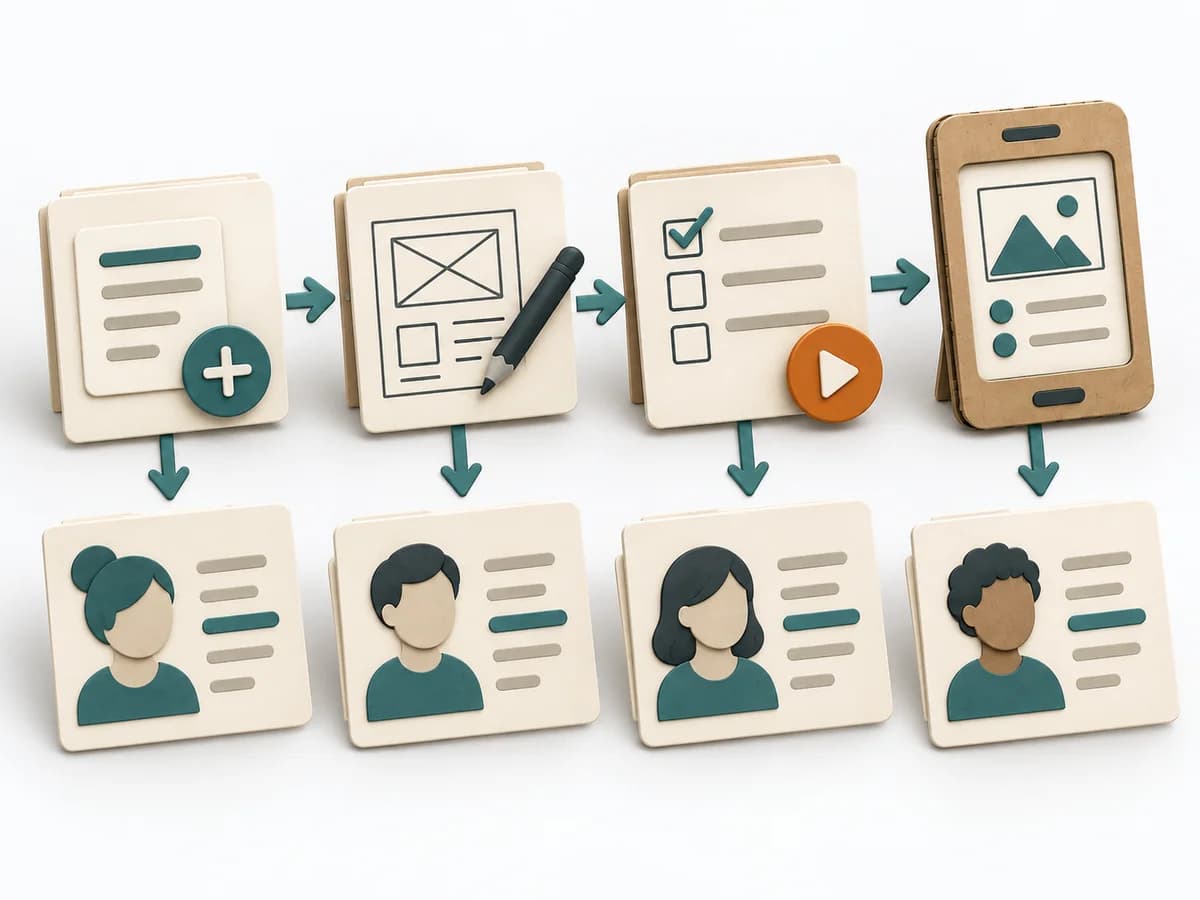 Knowledge Modeling Event Modeling |  Knowledge Modeling IBIS |  Decision Making Constraint Analysis |  Knowledge Modeling Domain Storytelling |
|---|---|---|---|---|
Purposedifferent | Event Modeling connects business workflows with commands, events, and views into one coherent mental model. It helps design behavior, UI, and technical slices from the same underlying logic. | IBIS structures thinking about complex questions as a sequence of issues, ideas, and arguments. The method keeps discussions open without forcing them into premature consensus. | When an initiative stalls, the limit often lies not in the idea but in hard or soft boundary conditions. Constraint Analysis separates these limits and shows which of them can actually be shaped. | Domain Storytelling translates domain knowledge into a shared narrative of actors, objects, and workflows. It is especially useful when language, rules, and process understanding must be tightly connected. |
Complexitydifferent | Medium | Medium | Low | Low |
Timedifferent | 2-6 h | 1-3 h | 30-90 min | 1-2 h |
Participantssame | 2-8 | 2-8 | 2-8 | 2-8 |
Formatdifferent | Workshop + async | Workshop + async | Workshop + async | Workshop |
Outputdifferent | Event Model, UI Flow, Commands, Read Models | Issue Map, Positions, Argument Notes | Constraint List, Hard/Soft Classification, Option Impact Notes, Decision Boundaries | Domain Story, Glossary Notes, Process Narrative |
Tagsno overlap | EventsBlueprintDomain-Driven DesignBehavior | RationaleKnowledgeDecision | ConstraintsDecisionPlanningOptions | KnowledgeDomain-Driven DesignProcess |